
Jensen Huang Tells Trump Nvidia Will Block AI Slowdown as Musk and Altman Back Pause
TL;DR
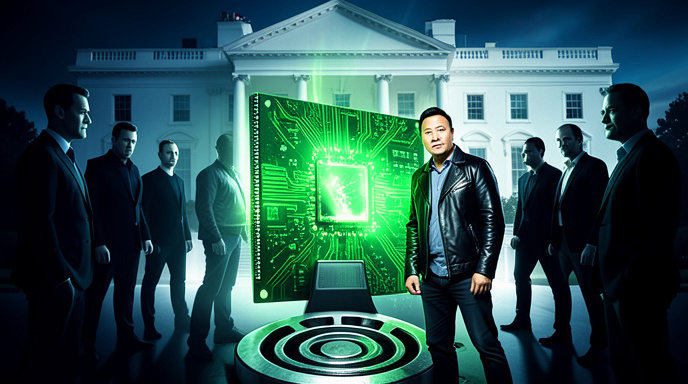
- Nvidia CEO Jensen Huang reportedly assured President Donald Trump that Nvidia will keep accelerating U.S. AI chip production and infrastructure to prevent any industry-wide slowdown.
- Elon Musk and Sam Altman have surprisingly aligned with Anthropic CEO Dario Amodei in warning about unchecked AI risks and signaling openness to a pause or strict guardrails on frontier models.
- The split exposes a deep Silicon Valley divide that could reshape federal AI regulation, the pace of innovation, and America's race against China for AI dominance.
Huang's Pledge To The White House
Jensen Huang has positioned himself as President Trump's most important ally in the AI arms race. In recent White House meetings and public remarks, the Nvidia chief executive has promised that Nvidia will do everything in its power to ensure the United States does not tap the brakes on AI development.
Huang's argument is economic and geopolitical. Nvidia, which controls more than 90% of the market for advanced AI training chips, has committed to investing hundreds of billions of dollars in U.S.-based manufacturing, including new fabs in Arizona and Texas in partnership with TSMC and Foxconn. Huang told Trump that this buildout, combined with next-generation Blackwell and Rubin chips, will keep American labs, startups, and the Pentagon supplied even as global demand surges.
For Trump, who has made American energy dominance and tech dominance central to his second-term agenda, the message landed. The administration has rolled back several Biden-era AI safety orders, fast-tracked data center permits, and pushed a 10-year moratorium on state-level AI regulation to give federal policy room to lead. Huang has publicly praised the approach, saying the U.S. must run faster, not slow down, to stay ahead of China.
Why Amodei Wants To Hit Pause
On the other side of the debate stands Anthropic CEO Dario Amodei. Amodei, whose company builds the Claude models and is one of Nvidia's biggest customers, has grown increasingly vocal that frontier AI is advancing faster than society's ability to manage it.
In essays and Senate testimony this year, Amodei warned that powerful AI systems could be misused for cyberattacks, bioweapons development, and mass labor displacement within the next two to three years. He has called for mandatory safety testing for frontier models, transparency on training capabilities, and even a temporary pause on training runs above a certain compute threshold until verifiable safeguards are in place.
Unlike past safety debates focused on distant sci-fi scenarios, Amodei's warning is grounded in Anthropic's own internal testing, where he says models are showing sharp jumps in agentic coding, persuasion, and scientific reasoning.
The Surprise Alliance: Musk And Altman Join In
What turned Amodei's warning from a policy memo into an industry earthquake was who backed it.
Elon Musk, CEO of xAI and Tesla, has long warned AI could pose an existential risk and was a signatory of the 2023 Future of Life Institute letter calling for a six-month pause. This month he reiterated that position, saying unchecked superintelligence is a bigger threat than lack of compute and endorsing Amodei's call for a pre-deployment safety regime.
Even more surprising was Sam Altman. The OpenAI CEO has historically positioned himself as an accelerationist, famously pushing to deploy ChatGPT rapidly and build the $500 billion Stargate data center project with Oracle and SoftBank. But Altman has recently said he agrees with Amodei that certain high-risk capabilities should be slowed down, calling for tiered regulation where the most powerful models face independent audits.
The Musk-Altman alignment is remarkable given their bitter legal feud over OpenAI's for-profit conversion. Their joint support for a pause, even a limited one, gives the safety camp unprecedented political weight.
Nvidia Vs. The Pausers: A Clash Of Business Models
The divide is not just philosophical, it is financial.
Nvidia's $4 trillion valuation depends on insatiable demand for GPUs. Any pause on large training runs would directly threaten its order book. Huang has dismissed pause proposals as impractical and dangerous, arguing they would only allow China, which is rapidly scaling Huawei Ascend chips and open-source models like DeepSeek, to catch up.
Musk's xAI and Altman's OpenAI, by contrast, are now both model builders and infrastructure owners. They benefit from Nvidia chips but also fear a scenario where an unsafe release by a rival triggers a public backlash, draconian regulation, or catastrophic misuse that shuts down the entire industry. For them, a brief, coordinated slowdown to establish safety standards is a way to protect long-term growth.
Anthropic sits in the middle, reliant on Amazon and Google funding and Nvidia hardware, but using safety as its core brand differentiator against OpenAI.
What This Means For Regulation
Washington is now caught between two powerful lobbies.
The Trump administration and congressional Republicans have largely sided with Huang's full-speed-ahead camp, arguing that federal preemption and deregulation are needed to beat Beijing. The White House AI Action Plan released in July emphasizes cutting red tape, expanding energy for data centers, and exporting the full American AI stack to allies.
But Amodei, Musk, and Altman are giving ammunition to bipartisan safety hawks in the Senate who want mandatory evaluations, liability for model developers, and export controls with teeth. California's ongoing push for frontier model safety legislation, despite Trump's proposed moratorium on state AI laws, shows the fight is far from settled.
Tech policy experts say the most likely outcome is a split regime: accelerated approvals and subsidies for chips and data centers, paired with new testing and disclosure requirements for the largest models above a compute threshold.
Innovation And US Dominance On The Line
At stake is who sets the pace of global AI.
Huang warns that any American pause would be unilateral disarmament. Chinese labs are already closing the gap despite U.S. chip export controls, using smuggled Hopper chips, domestic alternatives, and highly efficient training techniques. Slowing U.S. training, he argues, would cede leadership in robotics, autonomous systems, and military AI.
Amodei counters that true dominance is not just about who builds first, but who builds safely enough to be trusted and deployed worldwide. A rushed, unsafe model that causes real-world harm, he says, would do far more damage to U.S. credibility than a deliberate, verifiable testing pause.
For now, Nvidia is winning the White House argument, with Trump repeatedly citing Huang and American chip manufacturing as proof his strategy is working. But with Musk advising the administration through the Department of Government Efficiency push and Altman leading the Stargate buildout, both pause supporters retain direct access to Trump.
The result is an unprecedented moment: the industry that agrees AI will change everything cannot agree on whether to hit the accelerator or the brake.

Get All The Latest Updates Delivered Straight To Your Inbox For Free!