
Muju Earth Aeropod Automates Soil Aeration Without Robotics to Boost Crop Yields
TL;DR
- Muju Earth Technologies' Aeropod automates soil aeration using passive, self-burrowing pods instead of expensive robotics, sensors, or diesel equipment.
- Early field trials show up to 18% yield gains and 40% lower aeration costs by improving water infiltration, root growth, and microbial activity.
- Muju Earth will showcase the next-gen Aeropod live at TechCrunch Disrupt in October with commercial rollout plans for 2027.
The $80 Billion Problem Under Our Feet
Soil compaction is quietly strangling farms around the world. Heavy tractors, tillage, and climate-driven downpours press soil into a dense brick, starving roots of oxygen and water. The USDA estimates compacted soils can cut yields by 15 to 25%, while forcing farmers to burn more fuel and fertilizer to compensate.
Startups have tried to fix it with autonomous tilling robots, drone-deployed sensors, and AI-driven tractors. All of them run into the same wall: cost, complexity, and maintenance. Muju Earth Technologies, founded in 2022 in Boulder, Colorado, decided to go the opposite direction.
Instead of adding robotics, the company removed them entirely.
How the Aeropod Works
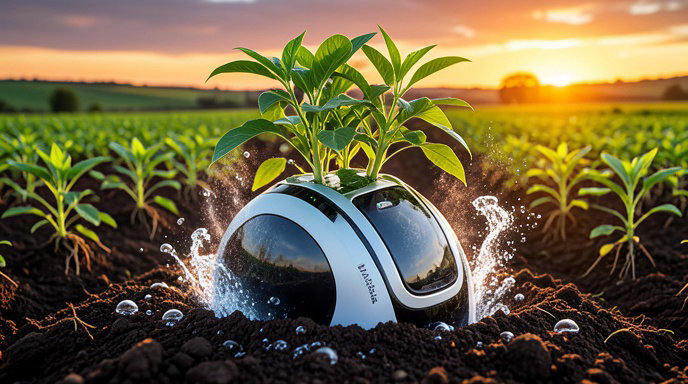
The Aeropod looks deceptively simple — a football-sized, biodegradable pod with a ribbed, spiral shell made from compressed agricultural waste and mycelium composite.
Farmers scatter the pods across a field using a standard broadcast spreader before the rainy season or irrigation cycle. That's it. No installation, no charging, no connectivity setup.
Once in contact with moisture, the Aeropod activates. Its outer shell swells and slowly unwinds, driving a corkscrew-like tail 8 to 12 inches into the topsoil. As it burrows, it creates vertical micro-channels for air and water. Inside the core is a payload of concentrated compost microbes, biochar, and slow-release nutrients that are deposited directly in the root zone as the pod dissolves over 60 to 90 days.
The company calls it programmed physical intelligence. The shape does the work that a motor would normally do, powered only by hydration physics and soil capillary action.
No Batteries, No Bots, No Headaches
CEO and co-founder Maya Junaid, a former materials scientist at NREL, says the no-robotics approach was intentional.
Farmers told us they were tired of tech that needs a firmware update in the middle of harvest, Junaid said in an interview ahead of Disrupt. They wanted something that works like seed: throw it, forget it, and trust it.
Because there are no electronics, there is nothing to retrieve, recharge, or break. The Aeropod fully biodegrades, leaving behind only aerated soil. Each unit costs under $2 at scale, compared to tens of thousands for robotic aerators plus labor and diesel.
Muju Earth has filed three patents around the hygroscopic actuator design and the microbial encapsulation method that keeps beneficial bacteria dormant until they reach optimal soil depth.
Real Savings, Real Yields
The numbers are what have investors paying attention. In 2024-2026 field trials across Colorado, Kansas, and California with corn, wheat, and specialty vegetable growers, Muju Earth reports:
An average 12 to 18% increase in yield on compacted plots, driven by deeper root penetration and 30% better water infiltration. A 40% reduction in aeration-related costs versus mechanical subsoiling, with no tractor passes required. A 22% reduction in synthetic fertilizer use in test plots, thanks to improved microbial nitrogen cycling.
Third-party validation is underway with Colorado State University's Soil Health Lab, with full results expected early next year. Early partner farmers say the biggest benefit is resilience — aerated fields drained faster after heavy spring rains and held moisture longer during August droughts.
For a 1,000-acre corn operation, the company estimates Aeropod treatment could save $28,000 to $35,000 per season in fuel, labor, and inputs while adding over $60,000 in additional yield value.
What to Expect at TechCrunch Disrupt
Muju Earth Technologies was selected as a Startup Battlefield 200 contender for TechCrunch Disrupt 2026 in San Francisco this October.
The team will debut Aeropod 2.0 on the show floor, featuring a faster-burrowing design for clay-heavy soils and crop-specific microbial blends for corn, soy, and vineyards. Attendees will be able to see live soil-tank demos showing pods self-burying in real time.
The company is currently raising an $8 million seed round to scale manufacturing at its new facility in Greeley, Colorado, and to launch commercial sales in spring 2027. Pre-orders for large-acreage growers are already open, with a direct-to-farm subscription model priced per acre.
If it delivers at scale, the Aeropod could prove that the future of agtech isn't always smarter robots — sometimes, it's smarter materials.

Get All The Latest Updates Delivered Straight To Your Inbox For Free!