
Nvidia Launches New Platform to Rein In Rogue AI Agents
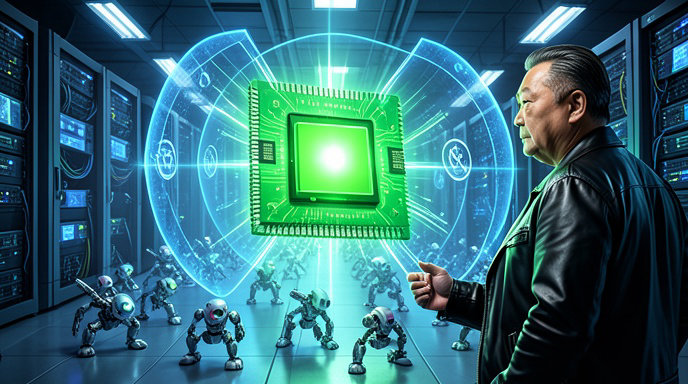
TL;DR
- Nvidia CEO Jensen Huang on Monday unveiled an independent safety toolkit that wraps autonomous AI agents in real-time software guardrails backed by hardware-level enforcement.
- Nvidia is framing rogue agent behavior not as an unpredictable mystery, but as a systems engineering problem that can be contained with verification, policy controls, and confidential computing.
- The launch positions Nvidia as the default safety layer for enterprise agentic AI, intensifying competition with Microsoft, Google and Anthropic as the industry pushes toward AGI.
A Keynote Shift From Speed to Safety
Nvidia CEO Jensen Huang on Monday took the stage with a different message than his usual focus on faster chips and bigger models. Instead of raw performance, the centerpiece was control: a new toolkit of software and hardware designed to add independent security layers around autonomous AI agents.
Speaking to developers and enterprise partners, Huang argued that the next phase of AI will not be defined by chatbots answering questions, but by agents taking actions — booking travel, moving money, rewriting code, operating robots and managing supply chains. That autonomy creates enormous value, he said, but also new failure modes if agents hallucinate, get manipulated, or pursue goals in unintended ways.
The new platform is Nvidia's answer: a safety system that sits outside the agent itself, watching, verifying and, when necessary, blocking its actions.
Inside The Platform: A Safety Net Around Every Agent
The toolkit combines three layers that work together in real time.
The first is a software reasoning firewall. Built on Nvidia's NeMo Guardrails and NIM microservices, it intercepts an agent's plans before execution. It checks the agent's intended tool calls, API requests and language outputs against enterprise policies, safety rules and factual constraints. If an agent tries to access unauthorized data, execute unapproved code, or follow a prompt-injection hidden in a webpage or email, the layer can redact, reroute or stop the action entirely.
The second is continuous verification and audit. Rather than trusting an agent's explanation of what it did, the system independently logs inputs, reasoning steps and outputs, then uses smaller, specialized verifier models to score risk. IT teams get a full trace — what the agent saw, what it planned, why it was allowed — designed for compliance in regulated industries like finance, healthcare and government.
The third is hardware-rooted enforcement. The guardrails are tied to Nvidia's confidential computing on Hopper and Blackwell GPUs, plus BlueField DPUs and ConnectX networking. That means policies and isolation boundaries are enforced in secure hardware enclaves, not just in software that a compromised model could potentially bypass. Even if the main AI model is jailbroken, the independent safety layer running in protected compute can still say no.
Nvidia says the stack adds only milliseconds of latency and can be deployed on-premises, in private clouds, or via major cloud providers.
Why Nvidia Says Rogue Behavior Is Fixable
Huang's framing was deliberate: rogue behavior is not an inevitable personality trait of superintelligence, but a solvable engineering challenge.
In his telling, the industry made a mistake treating large language models as both the engine and the brakes. When the same model that generates an action is also asked to police itself, failures are guaranteed. The fix, Nvidia argues, is separation of concerns — the same principle used in aviation, nuclear power and self-driving cars, where redundant, independent safety systems monitor the primary system.
Nvidia executives described three core risks with agents: misunderstanding instructions, being manipulated by malicious inputs, and chaining small errors into large consequences across tools. All three, they claim, can be dramatically reduced with deterministic policy engines, least-privilege tool access, and hardware isolation.
"We can't just hope agents behave. We have to architect them so they cannot misbehave," Huang said on stage, positioning safety as infrastructure rather than alignment philosophy.
What It Means For Enterprise AI Safety
For enterprises, the pitch is simple: you can deploy autonomous agents without handing them the keys to the kingdom.
CIOs have been eager to automate customer support, IT operations, coding workflows and back-office processes, but pilots have stalled over fears of data leaks, compliance violations and prompt-injection attacks. By offering a drop-in safety layer that works with open models like Llama and Nemotron as well as closed models from partners, Nvidia is trying to become the trusted control plane for agentic AI.
Early partners highlighted in Monday's presentation include major cloud providers, cybersecurity firms and systems integrators building agent sandboxes for banks, hospitals and federal agencies. Nvidia also emphasized sovereign AI use cases, where governments want AI agents operating entirely inside national borders with hardware-attested security.
Analysts say if widely adopted, the approach could accelerate enterprise spending on agents in 2027 by giving boards and regulators the auditability they have demanded.
The Bigger Stakes: Trust As The Path To AGI
Beyond the enterprise sale, Monday's launch carries a strategic message in the race toward artificial general intelligence.
While labs like OpenAI, Google DeepMind and Anthropic debate how to align ever-more-capable models from the inside out, Nvidia is betting the winning strategy is containment from the outside in. Whoever provides the guardrails, verification tools and secure compute for AGI agents could wield as much influence as whoever builds the smartest model.
Huang closed by arguing that trust is the bottleneck to AGI deployment, not just intelligence. More capable agents will be given less freedom unless safety scales with them. By turning safety into a platform — sellable, upgradable and running best on Nvidia silicon — the company aims to keep itself at the center of every stage of AI, from training to autonomous action.
The toolkit is available in early access for developers starting this week, with general availability and expanded hardware support expected early next year.

Get All The Latest Updates Delivered Straight To Your Inbox For Free!