
AI Boom Hijacks Climate Week: Data Centers Divide Climate Tech Founders and Investors
TL;DR
- Climate Week NYC 2026, which wrapped Sept. 27, was dominated by AI and data centers, as Big Tech's race for compute collided with record U.S. electricity demand and rising emissions scrutiny.
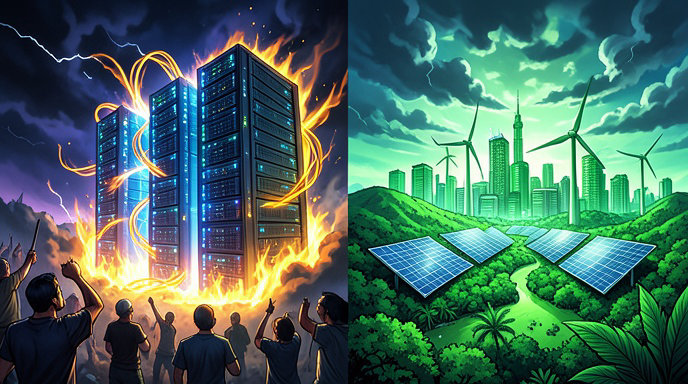
- Climate tech founders and investors split into two camps: one arguing AI will accelerate the clean energy transition through grid optimization and new clean firm power deals, the other warning it is locking in gas plants and delaying coal retirements.
- The emerging consensus from the week: AI's climate impact will be decided by policy and power deals in the next 18 months, from permitting reform and 24/7 clean power standards to nuclear restarts and behind-the-meter gas fights.
The Week AI Ate Climate
Climate Week NYC has always been part policy summit, part pep rally. This year, it felt like a cloud conference.
From the opening hub on West 23rd to packed side events in Brooklyn and the Nest Climate Campus at the Javits Center, nearly every panel from Sept. 21-27 circled back to the same question: What do we do about AI's insatiable appetite for electricity?
Organizers estimated more than 100,000 attendees across 900+ events, the largest Climate Week ever. But instead of the usual focus on EVs, solar milestones, or climate finance pledges, the buzzword on every rooftop and in every greenwashing debate was data centers.
Protesters outside the New York Times Climate Forward event and the Fortune Brainstorm Climate gathering drove the point home with signs reading "Data Centers = Climate Delay" and "AI Wants Watts, We Want Future." Inside, executives from Microsoft, Google, Amazon, and Constellation Energy argued the opposite: that AI is the reason clean energy will finally scale.
It was, as one founder put it on stage, "COP meets CES, and nobody's comfortable."
By The Numbers: A Demand Shock No One Planned For
The anxiety is grounded in staggering numbers that dropped just before Climate Week.
The U.S. Energy Information Administration now expects U.S. electricity demand to grow 2-3% per year through 2030, after nearly two decades of flat load, driven almost entirely by data centers. The International Energy Agency estimates global data center electricity use could double to more than 1,000 TWh by 2026-2027 levels by 2030, roughly equivalent to Japan's total consumption.
In the U.S., utility filings tracked by EPRI and Lawrence Berkeley National Lab suggest data centers could consume 8-12% of total U.S. power by 2028, up from around 4-5% in 2024. PJM, the nation's largest grid operator, just cleared record capacity prices for 2027-2028, a cost that will flow directly to household bills and was cited repeatedly during Climate Week as political dynamite.
Big Tech's own emissions reports added fuel. Google and Microsoft have both acknowledged that data center growth has pushed their emissions well above 2020 baselines despite massive clean energy purchases, putting their 2030 carbon-negative and net-zero goals at risk. That admission hung over every net-zero panel last week.
The Backlash Hits Main Street
What changed in 2026 is that the data center debate left the wonk bubble.
Governors, mayors, and community groups hijacked Climate Week sessions to talk about ratepayer backlash in Virginia, Ohio, Georgia, and Arizona — the top data center corridors. New polling released during the week showed a majority of Americans in those states now worry data centers will raise their utility bills and strain water supplies.
Several sessions focused on the fight over behind-the-meter gas plants, where developers want to power AI campuses directly with new gas turbines to avoid waiting 4-7 years for grid interconnection. Environmental groups including the Sierra Club and Earthjustice warned this creates a shadow fleet of unregulated fossil plants. Tech companies countered that they will offset with clean power later, a promise activists called "buy now, clean up never."
Water use also broke through. One viral moment came when a Data Center Watch protest projected water usage figures onto the Javits Center, claiming a single large training cluster can use millions of gallons a day for cooling in drought-prone areas.
Camp Accelerate: AI Will Save Us
On one side of the divide are the techno-optimists — a vocal coalition of founders, Big Tech sustainability chiefs, and deep-tech VCs.
Their pitch, repeated by Breakthrough Energy-linked investors and startups like Fervo Energy, Commonwealth Fusion Systems, and a wave of grid-AI companies, goes like this: AI is an energy hog today, but it is also unlocking the tools to build a bigger, cleaner grid faster.
Examples were everywhere on the show floor. Startups demoed AI for permitting and interconnection queue triage, cutting transformer design times from months to days, predicting wildfire faults, and orchestrating virtual power plants across millions of thermostats and EVs. Utilities like Con Edison and National Grid showcased pilots where AI forecasting shaved peak demand by double digits.
More importantly, this camp argues Big Tech's money is finally making first-of-a-kind clean firm power bankable. Microsoft's deal to restart Three Mile Island Unit 1 with Constellation, Google and Amazon's advanced nuclear and geothermal offtake agreements, and Meta's 24/7 carbon-free energy RFPs were held up as proof that AI load is underwriting the nuclear renaissance and long-duration storage, not killing it.
As one prominent climate VC said during a much-quoted panel: "Without AI demand, we have no business case for 10 gigawatts of new nuclear. With it, we do. Choose."
Camp Derail: AI Is Locking In Fossil Fuels
The other side — including many early-stage climate founders, environmental justice leaders, and a growing number of infrastructure investors — isn't buying it.
Their argument is about timing and physics. Solar and wind are cheap but slow to connect, nuclear is still years away, so in the real world of 2026-2028, utilities are meeting AI demand by keeping coal plants open and building new gas.
They pointed to specific reversals discussed at Climate Week: utilities in the Midwest and Southeast delaying coal retirements to 2030 and beyond, a rush of new gas peaker proposals justified explicitly as "data center reliability," and tech companies quietly lobbying for tariffs and interconnection carve-outs that favor speed over cleanliness.
Founders of community solar, building electrification, and methane mitigation startups were particularly blunt, saying AI hype is sucking oxygen — and capital — away from proven decarbonization. Climate tech venture funding has rebounded in 2026 to around $15-20 billion per quarter globally, but speakers noted a growing share is flowing to data-center-adjacent plays like cooling, power electronics, and small modular reactors, while harder sectors like cement, freight, and adaptation struggle.
"You can't AI your way out of a gas contract that runs to 2050," one founder said to applause at a founders vs. funders debate.
The Money Fight: Where VCs Are Placing Bets
If founders were divided, investors were openly split.
Traditional climate VCs like Energy Impact Partners, Lowercarbon Capital, and Prelude Ventures used Climate Week to double down on what one partner called "picks and shovels for the electron economy" — advanced geothermal, next-gen nuclear, grid-enhancing technologies, long-duration batteries, and AI-native demand response. Their thesis: data center load growth makes electrons more valuable, lifting all clean tech boats.
But a counter-cohort of investors warned of an AI bubble distorting climate priorities. They argued valuations for anything labeled "AI for energy" have overheated, while ratepayer revolts and permitting delays could strand data center assets. Several family offices said they are shifting toward resilience, water, and distributed solar-plus-storage as a hedge against centralized grid failure.
A new phrase heard repeatedly: "24/7 clean." Investors on both sides agreed the old model of buying annual renewable energy credits to claim "100% renewable" is dead. The new standard Big Tech is being pushed toward — matching every hour of data center use with local clean power — could create a multi-billion-dollar market for clean firm power, if standards hold.
What Actually Got Decided
For all the drama, Climate Week 2026 produced few binding deals but clarified the policy battleground for the next year.
Three fights to watch:
First, U.S. permitting reform. Bipartisan bills to speed transmission and clean generation permitting were a constant topic, with tech lobbyists and greens in rare alignment that the current 10-year timeline for new transmission kills both AI and climate goals.
Second, who pays. State regulators from New York, Illinois, and California previewed new data center tariffs designed to make hyperscalers pay for new grid capacity upfront, shielding households. How strict those tariffs are will determine where the next 50 gigawatts get built.
Third, nuclear and gas rules. The DOE's loan programs and the EPA's power plant rules for new gas will decide whether Three Mile Island-style restarts and new SMRs scale, or whether utilities default to unrestricted gas for AI.
The verdict from Climate Week? AI didn't just hijack the conversation — it forced climate tech to grow up. The movement can no longer pretend electrons are unlimited and free. Whether AI becomes the clean transition's biggest customer or its biggest excuse will come down not to models and chips, but to transformers, turbines, and transmission towers.

Get All The Latest Updates Delivered Straight To Your Inbox For Free!