
Samsung Backs Kairos Power With $100M to Build Nuclear Reactor for Google
TL;DR
- Samsung C&T will invest up to $100M in Kairos Power and serve as construction partner for its first 50-megawatt commercial advanced reactor for Google in Tennessee.
- The plant will use Kairos Power's fluoride salt-cooled, TRISO-fueled KP-FHR technology, with construction lessons from the Hermes demonstration reactors in Oak Ridge and a target to deliver power to Google by 2030.
- The deal highlights Big Tech's accelerating bet on firm nuclear power to meet soaring AI data center demand and 24/7 carbon-free energy goals.
Samsung Gets Into The Reactor Business
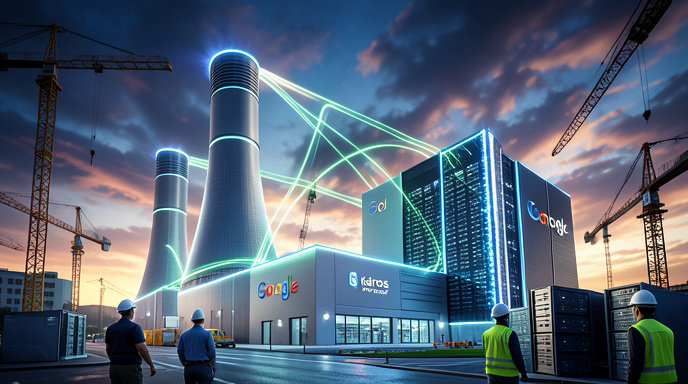
In another sign that the future of AI will be powered by nuclear, Samsung C&T has agreed to back U.S. advanced nuclear startup Kairos Power with up to $100 million to build its first commercial-scale plant for Google.
The agreement, announced this week, pairs one of the world's most experienced nuclear builders with one of Silicon Valley's most aggressive nuclear buyers. Samsung C&T, the engineering and construction arm of the Samsung Group that co-built the Barakah nuclear plant in the United Arab Emirates, will take an equity stake in Kairos Power and act as a key construction and project delivery partner.
For Kairos, a Alameda, California-based startup founded in 2016, it is both a major funding boost and a validation of its rapid-build strategy. For Samsung, it is a foothold in the booming U.S. advanced reactor market.
The Deal Structure
Under the terms, Samsung C&T will invest up to $100 million in Kairos Power through a staged equity investment tied to project milestones. The funding will go directly toward development and construction of Kairos Power's first 50-megawatt electric commercial plant, known as Hermes 2-adjacent commercial deployment, planned for Tennessee to serve Google under a long-term power purchase agreement.
More important than the cash, executives say, is the construction partnership. Samsung C&T America and Samsung C&T's Engineering & Construction Group will work with Kairos Power and its engineering partner Barnard Construction on project execution, modular construction, schedule optimization, and supply chain development.
Kairos Power has deliberately pursued a hardware-iterative approach — build fast, learn fast — rather than going straight to a giant gigawatt-scale plant. Samsung brings deep experience in delivering large nuclear projects on time and on budget, including four APR-1400 reactors at Barakah, the first nuclear plant in the Arab world.
Google, which is not a direct party to the Samsung investment, has already committed to buying the power. In October 2024, Google signed a landmark corporate power purchase agreement with Kairos Power to deploy 500 megawatts of advanced nuclear capacity in the U.S. by 2035, with the first 50-megawatt reactor targeted for 2030.
Inside The Technology: Not Your Grandfather's Reactor
Unlike conventional light-water reactors, Kairos Power's KP-FHR technology is a fluoride salt-cooled, high-temperature reactor.
Here's what makes it different:
Instead of water as a coolant, it uses chemically stable molten fluoride salt at low pressure. That eliminates the risk of high-pressure steam explosions and allows for a more compact, simpler containment design. The salt also retains fission products, adding an extra safety barrier.
Instead of traditional fuel rods, it uses TRISO tristructural isotropic particle fuel — billiard-ball-sized graphite pebbles packed with thousands of uranium kernels coated in carbon and ceramic layers. TRISO is widely considered one of the most robust nuclear fuels ever made, capable of withstanding temperatures above 1,600 degrees Celsius without melting.
The design operates at near-atmospheric pressure and passively sheds decay heat, meaning it can cool itself without operator action or backup power.
The first 50-megawatt plant for Google will essentially be a scaled-up commercial version of the company's Hermes demonstration reactors now under construction in Oak Ridge, Tennessee. Hermes, a 35-megawatt thermal non-power test reactor, received the first-ever construction permit from the U.S. Nuclear Regulatory Commission for a Generation IV reactor and began major construction in 2024. Its successor, Hermes 2, will include two units and demonstrate electricity production.
Construction Timeline: Tennessee First
Kairos Power and Samsung C&T will focus first on Oak Ridge and the broader Tennessee Valley.
Current timeline shared by the companies:
2024-2026: Construction of Hermes low-power demonstration reactor in Oak Ridge, with initial criticality targeted in the next year.
2026-2028: Construction of Hermes 2 demonstration plant, already approved by the NRC, to prove commercial-scale heat and power systems.
2027-2030: Construction of the first 50-megawatt commercial KP-FHR for Google, leveraging lessons learned and a modular supply chain co-developed with Samsung. Site selection is focused in Tennessee in coordination with the Tennessee Valley Authority.
2030-2035: Scale-up to multiple 75-megawatt KP-FHR units to fulfill Google's full 500-megawatt commitment, with Kairos Power targeting a fleet of standardized, factory-built reactors rather than one-off megaprojects.
The iterative timeline is key to Kairos Power's pitch: by building three reactors in quick succession before 2030, it can de-risk cost, licensing, and construction — the three factors that have killed most U.S. nuclear projects in the past.
Why Big Tech Is Going All-In On Nuclear
Google is not alone. The Samsung-Kairos deal is the latest in a frenzied wave of Big Tech nuclear investments driven by AI.
U.S. data center electricity demand is projected to more than double by 2030, driven almost entirely by AI training and inference workloads. A single large AI data center campus can consume 100 to 500 megawatts — roughly the output of a small nuclear plant — and requires 24/7 uptime that solar and wind alone cannot provide without massive storage.
Google has pledged to operate on 24/7 carbon-free energy by 2030, a goal it has fallen behind on as AI growth pushed its emissions up nearly 50% since 2019. Firm, always-on nuclear power is now central to closing that gap.
Its rivals are making similar moves. Microsoft has signed a deal to restart the Three Mile Island Unit 1 reactor with Constellation and is backing fusion and fission startups. Amazon has invested in X-energy and Energy Northwest for up to 960 megawatts of small modular reactors in Washington state. Meta has issued requests for proposals for up to 4 gigawatts of nuclear capacity and signed deals with Oklo and Vistra.
For Big Tech, advanced reactors like Kairos Power's offer three advantages over traditional nuclear: smaller size that matches data center scale, siting flexibility away from water-intensive cooling needs, and faster deployment timelines that align with AI buildout cycles.
What Comes Next
The Samsung investment still leaves Kairos Power with significant capital needs to reach commercialization. The company has already raised more than $1 billion from investors including Temasek, BlackRock, and the U.S. Department of Energy's Advanced Reactor Demonstration Program, which awarded it up to $303 million in risk-reduction funding.
Analysts say the real test will be execution: delivering Hermes on schedule, proving out the molten salt supply chain — including a new beryllium fluoride salt production facility in Ohio — and navigating NRC licensing for a commercial power reactor.
But with Google as a guaranteed buyer, Samsung as a builder, and the DOE as a backer, Kairos Power now has something few advanced nuclear startups have ever had: a full path from demonstration to deployment.
If the Tennessee plant plugs into the grid by 2030 as planned, it would be one of the first Generation IV commercial reactors operating in the U.S. — and a blueprint for how AI giants plan to power the next decade.

Get All The Latest Updates Delivered Straight To Your Inbox For Free!