
SpaceX Targets September 22 for First Starship Orbital Flight With V3 Starlink Debut
TL;DR
- SpaceX is targeting September 22 for Starship's first true orbital flight from Starbase, Texas, pending FAA approval and final ground system checks.
- The mission will attempt to deploy next-generation V3 Starlink satellites in orbit for the first time, a critical test of Starship's Pez dispenser system and commercial viability.
- A successful orbital insertion, payload deployment, and controlled splashdown would mark a major step toward rapid reusability, global gigabit internet, and Elon Musk's Mars colonization timeline.
A Decade in the Making: Why This Flight Is Different
SpaceX has flown Starship ten times before, but every previous test has been suborbital by design. The vehicle has launched, coasted across the Atlantic or Indian Ocean on a transatmospheric arc, and splashed down without ever completing a full orbit around Earth.
That changes on September 22.
According to mission details shared by SpaceX and regulatory filings, the upcoming Flight 11 will attempt to place the Starship upper stage into a stable low Earth orbit for the first time in the program's history. Liftoff is targeted from Starbase in Boca Chica, Texas, during an early morning window, with backup opportunities through late September.
The flight plan calls for the Super Heavy booster to lift Starship off the pad with 33 Raptor engines, separate minutes into flight, and return for a catch attempt by the Mechazilla tower arms. Meanwhile, the Ship upper stage will fire its six Raptors to reach orbital velocity — roughly 17,500 mph — circle the planet, deploy its payload, and then deorbit for a controlled splashdown in the Indian Ocean off Western Australia.
SpaceX officials have stressed the date remains tentative pending FAA launch license approval, weather, and final reviews of upgraded ground and flight systems.
Meet V3 Starlink: Bigger, Faster, and Starship-Only
The star cargo on this historic run is a batch of next-generation V3 Starlink satellites.
Unlike the V2 Mini satellites currently launched by Falcon 9, the V3 spacecraft are significantly larger, heavier, and more powerful — too large to fly on anything but Starship. Each V3 satellite weighs nearly two tons and features upgraded phased-array antennas, advanced laser interlinks, and next-gen Hall-effect thrusters.
SpaceX says a single V3 satellite offers more than ten times the throughput of a V2 satellite, with a goal of delivering true gigabit speeds directly to customers and eventually direct-to-cell service without ground antennas. A full V3 constellation could push total network capacity beyond 60 terabits per second.
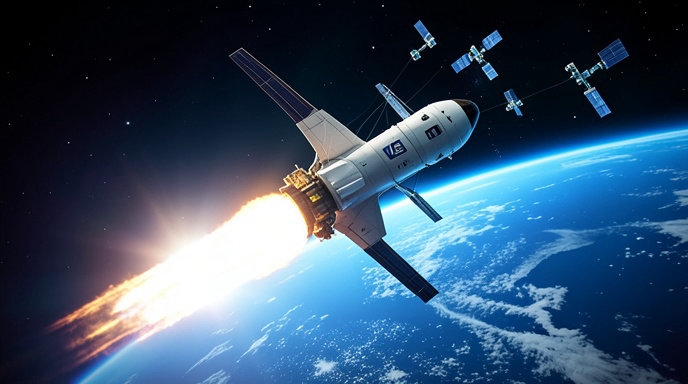
For this debut, Starship will carry a small demonstration batch using its Pez-style dispenser system, which ejects satellites in a spinning stack once in orbit. Previous flights tested the dispenser doors with simulators. This time, SpaceX will attempt to deploy functional satellites, verify they power up, communicate, and maneuver before raising themselves to operational altitude.
Inside the New Starship
The September 22 attempt will fly on an upgraded Block 3 Starship and Super Heavy combination, incorporating dozens of lessons learned from Flights 7 through 10.
Key upgrades include redesigned forward flaps for better reentry control, a reinforced heat shield with second-generation tiles, higher-thrust Raptor 3 engines, and increased propellant capacity. The Ship stretches taller than previous versions, giving it the volume needed for large payloads and future propellant transfer demonstrations.
SpaceX has also overhauled the launch pad's water deluge and flame trench systems after earlier flights caused pad damage. NASA will be watching closely, as the same Starship architecture is slated to serve as the Artemis III lunar lander as early as 2027.
High Stakes, High Reward
No Starship test has ever been routine, and SpaceX is openly cautioning that orbital flight adds new layers of risk.
To stay in orbit, Starship must nail engine cutoff timing to the second, survive extended exposure to orbital cold and radiation, restart a Raptor in space for deorbit, and survive a much hotter, faster reentry from orbital velocity. Payload deployment must also work perfectly while weightless.
Elon Musk has said on X that success is far from guaranteed, estimating even odds on achieving all primary objectives. As with past flights, SpaceX considers data collection itself a win, and the company has built multiple Ships to fly in quick succession if this one is lost.
What Success Would Mean for Musk's Two Big Bets
If SpaceX pulls it off, the implications go far beyond one test flight.
First, for global internet: Proving Starship can haul dozens of V3 satellites to orbit at once would unlock the economics of Starlink's next phase. SpaceX currently needs hundreds of Falcon 9 launches to build out its network. A single operational Starship could deploy in one flight what takes Falcon weeks to accomplish, slashing cost per gigabit and bringing high-speed coverage to remote regions, airlines, and maritime users.
Second, for Mars: Orbit has always been the gatekeeper. Musk's long-stated goal of building a self-sustaining city on Mars by the 2030s depends on a fully reusable vehicle that can launch, refuel in orbit, and depart for deep space. Demonstrating stable orbital insertion, long-duration coast, and controlled reentry is a prerequisite for orbital refueling tests planned for next year — the linchpin of both Mars missions and NASA's moon return.
In short, September 22 isn't just another launch. It's SpaceX's attempt to prove Starship is no longer an experimental rocket, but the orbital workhorse it was promised to be.
What to Watch Next
All eyes now turn to Starbase for the final countdown milestones: a full wet dress rehearsal, static fire of both Booster and Ship, and FAA airspace closures for the launch corridor.
SpaceX will livestream the attempt, with coverage expected to begin about 30 minutes before liftoff. If the September 22 window slips, the company has reserved backup dates into early October.
Whether it ends with a tower catch and ocean splashdown or with another spectacular fireball over the ocean, one thing is certain: the race to true orbital Starship flight is officially on.

Get All The Latest Updates Delivered Straight To Your Inbox For Free!