
Tesla Roadster 2 Event Delayed Again as Flying Demo Needs Clear Weather
TL;DR
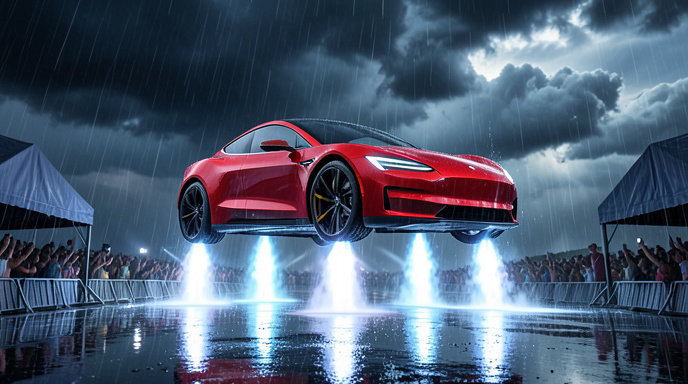
- Tesla has postponed its Roadster 2 reveal event once again, citing unsafe weather conditions for an outdoor-only showcase centered on a live flying demonstration.
- The demo was set to feature the long-promised SpaceX cold-gas thruster package, which Tesla says will allow the Roadster to briefly hover, hop, and brake harder than any production car.
- The delay pushes back production and delivery expectations further, with Tesla now targeting late 2026 validation builds and 2027 volume output if the demo clears safety review.
Another Setback For Tesla's Long-Awaited Halo Car
Tesla fans will have to wait a little longer to see the production-spec Roadster 2. The company confirmed this week that its highly anticipated reveal event has been delayed again due to bad weather at the planned outdoor test site in California.
According to updates shared by Tesla and Elon Musk, the showcase cannot be moved indoors because the centerpiece is a live flying demonstration. High winds, rain, and low visibility would make the stunt unsafe for both the driver and spectators, forcing the team to stand down until conditions clear.
The postponement continues a saga that stretches back nearly a decade. First unveiled as a prototype in 2017, the second-generation Roadster has suffered repeated delays due to engineering changes, Cybertruck and Model Y priorities, and now, the complexity of its most ambitious feature.
Why This Event Can Only Happen Outdoors
Unlike a typical static reveal, Tesla planned this Roadster event as an outdoor-only engineering showcase. Sources close to the program say the venue was chosen specifically for its long runway, open airspace, and FAA clearance for low-altitude maneuvers.
Tesla had planned to demonstrate short, controlled lifts and mid-air stabilization — not sustained flight, but what Musk has described as a "James Bond-style hop" of several feet off the ground. That kind of test requires clear weather, dry pavement, and minimal crosswinds to keep the lightweight composite thruster tanks and precise sensors operating safely.
Indoor arenas simply cannot accommodate the noise, pressure blast, and safety perimeter needed for cold-gas thrusters firing at full power, which is why Tesla says it has no backup indoor option.
The SpaceX Thruster Package Explained
At the heart of the delay is the optional SpaceX package, first teased by Musk back in 2018 and revived in detail over the past year.
The system uses a set of composite overwrapped pressure vessels hidden behind the rear seats, feeding around ten small rocket thrusters positioned around the car. Powered by ultra-high-pressure cold air, the thrusters are designed to deliver explosive bursts for acceleration, cornering, braking, and — most dramatically — lift.
Tesla claims the setup will enable 0-60 mph in under 1.0 second, a top speed over 250 mph, and a 620-mile range on the base tri-motor setup. For the flying demo, engineers were expected to show the Roadster hovering briefly, holding position against wind, then landing softly back on its wheels.
Safety regulators are watching closely. Because the system uses aerospace-grade pressure vessels, Tesla must prove containment, fail-safes, and pedestrian safety before it can offer the package to customers, even in limited form.
What The Delay Means For Production And Launch
The weather delay is more than a scheduling headache — it directly impacts production expectations.
Tesla had hoped a successful public flight demo would unlock final design sign-off and allow suppliers to tool up for low-volume production. Without that milestone, the timeline slips. Current internal guidance points to engineering validation builds in late 2026, followed by limited customer deliveries in 2027, nearly ten years after the original reveal.
Analysts say the Roadster was never meant to be a volume seller, but serves as a technology halo for Tesla's next-gen motors, batteries, and manufacturing. Still, repeated postponements risk eroding excitement as rivals like Rimac Nevera, Yangwang U9, and the next-gen Porsche 911 Turbo move ahead with record-breaking electric hypercars already on the road.
Tesla has not yet announced a new date, saying only that it will reschedule as soon as a clear multi-day weather window opens. For now, reservation holders — many of whom put down $50,000 for Founder's Series cars years ago — remain in a holding pattern.
What To Watch Next
All eyes are now on three things: a new event date, FAA and safety approvals for the thruster demo, and whether Tesla will finally lock in final specs and pricing.
If the flying demonstration succeeds, it would be an industry first and instantly re-establish the Roadster as the most talked-about EV in the world. If weather or technical issues cause further delays, pressure will mount on Tesla to ship a non-thruster version first and offer the SpaceX package later as an upgrade.
Either way, the message from Tesla is clear: the Roadster 2 will not launch quietly. It will either fly — literally — or it will wait until the skies are clear enough to let it try.

Get All The Latest Updates Delivered Straight To Your Inbox For Free!