
Waymo vs Tesla Cybercab Showdown: Why Waymo Says Vision-Only Autonomy Isn't Safe Enough
TL;DR
- Just days before Tesla's Cybercab is expected to debut, Waymo executives have publicly attacked Tesla's vision-only approach, arguing that true Level 4 autonomy cannot be achieved safely without lidar, radar, and cameras working together.
- The clash highlights a fundamental industry split: Waymo's expensive, redundant sensor suite and cautious geofenced rollout versus Tesla's low-cost, camera-only end-to-end AI that aims to scale everywhere humans can drive.
- With robotaxi leadership, regulatory approval, and public trust on the line, the debate will determine whether the future of autonomous transport is built on sensor redundancy or artificial intelligence alone.
Waymo Goes on Offense
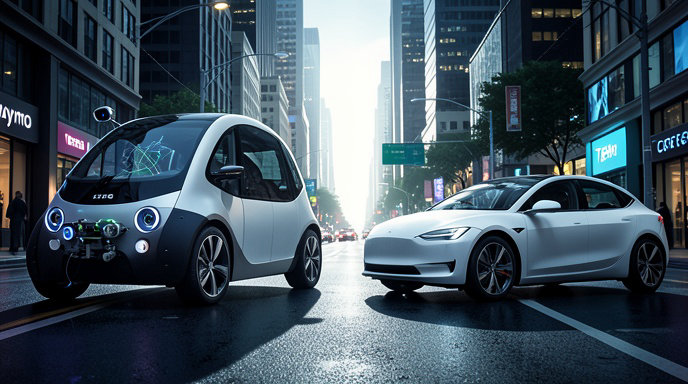
The timing was not accidental. With Tesla preparing to show a production-intent version of its Cybercab — the two-seat, steering-wheel-free robotaxi first unveiled as a prototype in October 2024 — Waymo has decided to go on the offensive.
In a series of recent interviews, blog posts, and public comments from co-CEOs Tekedra Mawakana and Dmitri Dolgov, the Alphabet-owned company has made its position bluntly clear: fully autonomous driving without lidar and radar is not safe, not scalable, and not truly autonomous.
Waymo's message is aimed directly at Tesla's core philosophy. While Waymo's 5th and 6th-generation Driver stacks use a full suite of lidar, radar, cameras, and supplemental sensors with overlapping fields of view, Tesla has doubled down on a pure vision strategy — eight cameras feeding a single end-to-end neural network, with no lidar or radar at all. Tesla CEO Elon Musk has repeatedly called lidar a "crutch" and an unnecessary expense that prevents autonomy from scaling.
Waymo is now arguing the opposite: that vision alone is the crutch.
The Core Divide: Redundancy vs. Human-Like AI
At the heart of the showdown is a technical disagreement about how a car should see the world.
Waymo's Case for the Full Stack
Waymo argues that each sensor modality covers the weaknesses of the others. Cameras excel at reading signs, traffic lights, and lane markings but struggle with depth estimation and perform poorly in direct sun glare, darkness, or heavy rain. Lidar provides precise 3D mapping and distance measurement in any lighting condition, while radar can see through fog, rain, and dust and instantly measure the velocity of surrounding objects.
The company's engineering leaders say this redundancy is non-negotiable for Level 4 driverless operation, where there is no human to take over. If a camera is blinded or a neural net misclassifies an object, another sensor system can act as a failsafe. Waymo points to edge cases like a white trailer against a bright sky, a pedestrian in dark clothing at night, or sun blinding a lens at an intersection — scenarios where lidar and radar provide critical data that cameras alone might miss.
Tesla's Bet on Vision and Neural Nets
Tesla's argument is philosophically different. The company contends that since humans drive with just two eyes and a brain, machines should be able to do the same with cameras and AI. Its latest FSD (Supervised) software has moved to an end-to-end architecture where video from cameras goes in and driving controls come out, with the neural network trained on millions of clips from its customer fleet.
Tesla says this approach is not only more elegant but the only one that can economically scale. Lidar units, even as prices have fallen, still add thousands of dollars to the cost of each vehicle. That matters when Tesla is targeting a sub-$30,000 price for the Cybercab and plans to build it in the millions at Giga Texas. A vision-only system, Tesla argues, can also drive anywhere, not just in the high-definition mapped, geofenced cities where Waymo currently operates.
The Safety Debate Reignited
Waymo's critique has reignited the industry's most contentious question: what actually counts as safe enough?
Waymo has been aggressively publishing its safety data to back up its claims. The company now reports more than 100 million fully driverless miles across Phoenix, San Francisco, Los Angeles, and Austin, and cites independent analyses showing significant reductions in injury-causing crashes and airbag deployments compared to human drivers in the same areas. Its vehicles are also designed to handle sensor failure gracefully, pulling over safely if a system degrades.
Tesla, meanwhile, points to its own data showing that cars using its FSD and Autopilot systems crash less frequently per mile than the national average, though those statistics are heavily debated because they compare mostly highway driving to all driving conditions and still require human supervision. Regulators are watching closely. The National Highway Traffic Safety Administration continues to investigate Tesla's vision-only system after high-profile incidents involving poor visibility, while Waymo has also faced scrutiny over more minor collisions and unexpected stops.
Safety advocates largely side with Waymo's redundancy principle, arguing that aviation-style redundancy should be mandatory for driverless cars. AI researchers are more divided, with some agreeing that Tesla's massive real-world dataset gives its neural nets an advantage that lidar cannot match.
What This Means for the Robotaxi Race
This is more than an engineering debate — it's a battle for the business model of autonomy.
Waymo is the clear leader in deployment today. It operates the only commercial, fully driverless paid robotaxi service in multiple major U.S. cities, completes over 250,000 paid trips per week, and is expanding through partnerships with Uber and others. But its growth is slow and capital-intensive, requiring detailed mapping and expensive hardware for every new city.
Tesla is promising the opposite: explosive scale. If its vision-only AI can truly handle unsupervised driving, it could overnight turn millions of existing Teslas into robotaxis via a software update and deploy fleets of purpose-built Cybercabs without lidar costs or geofencing limits. The company has already begun limited, supervised Robotaxi rides in Austin as a precursor to the Cybercab launch.
The risk for Tesla is that regulators and the public may not accept vision-only autonomy without a proven safety redundancy, especially for a vehicle with no steering wheel or pedals. The risk for Waymo is that it could be outscaled and underpriced if Tesla's AI gamble pays off, even partially.
Who Gets to Define Autonomous Leadership?
The coming months will be a crucial test for both visions. Tesla needs to prove its Cybercab can operate safely without human fallback and convince regulators to approve a vehicle that has no manual controls. Waymo needs to prove that its more expensive, methodical approach can scale fast enough and become profitable before a cheaper competitor rewrites the rules.
In the end, Waymo's offensive is a reminder that the robotaxi race is no longer just about who has the best demo. It's about who gets to define what "safe enough" means for a machine to drive itself — and whether true autonomy will be built on seeing the world like a human, or seeing it better than a human ever could.

Get All The Latest Updates Delivered Straight To Your Inbox For Free!