
Canva Launches First In-House Image Generation Model for All Users
TL;DR
- Canva has launched its first proprietary text-to-image model, replacing third-party reliance and rolling out to all Free, Pro, Teams, and Enterprise users.
- The new model delivers faster generation, improved photorealism, better text rendering, and deeper customization with style controls, aspect ratios, and brand-kit integration.
- The move cuts generation costs and positions Canva directly against Adobe Firefly, OpenAI, and Midjourney in the AI design race, with major implications for creators and businesses.
What Changed and Why It Matters
Canva has officially unveiled its first in-house image generation model, marking a major shift in its AI strategy. Previously, Canva's Magic Media and Text to Image tools relied on outside models from partners like OpenAI and Stability AI. Now, with a proprietary model built specifically for design workflows, Canva is taking full control over quality, speed, safety, and cost.
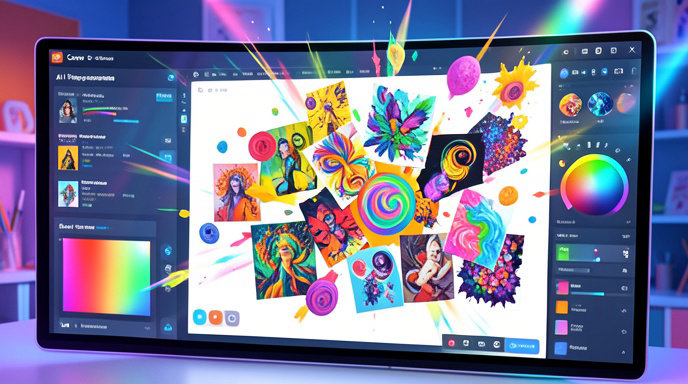
The rollout is global and available to all users starting this week, integrated directly into Canva's Magic Studio, Dream Lab, and the main editor. No plugin or opt-in is required - users will see the upgraded image generation experience automatically when they click Generate.
Performance Upgrades: Faster, Sharper, Smarter
At the core of the launch is a significant performance leap. Canva says the new model generates images up to 3x faster than its previous system, with a major boost in photorealism, lighting, and detail.
Early demos show dramatically improved faces, hands, and product shots - long-standing pain points for AI image tools. Text rendering inside images, such as posters, logos, menus and presentations, is also far more accurate, making outputs actually usable for real design work rather than just inspiration.
The model is also trained to understand design intent, producing cleaner backgrounds, better negative space for copy, and compositions that fit templates, thumbnails, social posts, and decks.
Improved Customization for Creators
Customization is where Canva's in-house approach stands out. Instead of a generic prompt box, the new system is built around design controls.
Users can now choose from curated styles like Photo, 3D Render, Watercolor, Anime, and Vector, fine-tune aspect ratios, lighting moods, and camera angles, and generate variations with the same character or object. A new Reimagine tool lets users restyle uploaded photos into on-brand visuals in one click.
Crucially, the model hooks into Brand Kit, Canva's library of brand fonts, colors, and logos. That means small businesses and marketing teams can generate images that automatically match their brand palette and style, a feature third-party models could not offer natively.
Lower Costs and Higher Limits
Building its own model also lets Canva slash inference costs. The company confirmed that generation credits go further, with Pro, Teams, and Enterprise users getting significantly increased monthly AI generation limits at no extra cost.
Free users also benefit, gaining access to the new model with a generous starter allowance. This aligns with Canva's broader goal to make professional-grade AI accessible to its more than 240 million monthly users without paywalling core creativity tools. Lower operating costs also give Canva more room to bundle video, code, and voice AI features into its Visual Suite.
Safety, Training, and Creator Compensation
Canva is emphasizing responsible AI as a differentiator. The company says the model was trained on licensed, public domain, and Canva-owned content, with strict filters to block copyrighted styles, NSFW content, and misleading deepfakes.
It also includes C2PA Content Credentials for AI transparency and opt-out controls for contributors. Through its Creator Compensation program, Canva confirmed it will continue to pay contributors whose stock photos, videos, and templates were used in training, with a $200 million commitment fund already established.
What It Means for the AI Design Race
This launch puts Canva in direct competition with Adobe Firefly, OpenAI's GPT Image 1.5 and DALL-E, Google's Imagen 3, Flux, and Midjourney. But unlike those standalone generators, Canva's edge is distribution - embedding a purpose-built model directly into the world's most-used design platform.
For creators, freelancers, and marketers, that means less prompt engineering and app-switching, and more finished designs. For competitors, it signals that Canva no longer wants to rent AI - it wants to own it, setting the stage for future proprietary models for video, 3D, and full layout generation.

Get All The Latest Updates Delivered Straight To Your Inbox For Free!