
Commonwealth Fusion Systems Lands $85M Federal Award for Fusion-Ready Superconductors
TL;DR
- Commonwealth Fusion Systems has secured an $85 million federal award to scale up advanced superconducting conductors and fusion-hardened power electronics for future power plants.
- The funding targets high-temperature superconducting (HTS) magnets and fusion-ready semiconductors that can survive extreme heat, radiation, and magnetic stress inside tokamaks like SPARC and ARC.
- The win cements CFS as the front-runner in the commercial fusion race, accelerating U.S. efforts to build a domestic supply chain for fusion power plants in the 2030s.
The Money Behind the Magnets
Commonwealth Fusion Systems, the MIT spinout and best-funded private fusion company in the world with more than $2 billion raised to date, has landed its biggest public-sector win yet: an $85 million federal award to develop next-generation conductors for fusion power plants.
The award, tied to U.S. Department of Energy efforts to accelerate fusion commercialization, is aimed at solving one of fusion's least glamorous but most critical challenges — how to carry massive amounts of electrical current reliably inside a machine that replicates the sun on Earth.
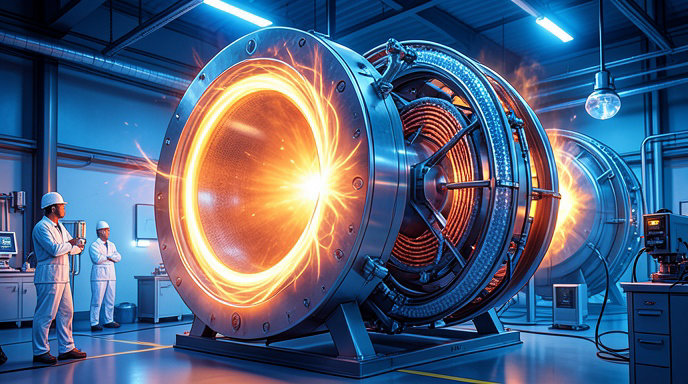
Rather than funding a whole new reactor, the money is focused squarely on enabling technology. That includes advanced high-temperature superconducting tape, magnet manufacturing processes, and the power electronics that will control them. For CFS, which is currently building its SPARC demonstration tokamak in Devens, Massachusetts, and planning its first ARC power plant in Virginia, the timing is critical.
What the $85 Million Actually Covers
According to details shared by the company, the funding will be split across three core pillars:
First, advanced HTS conductors. CFS pioneered the use of rare-earth barium copper oxide (REBCO) tape for its massive toroidal field magnets. The new funding will support higher-performance, lower-cost production of that tape in the U.S., improving uniformity, current density, and yield at industrial scale.
Second, magnet engineering and testing. Building a small test coil in a lab is one thing; building 18 10-ton D-shaped magnets that can generate over 12 tesla while withstanding enormous electromagnetic forces is another. The award funds irradiation testing, quench detection, jointing, and long-duration durability work needed for ARC-class power plants that must run 24/7 for years.
Third, fusion-ready semiconductors and controls. Modern tokamaks need ultra-fast, high-power switching to drive heating systems, manage plasma disruptions, and convert magnet power. Off-the-shelf chips fail under high neutron flux and electromagnetic interference. Part of the award will go to radiation-hardened semiconductors, cryogenic electronics, and solid-state power supplies.
Why Superconducting Magnets Are Fusion's Make-or-Break Tech
If fusion has a secret sauce, it's magnets.
To confine plasma hotter than the core of the sun — over 100 million degrees Celsius — you can't use physical walls. You have to use magnetic fields. The stronger the field, the smaller and more economical the reactor can be.
CFS bet the company on this insight in 2018. By moving from conventional low-temperature superconductors to HTS magnets, it showed it could achieve a 20-tesla field in its landmark Toroidal Field Model Coil test in 2021. That breakthrough is what allowed SPARC to be designed at roughly 1/40th the volume of ITER while targeting net energy gain.
But HTS tape remains expensive, fragile, and largely sourced from a handful of suppliers in Japan, Germany, and Korea. Defects at the micron scale can cause a magnet quench — a sudden loss of superconductivity that dumps megajoules of energy. The federal award is essentially a bet that the U.S. can onshore and de-risk this supply chain before ARC needs hundreds of kilometers of tape.
Why Fusion-Ready Semiconductors Matter Just As Much
Less talked about, but equally vital, are the chips and power systems around the magnets.
A fusion power plant is an electrical nightmare: sudden plasma disruptions can induce voltage spikes, superconducting coils require precise kiloamp control, and neutron bombardment degrades standard silicon over time. Silicon carbide and gallium nitride devices, designed for high voltage, high frequency, and high temperature, are emerging as fusion-ready alternatives.
Developing semiconductors that can live next to a tokamak — in high magnetic fields, vacuum environments, and near cryogenic systems — could slash downtime and improve efficiency when converting fusion heat to grid electricity. It's also dual-use tech with applications in EVs, AI data centers, and defense.
What It Means for the Race to Commercial Fusion
The $85 million award lands amid an intensifying global sprint.
In the U.S., CFS is competing with Helion Energy, TAE Technologies, Zap Energy, and Type One Energy, all chasing first electrons on the grid in the early 2030s. Internationally, China’s BEST project and the UK’s STEP program are pouring state billions into fusion. Private analysts now peg total private fusion investment at over $9 billion, with CFS accounting for nearly a quarter of it.
Federal money matters because it signals confidence. DOE milestone-based programs have increasingly favored teams that can show hardware progress, domestic manufacturing, and a credible path to a pilot plant. For CFS, which has committed to delivering 400 MW of fusion power in Chesterfield County, Virginia with Dominion Energy in the early 2030s, Washington’s backing helps unlock state permits, utility partnerships, and supplier investment.
Critics will note $85 million is small compared to the $1.5 billion-plus cost of SPARC alone. But in fusion, conductors are leverage. A 20% improvement in conductor cost and performance ripples through the entire plant design — smaller magnets, simpler cooling, cheaper containment.
What Comes Next
All eyes now turn to Devens. CFS is targeting breakeven-equivalent scientific milestones at SPARC in 2026-2027, which would validate its magnet-led approach at full scale. Success there, combined with scaled-up conductor production funded by this new award, would clear the path for final investment decisions on ARC.
In short: fusion doesn't just need hotter plasma. It needs better wires to hold it. And with this $85 million, Washington just made CFS the company to build them.

Get All The Latest Updates Delivered Straight To Your Inbox For Free!