
DoorDash Reveals Six-Propeller Delivery Drone at Dash Forward 2026
TL;DR
- DoorDash unveiled a custom-built six-propeller delivery drone at Dash Forward 2026, marking its shift from third-party pilots to a first-party aerial network.
- The new hexacopter can carry up to 5 pounds for nearly 5 miles, with quieter rotors, all-weather sensors, and autonomous drop-off via winch.
- The launch signals DoorDash's push for sub-30-minute suburban delivery, starting with pilot markets in Texas, North Carolina, and Australia in early 2027.
From Pilots to Platform: A Strategy Built From the Ground Up
DoorDash didn't just wake up and decide to build a drone. The reveal at Dash Forward 2026, the company's annual merchant and partner conference held this week in New York, is the culmination of years of quiet experimentation.
Since 2022, DoorDash has relied on partners like Wing, Zipline, and Flytrex to test drone delivery in the U.S., Australia, and Finland. Those pilots taught the company one crucial lesson: third-party hardware couldn't keep up with the realities of food delivery. Hot soup sloshing, fragile grocery bags, and tight suburban backyards demanded something purpose-built for DoorDash orders, not generic parcel drops.
Enter DoorDash Labs. Over the past two years, the in-house robotics team took over the program, interviewing hundreds of merchants, Dashers, and customers to design an aircraft around food first. The result is a vertically integrated strategy where the drone, the merchant tablet integration, and the customer tracking experience in the DoorDash app all work as one system. Instead of drones as a novelty, DoorDash is pitching them as a new delivery tier sitting alongside Dashers on bikes, in cars, and on robots.
Inside the Hexacopter: What the New Drone Can Do
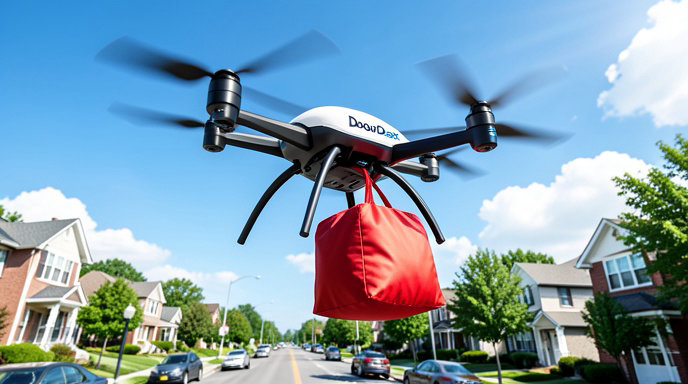
The star of Dash Forward was impossible to miss hovering above the stage. The new aircraft is a hexacopter — six propellers arranged for redundancy, stability, and power.
DoorDash says the design choices were deliberate. Six rotors mean the drone can lose one motor and still land safely, a key requirement for FAA approval for flights over people and suburbs. It's also significantly quieter than earlier quadcopter prototypes, with custom shrouded propellers that DoorDash claims cut perceived noise by nearly 50% — critical for neighborhood acceptance.
On specs, the drone is built for the sweet spot of food delivery:
- Payload of up to 5 pounds, covering roughly 90% of DoorDash restaurant orders, from two burrito bowls to a 12-inch pizza and drinks.
- Range of nearly 5 miles round-trip from a merchant or DashMart hub, cruising at around 45 mph.
- Autonomous navigation using onboard cameras, radar, and GPS, with remote human supervisors monitoring fleets rather than piloting individual flights.
- Winch delivery system that lowers orders from 150 feet to a backyard, driveway, or designated drop mat, meaning no landing pad is required and rotors stay far from people and pets.
The drone is also weather-hardened for light rain and winds up to 30 mph, and features heated cargo bays to keep hot food hot and cold drinks cold — a direct response to merchant feedback from early Wing trials.
What It Means for Restaurants and Customers
For merchants, the pitch is speed and reach without extra work. During the keynote demo, DoorDash showed how an order placed for drone delivery flows through the exact same Storefront and tablet system. If the address is drone-eligible and the weight fits, the kitchen staff simply packs it in a standard drone box and hands it to a loading tech. No new app to learn.
For customers, drone delivery will appear as a new fulfillment option at checkout labeled Fastest, alongside Priority and Standard. Eligible users will get live aerial tracking, a countdown to the winch drop, and a photo confirmation of delivery. DoorDash says early tests averaged under 20 minutes door-to-door in suburban zones, even during dinner rush when road traffic spikes.
Importantly, DoorDash stressed that drones are meant to supplement Dashers, not replace them. The company positions aerial delivery for low-density suburbs where driving 4 miles for a single taco order is inefficient, freeing up human Dashers for larger, complex, or urban high-rise orders.
The Road — and Sky — Ahead
DoorDash was careful not to promise nationwide skies just yet. Regulatory hurdles, air traffic management, and community noise concerns remain the biggest bottlenecks.
The rollout plan starts small. DoorDash confirmed expanded pilot operations in Dallas-Fort Worth, Texas and Charlotte, North Carolina, plus Logan, Australia, beginning in early 2027, operating out of select Wing-style nests atop shopping centers and DashMarts. The company says it is actively working with the FAA on Type Certification and beyond-visual-line-of-sight waivers needed to scale to thousands of daily flights.
If it succeeds, the implications go far beyond faster burritos. DoorDash envisions a multi-modal logistics network where AI dispatches each order to the most efficient vehicle — drone for fast and light in the suburbs, robot for campus, Dasher for everything else. Competitors like Amazon Prime Air and Walmart's Zipline network are chasing the same vision, but DoorDash's advantage is its massive merchant base and order density.
As CEO Tony Xu told the Dash Forward crowd: We built this drone for dinner, not just for demo. Whether neighborhood skies are ready for a buzz of six-propeller dinner runs is the next big test.

Get All The Latest Updates Delivered Straight To Your Inbox For Free!