
BMW 3 Series EV Is $4400 Cheaper Than Gas Model in Historic Price Flip
TL;DR
- BMW's all-new 2026 3 Series starts at $45,950 for the gas 330i, while the nearly identical electric i3 40 starts at just $41,550 — a historic $4,400 price flip in favor of the EV.
- The reversal is driven by BMW's 6th-gen cylindrical batteries that are 20% cheaper to make, 800-volt Neue Klasse platform, and a unified gas-and-EV production line that eliminates duplicate engineering costs.
- Analysts call it an industry tipping point, proving that with scale and shared platforms, EVs can now undercut combustion cars without subsidies.
A Historic First For Munich
For decades, the question wasn't if you wanted an electric BMW, it was how much extra you were willing to pay for one. That era just ended.
BMW has officially revealed pricing for its completely redesigned 2026 3 Series lineup, and in a move that stunned the auto industry, the fully electric version is significantly cheaper than the gasoline version. Not after tax credits. Not after fuel savings. Cheaper on the window sticker, day one.
The new gas-powered BMW 330i will start at $45,950 including destination. The new electric BMW i3 40 eDrive, built on the same body, in the same factory, with nearly identical trim and equipment, will start at $41,550. That's $4,400 less for the EV, a historic price flip that no major legacy automaker has achieved before at this scale.
It's the first time BMW's volume-selling electric sedan has undercut its direct combustion counterpart, and it signals that the long-promised EV price parity has not just arrived — it's been blown past.
Same Car, Two Powertrains
This isn't a compliance car versus a real car situation. The two models are essentially twins.
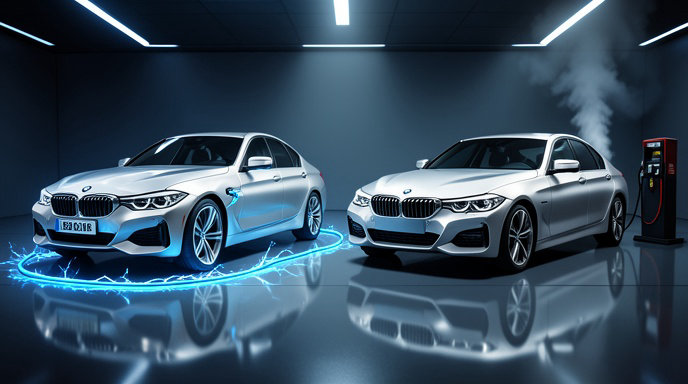
Both the 330i and i3 40 ride on BMW's new Neue Klasse platform, share the same 112.4-inch wheelbase, same interior with the Panoramic Vision head-up display and iDrive X, same trunk space, and same M Sport styling. Parked side by side, only the closed-off grille, lack of exhaust tips, and small i3 badge give the electric away.
Performance is remarkably close, too. The 330i uses a revised 2.0-liter turbo four-cylinder with 48-volt mild-hybrid assist making 255 horsepower. The i3 40 uses a single rear-mounted motor making 335 horsepower, with a 0-60 mph time of 5.0 seconds versus 5.6 seconds for the gas car.
Where they diverge is range and refueling. The i3 40 packs an 85 kWh usable battery pack good for an EPA-estimated 371 miles of range, plus 400-kW fast charging that adds 200 miles in 10 minutes. BMW says the gas 330i will still win for long-haul drivers, offering over 480 miles of total range on a full tank.
Why The EV Finally Won On Price
So how did BMW make the electric cheaper? It comes down to two words: batteries and scale.
Battery costs have been in freefall. According to industry data through September 2026, average lithium-ion pack prices have dropped to around $78 per kWh, down nearly 50% from 2022 peaks. BMW's new 6th-generation cylindrical cells, developed in-house and produced in joint-venture plants in South Carolina, Hungary, and China, are central to the savings.
BMW says its Gen6 round cells offer 20% higher energy density, 30% faster charging, and critically, 40-50% lower manufacturing cost than the prismatic cells used in the old i4 and iX. By building the cells directly into the body structure as cell-to-pack, BMW eliminated dozens of modules, wiring harnesses, and pounds of weight.
At the same time, gas car costs are rising. Stricter Euro 7 and U.S. emissions rules forced BMW to add more expensive exhaust after-treatment, particulate filters, and hybrid assist to the 330i's turbo engine. BMW executives admitted this week that cleaning up combustion is now more expensive than adding batteries.
One Platform To Rule Them All
The other secret weapon is BMW's unified platform strategy.
Unlike rivals who built separate EV-only skateboards, BMW designed Neue Klasse from the start to support gasoline, plug-in hybrid, full electric, and even hydrogen on a single assembly line in Munich and Spartanburg. That means one body shop, one paint shop, one set of robots, and one supply chain for 80% of parts including seats, dashboards, suspension, and electronics.
Previous EVs like the i4 had to be adapted to a gas platform, adding cost. Standalone EVs like the iX required a dedicated factory. The new approach spreads billions in development costs across more than 1.5 million projected 3 Series and X3 vehicles per year, gas and electric combined.
BMW CFO Walter Mertl told reporters this week the shared strategy cut per-unit production cost for the i3 by 32% compared to the outgoing i4, allowing BMW to price aggressively while preserving its signature 8-10% automotive margin.
What This Means For Tesla, Mercedes, And Everyone Else
The implications go far beyond Munich.
For years, automakers argued EVs would reach price parity around 2028-2030, and only with cheaper LFP chemistries in smaller cars. BMW just did it in 2026 in the heart of the premium sports sedan segment, with a long-range nickel-based battery.
It puts immediate pressure on Tesla's Model 3, Mercedes-Benz's upcoming electric C-Class, and Audi's A4 e-tron, all of which now face a rival that is both cheaper than its own gas sibling and cheaper than many of their EVs.
It also deflates the argument that consumers need subsidies to choose electric. The $4,400 advantage exists before the $7,500 U.S. EV lease credit or European incentives, which could stretch the real-world gap to over $10,000.
Analysts say if BMW can hold this pricing as battery material prices stabilize, other segments will follow quickly. The 2027 electric X3 is already expected to undercut the gas X3, and BMW's CEO Oliver Zipse hinted the upcoming 1 Series and 5 Series EVs will follow the same formula.
For drivers, the math has fundamentally changed. You no longer pay more to go electric in a 3 Series — you pay more not to.

Get All The Latest Updates Delivered Straight To Your Inbox For Free!