
Eka Robotics Hits $1.45B Valuation With Human-Like Picking Arm Powered by Physical AI
TL;DR
- Eka Robotics has reportedly reached a $1.45 billion valuation, fueled by investor enthusiasm for its breakthrough physical AI foundation model for warehouse picking.
- The company's human-like robotic arm stands out for ultra-smooth, adaptive motion, capable of handling a wide range of objects from fragile parcels to irregular-shaped items without task-specific programming.
- Industry experts say Eka's approach could redefine warehouse automation by slashing deployment time and labor costs as e-commerce fulfillment faces mounting pressure.
A New Unicorn in Warehouse Robotics
Eka Robotics has officially entered unicorn territory. The warehouse automation startup has reached a $1.45 billion valuation following its latest funding round, a milestone that underscores Wall Street and Silicon Valley's growing bet on physical AI as the next major platform shift after large language models.
Sources familiar with the deal say the round was oversubscribed, with leading venture firms and strategic logistics investors piling in. The funding will be used to scale manufacturing of Eka's robotic picking arm, expand its AI training infrastructure, and deploy thousands of units with third-party logistics providers and major e-commerce retailers heading into the peak holiday season.
What makes the valuation remarkable is the speed. Founded just a few years ago, Eka has moved from research prototype to commercial deployment in record time, riding a wave of demand for automation amid persistent warehouse labor shortages and rising fulfillment costs.
Inside The Breakthrough Physical AI Model
At the heart of Eka's rise is what the company calls a breakthrough physical AI model - a large-scale vision-language-action model trained on millions of real-world picking episodes.
Unlike traditional warehouse robots that rely on hard-coded routines and suction-cup heuristics for a narrow set of SKUs, Eka's model learns generalizable manipulation skills. It fuses high-resolution vision, force-torque feedback, and proprioceptive sensing to understand shape, weight, texture, and fragility in real time.
The result is a system that doesn't need to be reprogrammed for every new product. Show it a cluttered tote of mixed items it has never seen before - from polybags and cosmetics to glass bottles and soft plush toys - and it reasons about the best grasp strategy on the fly, company executives say.
Ultra-Smooth, Human-Like Motion
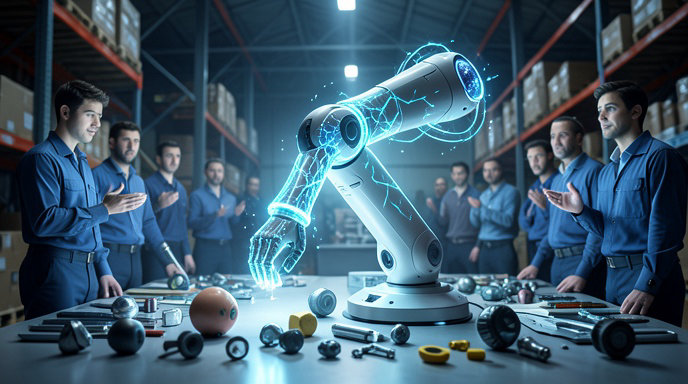
Watch Eka's robotic arm in action and the first thing you notice is how little it looks like a traditional industrial robot. There are no jerky, stop-and-start movements. Instead, the seven-axis arm glides with fluid, human-like grace.
That smoothness is intentional and functional. Using diffusion-based motion planning, the arm continuously predicts and refines its trajectory dozens of times per second, adjusting its wrist angle, grip force, and approach speed much like a human wrist and hand would.
In demo videos that have gone viral among robotics researchers, the arm delicately slides a blister pack from under a heavy box, gently reorients a tipped-over bottle, and uses two-finger nudging to separate tangled apparel items before lifting - tasks that have long stumped conventional pick-and-place systems.
Mastering The Long Tail of Picking
The holy grail of warehouse automation is handling the long tail - the millions of odd-shaped, deformable, reflective, or fragile items that make up modern e-commerce inventory.
Eka says its arm now achieves over 99% success rates on representative customer assortments at speeds approaching 600 picks per hour, matching or exceeding human picker performance for the first time without sacrificing reliability.
Key to that performance is compliant gripping and tactile intelligence. The gripper senses slip in milliseconds and automatically increases force just enough to secure the item without crushing it. That allows one single hardware platform to pick everything from a bag of chips to a 10-pound dumbbell set in back-to-back cycles.
For warehouse operators, that versatility eliminates the need for separate stations for different product categories, dramatically simplifying facility design.
Why Industry Experts Say It Could Redefine Automation
Industry analysts argue Eka represents a fundamental shift from automation-as-project to automation-as-software-update.
Legacy systems required months of integration, custom engineering, and controlled lighting and presentation. Eka's physical AI approach promises drop-in deployment in days, with performance improving over time via over-the-air model updates trained on fleet-wide data.
Logistics consultants point to three disruptive implications: drastically lower cost-per-pick, the ability to automate chaotic manual decanting and each-picking stations that were previously considered unautomatable, and a path toward fully lights-out fulfillment centers.
Competitors are taking notice. Major robotics players have accelerated their own foundation model efforts this year, setting up a high-stakes race to own the intelligence layer for physical labor.
What Comes Next
With fresh capital at a $1.45 billion valuation, Eka plans to scale rapidly. Priorities include opening a new U.S. manufacturing facility, doubling its team of AI researchers and field engineers, and launching a Robots-as-a-Service offering that lets smaller warehouses deploy the arm for an hourly fee with no upfront cost.
Challenges remain, including proving long-term reliability across 24/7 operations, navigating safety certification, and addressing concerns about warehouse job displacement. Eka counters that its systems are designed to collaborate with human associates, taking over repetitive, injury-prone picking while creating new roles in robot supervision and maintenance.
If the company delivers on its roadmap, including a bi-manual version and mobile manipulator teased for 2027, the $1.45 billion mark may be just the beginning of its bid to define the physical AI era.

Get All The Latest Updates Delivered Straight To Your Inbox For Free!