
US Bans DeepSeek AI From Federal Agencies Over Security Fears
TL;DR
- The White House Office of Management and Budget has ordered all federal civilian agencies to identify and remove DeepSeek products and any third-party apps built on DeepSeek models from government systems.
- Officials say the Chinese AI lab's apps pose unacceptable national security risks around data exfiltration, surveillance, and embedded censorship, prompting an aggressive removal and reporting timeline.
- The move marks the toughest U.S. action yet against a Chinese AI model, escalating the U.S.-China AI rivalry and signaling stricter federal cybersecurity rules for foreign AI.
What Washington Just Ordered
The U.S. government has officially cut ties with DeepSeek.
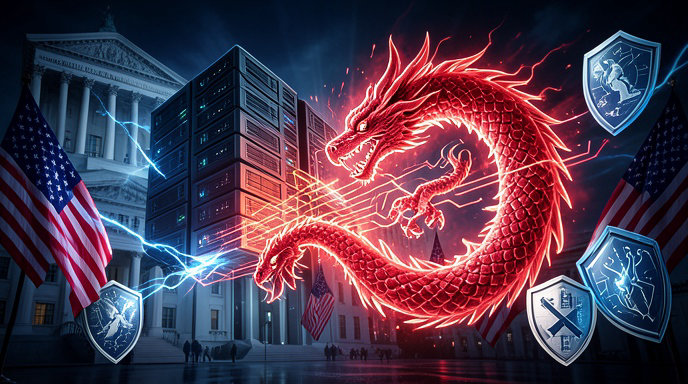
In new guidance issued by the Office of Management and Budget, federal civilian agencies are being told to strip DeepSeek's AI products — and any third-party services built on its technology — from all government systems. The order covers direct downloads of DeepSeek's chatbot and coding tools, as well as embedded uses where DeepSeek models power other vendors' software, cloud services, and APIs.
Agencies must inventory their networks, block new installations or contracts involving DeepSeek tech, uninstall existing deployments, and certify compliance back to OMB and the Cybersecurity and Infrastructure Security Agency. Contractors and managed service providers supporting federal systems are also expected to be swept into the review.
The directive does not apply to the military and intelligence community, which operate under separate authorities, but those agencies have long since blocked the Chinese chatbot internally.
Why Officials Say DeepSeek Is a Threat
Federal officials framed the ban as a straightforward national security call.
At the core of the concern is data. U.S. cybersecurity reviewers warn that queries, documents, source code, and other sensitive inputs entered into DeepSeek's app or API could be stored on servers in China and accessed under Chinese national security and intelligence laws. That creates a risk of espionage, coercion, and mapping of federal operations.
Analysts have also flagged two other issues: censorship and manipulation, with DeepSeek's R1 and V-series models refusing or reframing answers on topics sensitive to Beijing, and a lack of transparency around model training, data retention, and supply-chain integrity.
OMB officials said allowing a foreign adversary-controlled AI system to process federal information, generate government code, or sit inside agency networks was incompatible with minimum federal cybersecurity standards. In short, Washington now treats DeepSeek less like a rival chatbot and more like banned telecom and drone hardware from China.
What Agencies Actually Have To Do
The removal order is broader than a simple app ban.
Agencies are required to hunt for both obvious and hidden uses of DeepSeek. That includes the iOS and Android chatbot app on government-issued phones, desktop clients, browser extensions, open-source code derivatives, and backend API calls where a U.S. vendor quietly routes prompts through DeepSeek-R1 or DeepSeek-V3 to save money.
IT teams must block network traffic to DeepSeek domains, remove software from authorized app catalogs, update procurement blacklists, and add DeepSeek screening to vendor risk reviews. Any discovery of DeepSeek in national security systems, high-value assets, or contractor-operated infrastructure must be reported quickly to CISA.
Federal CISOs privately say the third-party part will be the hardest. Thousands of AI productivity tools, coding assistants, and customer-service bots advertise that they are powered by leading open models — and DeepSeek's cheap, powerful open-weights models became a popular backend in early 2025. Untangling that supply chain could take months.
How DeepSeek Responded — And How China Reacted
DeepSeek has previously said it stores user data on servers in China and operates under Chinese law, while insisting it does not share personal information improperly. The Hangzhou-based startup has not shown any willingness to create a segregated U.S. government cloud or agree to U.S. auditing requirements that might have eased Washington's concerns.
Beijing blasted the decision as discriminatory and an abuse of national security concepts, arguing the U.S. is politicizing technology and trying to suppress Chinese innovation. Chinese state media portrayed DeepSeek as a victim of its own success after its low-cost R1 reasoning model stunned Silicon Valley and triggered a global price war last year.
Industry reaction in the U.S. is split. American AI firms like OpenAI, Anthropic, Google, and Meta stand to benefit as agencies shift to FedRAMP-authorized domestic models. Open-source advocates, however, warn that banning a specific set of weights is hard to enforce now that DeepSeek models have been downloaded, fine-tuned, and re-hosted millions of times on Hugging Face and private servers.
What It Means for the US-China AI Rivalry
This is more than an IT cleanup — it's a new front in the AI cold war.
Until now, U.S. restrictions focused on slowing China down: export controls on Nvidia's top AI chips, investment curbs, and limits on advanced manufacturing. The DeepSeek order flips the strategy to keeping Chinese AI out, even when it is cheaper and openly available.
Expect ripple effects. State governments, which largely mirrored the earlier federal TikTok ban, are likely to issue their own DeepSeek prohibitions. Congress is already pushing for legislation that would permanently codify the ban and extend it to other Chinese labs. Key allies in the Five Eyes and EU are reviewing similar restrictions for sensitive public-sector use.
For federal cybersecurity policy, the message is clear: foreign-made foundation models will now face the same zero-trust scrutiny as hardware and telecom gear. The era of agencies experimenting with any viral AI app is over.
What's Next
OMB is expected to release a compliance scorecard and updated acquisition rules that require vendors to disclose whether any Chinese-origin models are present in their products. CISA will issue technical indicators to help agencies detect DeepSeek traffic and embedded SDKs.
Agencies that fail to meet the removal deadlines could face procurement freezes for new AI tools and additional oversight hearings.
For federal workers, the rule is simple for now: if it runs on DeepSeek, delete it, disconnect it, and report it.

Get All The Latest Updates Delivered Straight To Your Inbox For Free!