
Fervo Energy Completes World's First Enhanced Geothermal Plant in Record 23 Months
TL;DR
- Fervo Energy has completed construction of Cape Station Phase 1 in Beaver County, Utah in just 23 months, creating what the company calls the world's first large-scale enhanced geothermal power plant.
- The project uses horizontal drilling, hydraulic stimulation, and real-time fiber-optic monitoring borrowed from the shale industry to unlock heat in hot, dry rock that traditional geothermal couldn't reach.
- With 100 MW ready for grid connection in the first phase and 400 MW more already under development, Fervo says standardized design and faster drilling will make future phases even quicker to build and connect.
A Two-Year Build That Changes The Timeline For Clean Firm Power
Fervo Energy has finished building its first full-scale enhanced geothermal power plant in less than two years. The project, Cape Station Phase 1 in Beaver County, Utah, went from groundbreaking to completion in 23 months, a pace almost unheard of for a first-of-a-kind geothermal development.
For an industry where conventional geothermal projects often take 5 to 10 years of exploration, permitting, and construction, the 23-month timeline is the story. Fervo broke ground in late 2023 and early 2024, drilled dozens of deep wells through 2024 and 2025, and completed the power plant and surface facilities by fall 2026. The first 100 megawatts are now in commissioning and preparing to connect to the grid.
Once online, Cape Station will deliver 24/7 carbon-free electricity, enough in its first phase to power roughly 70,000 homes, with the full 500-megawatt station designed to power up to 350,000 homes.
How Fervo Pulled Off The 23-Month Sprint
Fervo didn't get faster by cutting corners. It got faster by treating geothermal like shale oil.
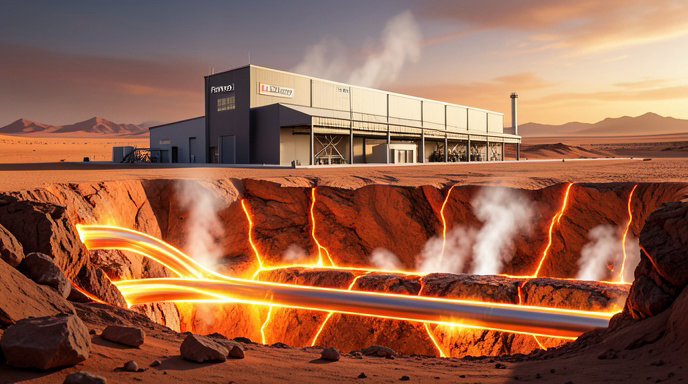
Instead of hunting for rare natural steam reservoirs like traditional geothermal, Fervo creates its own. The company drills deep vertical wells 8,000 to 10,000 feet down into hot granite, then turns horizontally for 3,000 to 5,000 feet. Water is pumped down at high pressure to create a network of tiny fractures in the rock, and a second horizontal well recovers the superheated water to drive turbines at the surface.
Three innovations made the speed possible:
First, factory-style drilling. Fervo used the same horizontal drilling rigs, polycrystalline diamond bits, and supply chains perfected in the Permian Basin. At Cape, drilling times fell dramatically from well to well, with later wells drilled up to 70% faster than early ones.
Second, real-time subsurface control. Fiber-optic cables cemented into the wells provide second-by-second temperature, flow, and fracture data. That let engineers steer fractures precisely and prove reservoir performance without years of test wells.
Third, parallel construction. While drilling continued on multi-well pads, Fervo built the power plant, transmission spur, water systems, and substations simultaneously using modular organic Rankine cycle equipment. Early power purchase agreements and streamlined permitting on private land and pre-approved federal zones also removed typical multi-year delays.
Why Enhanced Geothermal Is Different
Traditional geothermal only works in a handful of volcanic hotspots like Iceland, California's Geysers, or Nevada. Enhanced geothermal systems, or EGS, work anywhere rock is hot enough at depth — which is almost everywhere if you drill deep enough.
That makes EGS a firm clean energy source: it runs day and night, winter and summer, regardless of wind or sun. Unlike nuclear, it is modular and can be sited in 100-megawatt increments. Unlike natural gas with carbon capture, it has no fuel costs and near-zero emissions once built.
At Cape Station, Fervo demonstrated commercial flow rates of more than 10 megawatts per well pair in testing, far above Department of Energy benchmarks from just a few years ago. Independent validation of its earlier 3.5-megawatt Project Red pilot in Nevada for Google in 2023 gave utilities confidence to sign on.
Why Utilities Are Buying In Fast
Cape Station is already largely sold out. Southern California Edison has contracted for 320 megawatts, and Google has contracted for additional carbon-free power to run data centers, part of a broader push for 24/7 clean power for AI loads.
For utilities, the appeal is speed plus certainty. Solar and batteries are fast but intermittent. Nuclear is firm but can take a decade or more. Fervo is pitching geothermal as fast AND firm — new capacity in about two years with a 30-plus year plant life and stable pricing.
That timing matters as U.S. electricity demand surges for the first time in two decades, driven by data centers, manufacturing, and electrification. Grid operators in the West, where Cape will feed into the regional system, are urgently seeking nighttime, winter-proof power to complement massive solar buildouts.
What's Next: Even Faster Grid Connections
Fervo says Phase 1 was the slow one. Phase 2 at Cape, adding another 400 megawatts, is already being drilled with the same pads, permits, transmission corridor, and plant design.
The company expects three big accelerators:
- Learning curve drilling: With crews, geology, and bit designs now proven at Cape, Fervo targets days-per-well closer to shale norms, cutting months off each pad.
- Standardized plant blocks: Phase 2 will replicate the Phase 1 power island design, allowing pre-ordered turbines, cooling, and electrical gear instead of custom engineering.
- Ready grid access: The substation and 138-kV transmission tie-line built for Phase 1 were oversized for the full 500-megawatt project, meaning future electrons can flow with minimal new interconnection study delays.
Fervo is targeting full 500-megawatt operation at Cape by 2028, and is advancing a pipeline of over 1 gigawatt in Utah, Nevada, and California. Backed by more than $800 million in funding and a $148 million Department of Energy grant for EGS innovation, the company argues costs will fall with each phase, following a similar path to shale and solar.
The Road To Scale
Challenges remain. EGS still requires large upfront drilling capital, careful water management in arid Utah, and long-term proof that artificially created reservoirs maintain heat and flow for decades. Seismicity monitoring and community engagement will stay under close scrutiny as operations scale.
But completing the world's first large-scale enhanced geothermal plant in 23 months reframes what's possible. If Fervo can repeat and shorten that timeline, geothermal shifts from a niche, slow resource to a deployable, repeatable clean power platform — one that can be built at the speed of the AI boom it aims to power.

Get All The Latest Updates Delivered Straight To Your Inbox For Free!