
Google Says SpaceX Starship Needs 1800 Launches to Make Space Data Centers a Reality
TL;DR
- Google has launched its first TPU-equipped prototype satellites into orbit under Project Suncatcher to test whether AI workloads can run in space using direct solar power.
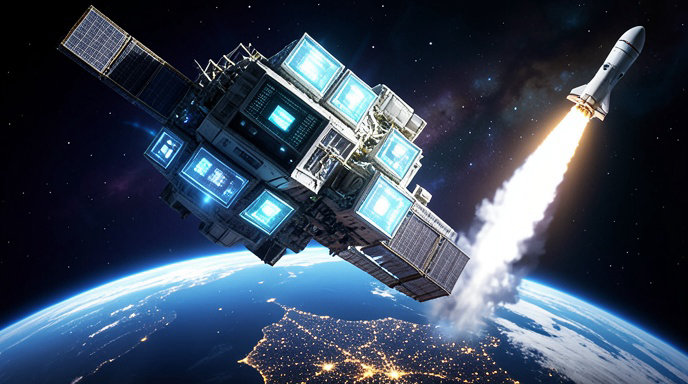
- Google estimates building gigawatt-scale orbital data centers would require around 1,800 SpaceX Starship launches, thanks to Starship's massive payload capacity and planned launch cadence.
- Space-based computing could bypass Earth's power grid bottlenecks with constant, 8x more productive solar energy, but radiation, networking, cost, and debris challenges remain unsolved.
Google's First Step Toward Data Centers in Orbit
Google has just taken its most concrete step yet toward moving AI computing off the planet.
The company confirmed it has launched prototype satellites carrying its custom Trillium TPUs into low Earth orbit, kicking off a project internally called Suncatcher. The mission, developed in partnership with satellite imaging company Planet, is designed to answer a deceptively simple question: can modern AI chips survive and operate reliably in space?
The payloads are not full data centers. They are testbeds packed with sensors to measure radiation impact, thermal performance, and compute reliability in the harsh environment of orbit. For now, Google is running ML inference workloads and stress tests, with results expected to shape a much larger constellation planned for late 2027.
If successful, it would mark the first time Google-grade AI accelerators have operated as part of a scalable orbital compute architecture, rather than as one-off space experiments.
Why Space? Earth's Power Grid Is Maxed Out
The motivation has little to do with science fiction and everything to do with electricity.
AI demand is exploding. Google says its data center power needs are growing far faster than new grid capacity and clean energy can be built in the U.S. and Europe. Permitting delays, transformer shortages, land constraints, and local opposition are slowing terrestrial expansion.
Space offers a workaround. Above the atmosphere, solar panels receive uninterrupted sunlight with no clouds, no night in sun-synchronous orbits, and about eight times the energy productivity per panel compared to the ground. Instead of competing for grid power, orbital data centers could harvest solar power directly and beam only the results back to Earth.
In Google's vision, future constellations would fly in sun-synchronous orbits, staying in near-constant daylight while machine learning training and inference run on solar power that would otherwise be untapped.
Why Google Says It Will Take 1,800 Starship Launches
Even Google admits the math only works with SpaceX's Starship.
In a technical paper accompanying the Suncatcher announcement, Google researchers calculated that a meaningful orbital AI system would need to scale to gigawatts of compute capacity to compete with today's terrestrial hyperscale campuses. That means launching tens of thousands of solar arrays, TPUs, batteries, optical terminals, and structural buses.
Only Starship, with its projected 100-150 ton reusable payload capacity and eventual goal of multiple launches per day, makes that mass-to-orbit affordable. Google estimates roughly 1,800 Starship flights would be required to deploy its first-generation fleet — a number that sounds staggering until you consider SpaceX's target launch rate.
Google explicitly tied the project's viability to Starship achieving rapid reusability and launch costs falling below $200 per kilogram. At Falcon 9 prices, the concept would be economically impossible. At Starship scale, the company argues, launching a 10-megawatt prototype and then scaling to gigawatts becomes plausible within the next decade.
In other words: no Starship, no space data centers.
How Orbital Computing Would Actually Work
Google is not proposing to replace Earth data centers entirely.
The Suncatcher architecture envisions tightly networked satellite clusters connected by free-space optical links — essentially laser internet in space capable of terabits per second. Each satellite would combine TPUs, solar arrays, and radiators for heat rejection, flying in formation to act as a distributed supercomputer.
Workloads best suited for orbit would be highly parallel, energy-intensive, and fault-tolerant, like AI training, video transcoding, and large-scale inference. Latency-sensitive tasks and long-term data storage would stay on the ground.
Crucially, Google plans to use the vacuum of space itself for cooling. Without air, heat must be radiated away, which is both an advantage and a major engineering challenge. The prototypes now in orbit will test new radiator designs and chip layouts to see if TPUs can run at full power without overheating.
The Massive Challenges Still in the Way
Despite the excitement, Google is candid that orbital data centers are far from inevitable.
Radiation is the first hurdle. High-energy particles can flip bits, degrade chips, and shorten lifespans from 7 years to months. Google's TPUs were never designed with radiation hardening, so the current mission will reveal whether software-level error correction is enough.
Thermal management is second. In direct sunlight, satellites swing between extreme heat and cold. Dissipating kilowatts of AI heat without fans or water cooling requires huge, lightweight radiators that have never been flown at this scale.
Then there is networking, collision risk, and maintenance. A gigawatt fleet would mean tens of thousands of satellites, dramatically increasing orbital debris concerns. Unlike a ground data center, you cannot send a technician to swap a failed TPU. Google will need autonomous rendezvous, robotic servicing, or simply accept high attrition rates.
Finally, cost and regulation remain open questions. Even with 1,800 Starship launches, the capital expenditure would run into tens of billions of dollars, and international rules on spectrum, orbital slots, and light pollution are still catching up.
What Comes Next
Google says the next milestone is a scaled demonstration in 2027: a small constellation of solar-powered TPU satellites operating as a single system with space-to-space laser links and direct downlink to Earth.
If that works, the company will evaluate a 10-megawatt operational prototype — still tiny compared to a 1-gigawatt terrestrial campus, but large enough to prove the economics.
Competitors are watching closely. SpaceX, Amazon, and startups like Starcloud and Axiom Space have all floated similar space-compute concepts, and the Pentagon has expressed interest in resilient orbital AI.
For now, Google frames Suncatcher as research, not a product roadmap. But the message is clear: as AI hits the limits of Earth's energy system, the next cloud region may not be in Iowa or Belgium — it may be 500 kilometers straight up.

Get All The Latest Updates Delivered Straight To Your Inbox For Free!