
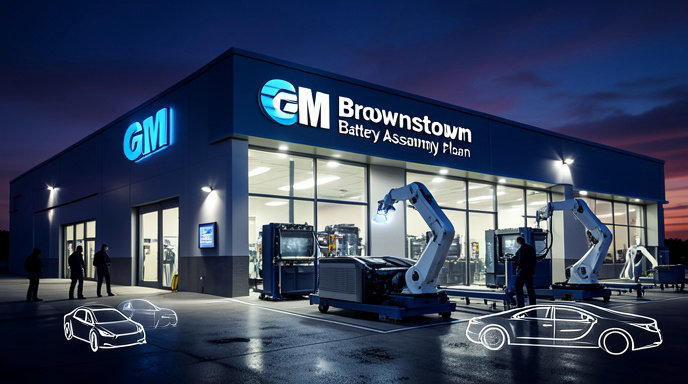
GM Closes Brownstown Battery Plant But EV Future Still Intact
TL;DR
- GM is shutting down its Brownstown Battery Assembly Plant in Brownstown Township, Michigan, by the end of 2025 as it consolidates battery pack production into newer, higher-volume EV plants.
- The closure is not an EV retreat but a shift away from older pack designs toward Ultium and next-gen LFP-based platforms built in Lansing, Spring Hill, and joint-venture Ultium Cells plants in Ohio, Tennessee, and Michigan.
- About 200 hourly and salaried workers will be affected, with GM offering transfers, buyouts, and UAW-negotiated placement support as pack work moves to more automated facilities.
Why Brownstown Is Closing Now
GM's Brownstown Battery Assembly Plant has been a quiet workhorse for more than 15 years. Opened in 2009 with federal stimulus backing to build packs for the Chevrolet Volt, it later handled packs for the Chevy Bolt EV and EUV, the GMC Hummer EV in its early ramp, and various hybrid and performance applications.
That versatility is now the problem. Brownstown was built for lower-volume, more manual pack assembly, with multiple chemistries and form factors moving through the same lines. GM's current electrification strategy is centered on large, standardized Ultium modules and, increasingly, lower-cost lithium-iron-phosphate cells for mainstream models like the next-gen Bolt, Equinox EV, and Blazer EV.
Company officials say it no longer makes financial or logistical sense to keep retrofitting a 2009-era facility when purpose-built pack plants attached to vehicle assembly or Ultium Cells factories in Lordstown, Ohio, Spring Hill, Tennessee, and Lansing, Michigan can do the same work at higher volume and lower cost per kilowatt-hour.
In short: Brownstown isn't closing because EVs failed. It's closing because GM's first-generation battery assembly model is obsolete.
This Is Consolidation, Not Retreat
The timing has fueled speculation that GM is backing away from EVs amid slower-than-expected U.S. adoption, high interest rates, and political uncertainty around EV tax credits and emissions rules in 2025-2026.
GM executives insist the opposite is true. The automaker has reaffirmed plans for 11+ EV models in the U.S. lineup through 2026, including the relaunch of the Chevrolet Bolt on a new LFP-based platform, expanded Equinox EV and Silverado EV production, and Cadillac's continued electric push with the Optiq, Lyriq, Vistiq, and Escalade IQ.
What has changed is how aggressively GM is chasing profitability. After losing money on early Ultium ramp-up and battery scrap issues in 2022-2024, GM shifted from a goal of 1 million EVs of annual capacity by 2025 to a demand-driven build strategy. That means fewer, fuller plants rather than many half-utilized ones.
Brownstown's pack volume had already declined sharply after Bolt production ended in late 2023 at Orion Assembly. With Orion being retooled for Silverado EV and Sierra EV pickups using packs built elsewhere, Brownstown lost its highest-volume program and never got a full replacement.
Inside GM's Evolving Battery Strategy
To understand Brownstown, you have to look at GM's three-layer battery map in 2026:
1. Cell Manufacturing: Ultium Cells LLC, GM's joint venture with LG Energy Solution, now runs at scale in Warren, Ohio and Spring Hill, Tennessee, with a third plant in Lansing, Michigan ramping. GM is also adding LFP cells through a partnership with Samsung SDI and CATL-licensed production in the U.S. to cut costs 20-30% for entry-level EVs.
2. Pack Assembly: New pack lines are co-located with vehicle assembly in Factory Zero in Detroit-Hamtramck, Spring Hill, and the upcoming Lansing Delta Township EV center. These lines are highly automated and designed specifically for Ultium large-format pouch cells and prismatic LFP cells.
3. Legacy Support: Brownstown had become a niche plant for service packs, low-volume performance packs, and development builds. GM says that work will move to its Wallace Battery Cell Innovation Center in Warren and to a smaller technical center operation, eliminating the need for a full 300,000+ square-foot assembly plant.
Executives have also pointed to advances in cell-to-pack design that reduce parts count by up to 70% compared to Volt-era packs. A plant designed to wire hundreds of small modules simply isn't needed when a Silverado EV pack can be built from 24 large modules in a fraction of the steps.
What It Means For Workers And The Community
The human impact is significant. Brownstown Township employs roughly 200 workers at the site, many of them long-tenured UAW Local 683 members who transferred from powertrain and stamping plants as GM promised battery jobs would replace engine jobs.
GM says it will honor its 2023 UAW national agreement provisions for plant closures, which include:
- Transfer opportunities to Ultium Cells Lansing, Factory Zero, Orion Assembly, and other Southeast Michigan facilities
- Early retirement and voluntary separation packages for eligible workers
- Tuition assistance and job placement through the UAW-GM joint training center
- Temporary layoff benefits and SUB pay during transition
Local officials in Brownstown Township and Wayne County have expressed disappointment, noting the plant was a symbol of Michigan's green manufacturing comeback after the 2009 bankruptcy. State leaders are already lobbying GM to repurpose the site for energy storage systems, supplier operations, or a future LFP service operation rather than leaving it idle.
Union leaders, meanwhile, are using the closure to press GM for stronger guarantees that future U.S. battery plants, including joint ventures, will be fully unionized with wage parity to traditional assembly.
What Comes Next For GM EVs
Brownstown's closure clears the way for GM's next phase: cheaper, more profitable EVs.
The most immediate test is the 2026 Chevrolet Bolt revival. Priced to start under $30,000 and built in Kansas City, it will use LFP packs assembled in the U.S. — not at Brownstown — delivering an estimated 300 miles of range with far lower pack costs than the original Bolt.
Beyond that, GM is preparing its next-generation chemistry roadmap for 2027-2030, including high-nickel NMC for trucks and performance Cadillacs, LFP for mass-market crossovers, and early solid-state and lithium-manganese-rich development at its Warren tech center.
For Detroit, the message is mixed but clear. Old EV jobs are disappearing just like old engine jobs did, but GM still plans to build the bulk of its North American EVs — and their batteries — within a 150-mile radius of Detroit. Brownstown opened the door to the Volt era. Its closure marks the end of the pilot phase and the start of GM betting everything on scale.

Get All The Latest Updates Delivered Straight To Your Inbox For Free!