
Google Joins Amazon to Break Nvidia GPU Grip on PyTorch AI Developers
TL;DR
- Google Cloud has launched a new open-source migration toolkit for PyTorch that automates moving AI workloads from Nvidia CUDA GPUs to Google TPUs, with one-line code changes and automatic performance tuning.
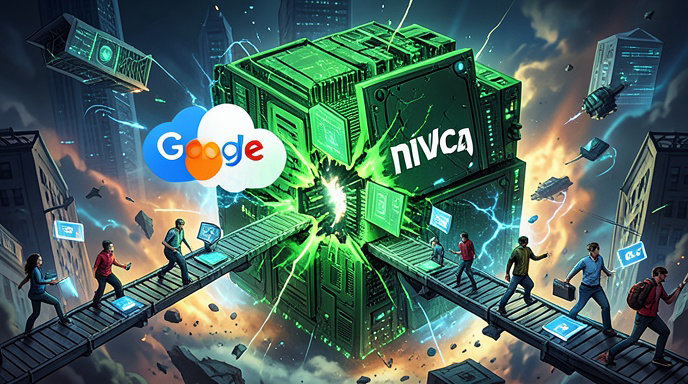
- The launch puts Google alongside Amazon, which has been pushing a similar PyTorch-to-Trainium migration path, in a direct attack on Nvidia's CUDA software moat that locks in 90%+ of AI developers.
- If successful, the tools could reshape AI infrastructure economics by making TPUs and Trainium viable drop-in alternatives, lowering costs and loosening Nvidia's grip on pricing and supply.
A Two-Front War on CUDA
For a decade, Nvidia's true superpower hasn't just been its H100 and Blackwell GPUs — it's been CUDA. The proprietary software stack and its tight integration with PyTorch, the framework behind the vast majority of large language models and generative AI apps, has made leaving Nvidia painful, expensive, and risky for developers.
That lock-in is now under coordinated assault. Google has joined Amazon in offering PyTorch developers a direct off-ramp from Nvidia GPUs.
This week, Google Cloud unveiled an upgraded PyTorch/XLA migration tool designed to let AI teams move existing PyTorch applications built for Nvidia CUDA to Google's TPU v5p and v6e Trillium accelerators with minimal code rewrites. The move mirrors Amazon Web Services' long-running push to migrate PyTorch workloads to its homegrown Trainium and Inferentia chips via its Neuron SDK.
Together, the two cloud giants are targeting the same chokepoint: the millions of developers who default to Nvidia because PyTorch just works there.
How Google's New Tool Works
Google's new toolkit builds on TorchXLA, the open-source bridge between PyTorch and XLA-compiled accelerators like TPUs. While TorchXLA has existed for years, developers have long complained it required manual tuning, lacked support for dynamic shapes, and broke on custom CUDA kernels.
The new release aims to fix that friction. According to Google, developers can now keep their native PyTorch code and change just the device string from cuda to xla, with an automated assessment layer that scans a codebase for incompatible CUDA operations, suggests replacements, and estimates expected TPU performance and cost savings.
Key upgrades include automatic graph compilation, support for PyTorch 2.x's torch.compile, improved handling of large language model training with Fully Sharded Data Parallel, and pre-validated templates for Llama, Mistral, Gemma, and Diffusion models. Google is also bundling profiling dashboards in Cloud Console that directly compare GPU vs. TPU latency, throughput, and dollar-per-token.
In short: upload your PyTorch repo, get a compatibility report, auto-convert, and deploy on TPU without learning JAX or rewriting kernels.
Why Amazon Started This Fight First
Google isn't first. Amazon Web Services has spent the last two years aggressively courting the same PyTorch developers for its Trainium2 chips.
AWS's Neuron SDK 2.0 now includes its own Torch-Neuron migration path, complete with a PyTorch front-end that intercepts standard torch.cuda calls and reroutes them to Trainium. AWS has funded benchmarks claiming 40-50% better price-performance over comparable Nvidia GPU instances for Llama 3 training and inference, and has signed up Anthropic, Databricks, and others as flagship Trainium users.
Amazon's strategy proved that developers would switch — if the tooling was easy enough and the cost savings were real. Google is now validating that playbook and extending it to TPUs, which are widely seen as more mature than Trainium for large-scale training.
The shared goal is clear: turn PyTorch itself into a hardware-agnostic layer, so choosing a non-Nvidia chip no longer means abandoning the PyTorch ecosystem.
Why Google and Amazon Are Teaming Up In Spirit
Google and Amazon remain fierce cloud rivals, but they share a common enemy and a common economic incentive.
First, cost and supply. Nvidia's H100, H200, and Blackwell B200 GPUs remain expensive and supply-constrained, with list prices running into tens of thousands of dollars and cloud GPU rents 2-3x higher than TPU or Trainium equivalents. By making their in-house silicon easier to adopt, Google and Amazon can offer cheaper AI cloud capacity while improving their own margins — they own the TPU and Trainium designs outright.
Second, sovereignty. Both companies want to reduce dependence on a single supplier for the most critical input of the AI boom. Internal workloads — Gemini training on TPUs for Google, Alexa and Bedrock models on Trainium and Inferentia for Amazon — already prove the chips at scale. The next step is external developers.
Third, open ecosystem momentum. Both firms are major backers of the PyTorch Foundation and the OpenXLA project. By investing in open compilers rather than proprietary CUDA alternatives, they hope to commoditize the software layer where Nvidia is strongest.
What It Means for Nvidia
Nvidia is not standing still. It still commands more than 90% of the AI accelerator market, and its moat includes not just CUDA but NVLink networking, cuDNN libraries, TensorRT inference optimization, and a massive library of pre-optimized model scripts that just work.
Nvidia has also responded with simplifications of its own, including CUDA Graphs, improved torch.compile support, and NIM microservices that make deployment easier across its GPUs.
But analysts say the Google-Amazon pincer movement is the most credible threat yet because it doesn't ask developers to abandon PyTorch — it meets them where they are. If even 10-15% of inference and fine-tuning workloads migrate to TPUs or Trainium for cost reasons, it could dent Nvidia's pricing power and force it to compete more aggressively on cloud rental rates.
For now, outright replacement of Nvidia for frontier model pre-training remains rare. The real battleground is inference and custom fine-tuning, where cost-per-token matters most and workloads are more portable.
What It Means for AI Developers and Startups
For PyTorch developers, the immediate impact is choice — and leverage.
Startups burned by GPU shortages and soaring A100/H100 bills can now realistically test-drive TPU v6e pods or Trainium2 UltraServers without a full rewrite. Google Cloud and AWS are both sweetening the deal with migration credits, free compatibility assessments, and hands-on solution architect support.
Early testers report that standard transformer training and inference ports in days rather than months, though highly customized CUDA kernels, FlashAttention variants, and complex multi-GPU communication patterns still require work. Debugging XLA compilation errors remains a learning curve.
Still, the direction is unmistakable: PyTorch is becoming portable. Developers who write clean, standard PyTorch 2.0 code with torch.compile will have the most freedom to shop between Nvidia, Google, Amazon — and soon, AMD and Intel — based on price and availability.
The Future of AI Infrastructure Is Heterogeneous
The deeper implication goes beyond any single tool. Google joining Amazon signals that the future of AI infrastructure won't be Nvidia-only, but heterogeneous.
Cloud providers envision a world where a developer deploys the same PyTorch app and a scheduler routes it to the cheapest available accelerator — Blackwell GPU for one job, TPU Trillium for the next, Trainium2 for overnight batch inference. Kubernetes-style abstractions, open compilers like XLA and Triton, and PyTorch 2.x's compiler layer are making that vision technically plausible for the first time.
Nvidia will remain dominant for years, thanks to its execution speed and full-stack ecosystem. But its grip is loosening at the edges. With Google and Amazon now both offering a one-line escape hatch for PyTorch users, CUDA's status as an unbreakable lock-in is being tested like never before.
For developers, that competition can't come soon enough.

Get All The Latest Updates Delivered Straight To Your Inbox For Free!