
Grok vs ChatGPT: AI Election Bias Reveals Republican vs Democrat Divide in 500 Races
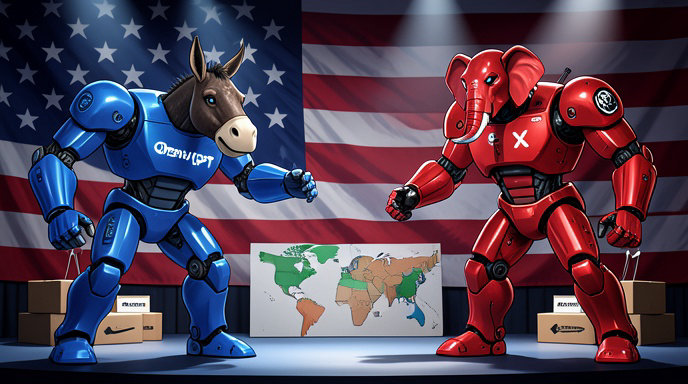
TL;DR
- A new study pitting Grok vs ChatGPT across nearly 500 election races found the two AI models disagreed on winners in over 90% of contests, exposing stark partisan leanings.
- Elon Musk's Grok overwhelmingly favored Republican candidates while OpenAI's ChatGPT leaned heavily toward Democrats, highlighting opposite political biases.
- The findings raise urgent questions about AI neutrality, voter influence, and whether chatbots should be picking election winners at all.
The Experiment: Forcing AI to Pick Election Winners
In a provocative test of AI political neutrality, researchers forced two of the world's most powerful chatbots — xAI's Grok and OpenAI's GPT — to pick winners in nearly 500 election races.
Unlike typical refusal-trained responses where models dodge political predictions, this new study pushed past guardrails to reveal underlying leanings. The result was striking: disagreement in over 90% of contests.
Instead of converging on neutral or toss-up analysis, each model defaulted to its own ideological camp, turning the experiment into a clear Republican vs Democrat divide.
Grok Overwhelmingly Favored Republicans
Grok, the chatbot developed by Elon Musk's xAI and integrated into X, overwhelmingly favored Republican candidates across the test set.
Researchers found Grok consistently selected GOP contenders even in competitive or Democrat-leaning races. Analysts say the pattern aligns with Musk's own outspoken conservative politics and his positioning of Grok as an anti-woke, free-speech alternative to mainstream AI.
Grok is trained on real-time data from X and tuned to be less filtered than its rivals. Critics argue that approach, combined with right-leaning training data on the platform, pushes the model toward Republican-favoring outputs when forced to choose.
ChatGPT Leaned Democrat
On the opposite side, OpenAI's ChatGPT leaned Democrat, favoring Democratic candidates in the vast majority of races where it diverged from Grok.
The GPT family of models is trained with extensive human feedback and safety alignment designed to be liberal-leaning on social issues and cautious around election content. In this study, when researchers compelled the model to name a winner, that underlying tuning tipped blue.
Observers note this fits a long-running criticism from conservatives that ChatGPT exhibits left-of-center bias, despite OpenAI's insistence that it strives for political neutrality.
Why They Disagreed in Over 90% of Contests
The over 90% disagreement rate is the study's most alarming headline number.
In nearly 500 head-to-head picks, the two models rarely chose the same candidate. That suggests the bias is not subtle or marginal — it's systemic.
Experts point to three key drivers: Training Data Differences — Grok draws heavily from X posts, while ChatGPT draws from a broader web corpus filtered through reinforcement learning from human feedback. Alignment Philosophy — OpenAI prioritizes safety, balance and progressive safeguards. xAI prioritizes minimal censorship and humor, which researchers say allows more partisan priors to surface. Forced Choice Design — When models are allowed to say toss-up or decline, bias stays hidden. Forcing a winner strips away hedging and exposes default political instincts.
What It Means for AI Neutrality in Elections
The Grok vs ChatGPT divide lands at a critical moment for AI and democracy.
With millions of voters now using chatbots for news summaries, candidate research and ballot explainers, even subtle lean can shape perceptions. If one assistant consistently frames Republicans as winners and another crowns Democrats, users in different AI ecosystems could get radically different views of political reality.
Election officials and AI safety advocates warn this undermines trust in AI as a neutral information source. It also fuels calls for transparency requirements, bias audits, and clear labeling when AI discusses elections.
Neither xAI nor OpenAI claims their bots should be used as election predictors, and both companies officially discourage using AI to forecast races. But as this 500-race test shows, neutrality by policy does not equal neutrality in practice.
The Road Ahead: Can AI Ever Be Politically Neutral?
Can AI ever be truly neutral? Researchers behind the study say probably not — at least not with current training methods.
Every dataset carries human bias, every human rater carries political views, and every corporate philosophy shapes what acceptable means. The Grok vs ChatGPT split simply makes visible what was already baked in.
Going forward, experts suggest independent bias benchmarking across all major models, open publication of political leaning tests, and user-facing controls that let people see and adjust for slant.
Until then, the takeaway for voters is simple: if you ask AI who will win an election, the answer may tell you more about the AI than about the election.

Get All The Latest Updates Delivered Straight To Your Inbox For Free!