
Helion Raises $225M to Double Fusion Output With New Semiconductors for Microsoft 2028 Plant
TL;DR
- Helion has raised an additional $225 million to accelerate construction of its first commercial fusion power plant, Orion, targeting electricity delivery to Microsoft starting in 2028.
- The raise values Helion at around $6.8 billion and brings total funding to over $1.4 billion, backed by existing investors including Sam Altman, Reid Hoffman, and Mithril Capital.
- Helion says newly developed in-house pulsed-power semiconductors - built at its own fab in Everett, Washington - will double the power output of its Polaris prototype and are critical to making Orion economical.
A Fusion Bet Gets Bigger
Helion Energy has secured an additional $225 million in new funding to accelerate its first fusion power plant, doubling down on its promise to deliver electricity to Microsoft in 2028.
The Everett, Washington-based startup confirmed the raise pushes its valuation to about $6.8 billion, making it one of the most valuable private fusion companies in the world. Total capital raised now exceeds $1.4 billion, with participation from longtime backers including OpenAI CEO Sam Altman, LinkedIn co-founder Reid Hoffman, Mithril Capital, Capricorn Investment Group, and Nucor.
The funding comes at a pivotal moment for commercial fusion. Helion is racing Commonwealth Fusion Systems, TAE Technologies, and others to be first to put fusion electrons on the grid. Unlike most competitors pursuing tokamaks or lasers, Helion uses a pulsed magneto-inertial approach that directly captures electricity, eliminating the need for steam turbines.
What The Money Is For: Orion
The fresh cash is earmarked for Orion, Helion's first commercial power plant planned for Chelan County, Washington.
Orion is designed to produce 50 megawatts-electric initially for Microsoft under a landmark power purchase agreement signed in 2023 - widely regarded as the world's first fusion PPA. Microsoft has agreed to buy power as early as 2028, with Constellation Energy serving as the transmission partner.
Helion says the $225 million will fund long-lead equipment, site preparation, and manufacturing scale-up for Orion's core reactor systems. The company broke ground on supporting infrastructure earlier this year and is currently building its seventh prototype, Polaris, which is expected to demonstrate net electricity generation.
Company founder and CEO David Kirtley has said Orion will use the same deuterium-helium-3 fuel cycle Helion has pursued since 2013, which produces minimal neutrons and allows direct energy recovery.
The Semiconductor Breakthrough
The centerpiece of Helion's technical update is not just money - it's chips.
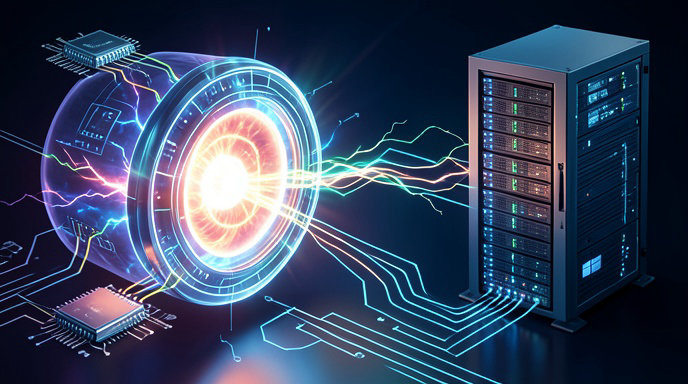
Helion has developed custom in-house semiconductors for pulsed power switching, which it says could double plant output compared to previous off-the-shelf components. Fusion machines like Helion's require firing massive banks of capacitors in microseconds to compress plasma to over 100 million degrees Celsius. Traditional silicon and even silicon-carbide switches lose huge amounts of energy as heat during those pulses.
Helion's new devices, designed and fabricated at its 165,000-square-foot facility in Everett, are purpose-built for high-voltage, high-current, ultra-fast switching. The company claims they recover energy far more efficiently between pulses, allowing its machines to fire faster - reportedly up to once per second - and capture more electricity per shot.
In practical terms, Helion says retrofitting its current Polaris prototype with the new semiconductors would double its peak power output. For Orion, that means fewer capacitors, smaller footprint, and lower cost per megawatt-hour.
Building a vertically integrated supply chain for pulsed power is unusual for a fusion startup, but Helion argues it is essential. Supply chain delays for high-power electronics have hampered previous prototypes, prompting the company to bring chip design, magnet manufacturing, and capacitor assembly under one roof.
What It Means For The 2028 Timeline
The 2028 Microsoft deadline remains one of the boldest claims in energy.
Helion still has to prove net electricity gain with Polaris, obtain permits for Orion, and scale helium-3 production - a rare fuel it plans to make itself via deuterium-deuterium fusion. Independent experts remain skeptical that a 50-MW commercial plant can be permitted and grid-connected in under three years.
But the new funding extends Helion's runway and signals continued confidence from sophisticated investors. Altman, who has invested $375 million to date, has repeatedly called Helion his biggest energy bet to power AI data centers.
Microsoft, meanwhile, has reaffirmed its commitment, saying firm, carbon-free power like fusion will be critical to meeting its 2030 carbon-negative goal and surging AI electricity demand.
If Helion hits even a delayed version of its target - first power in 2029 or 2030 - it would still beat most roadmaps that place commercial fusion in the mid-2030s. The combination of fresh capital, proprietary semiconductors, and a committed corporate buyer makes Orion the industry's most watched test case for whether fusion can move from physics experiment to power plant.

Get All The Latest Updates Delivered Straight To Your Inbox For Free!