
Musk Pledges SpaceX Share to Every American Kid After Anthropic Public Benefit Fund Announcement
TL;DR
- Elon Musk says he will give one SpaceX share to every child in America, a pledge made just hours after Anthropic announced it will commit 5% of its shares to a new public benefit fund ahead of a potential IPO.
- Both moves blend philanthropy with long-term corporate strategy, promising major potential upside for kids, nonprofits, and early stakeholders if SpaceX and Anthropic go public at soaring valuations.
- Experts urge caution, noting that neither pledge has detailed mechanics, timelines, or legal guarantees yet, leaving open questions about delivery, taxes, custody, and investor impact.
Anthropic's 5% Play First
Anthropic kicked off the one-two punch of tech philanthropy headlines with a striking commitment ahead of its highly anticipated public debut.
The AI lab behind Claude said it will allocate 5% of its equity to a newly created public benefit fund designed to support AI safety research, nonprofit innovation, and broad-based public interest initiatives. The fund is positioned as an extension of Anthropic's long-standing public benefit corporation structure, which legally obligates it to balance shareholder returns with societal impact.
While full details remain thin, the company framed the move as a way to ensure that if Anthropic's value explodes after an IPO, a meaningful slice of that wealth flows toward public good rather than only to founders, employees, and venture backers. Reports suggest the fund would be independently governed, with disbursements focused on safe AI deployment, education access, and grants to nonprofits working on existential risk and digital equity.
For investors, the 5% carve-out is both a feel-good story and a dilution question. Setting aside that much equity pre-IPO would reduce the pool available to public shareholders, but supporters argue it could boost Anthropic's brand, recruitment, and regulatory goodwill at a time when AI companies face intense scrutiny in Washington and abroad.
Musk Responds With a Share for Every Kid
Just hours later, Elon Musk upped the ante in characteristic fashion on X.
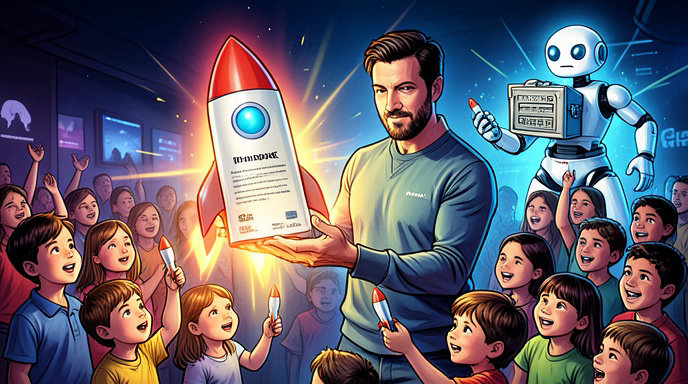
Musk pledged to give every kid in America one share of SpaceX stock, casting the idea as a way to give the next generation direct ownership in the future of space exploration. The post quickly went viral, racking up millions of views as fans calculated the potential windfall if SpaceX were to IPO at a rumored $800 billion to $1 trillion valuation.
Musk did not specify an age cutoff, how custody would work for minors, whether undocumented or all resident children would qualify, or how the shares would be distributed and held until recipients turn 18. He also did not clarify whether the gift would be common stock, a trust interest, or a synthetic equivalent, given that SpaceX is still private with strict transfer restrictions.
Even so, the symbolic power was undeniable: roughly 73 million children under 18 in the U.S. each holding a piece of the world's most valuable private space company.
What It Could Mean for Kids and Families
If fulfilled literally, the Musk pledge could function like a national baby-bond program tied to space.
At SpaceX's last reported private valuation of around $350 billion to $400 billion, a single share's value depends entirely on total share count, which SpaceX does not publicly disclose in a simple per-share retail sense. Secondary-market chatter has priced fractional interests at levels that would imply a single share could be worth tens to potentially hundreds of dollars today, and significantly more after an IPO if the bull case holds.
For low-income families, even a modest stake that compounds over 10 to 18 years could help with college, first-home, or startup costs. For all kids, proponents say it would create a powerful ownership mindset and direct excitement about STEM and space careers.
The logistical hurdles, however, are massive: verifying eligibility for tens of millions of minors, setting up custodial brokerage accounts, handling taxes on gifted stock, navigating securities laws, and funding transfer and administrative costs that could run into the billions.
What It Could Mean for Nonprofits
Anthropic's fund, by contrast, is aimed squarely at the nonprofit ecosystem.
A 5% stake in Anthropic at IPO could be worth billions of dollars, creating one of the largest AI-focused philanthropies overnight. That capital could supercharge nonprofits working on AI alignment, misinformation defense, open-source safety tooling, classroom AI literacy, and global access to frontier models.
Nonprofit leaders have cautiously welcomed the news, noting that sustained, unrestricted funding is the sector's scarcest resource. If structured as an endowment-like vehicle that sells shares gradually post-lockup, the fund could provide steady grants for decades.
Still, governance will be everything. Who sits on the board, how independent it truly is from Anthropic management, and whether funds can be used for lobbying or political activity will determine its credibility.
What It Could Mean for Investors
Wall Street is watching both pledges through a dilution lens.
Anthropic committing 5% off the top is a clear pre-IPO dilution event, though many ESG-minded funds may view it positively as a moat for talent and trust. It also sets a precedent that could pressure OpenAI, xAI, and other AI unicorns to make similar public-interest commitments before they list.
Musk's SpaceX giveaway, if structured as a personal transfer from his own holdings, might have minimal impact on other shareholders. If issued as new shares, however, distributing 73 million shares could meaningfully dilute existing holders and complicate SpaceX's cap table ahead of an IPO widely expected in 2026 or 2027. Tax treatment, lockups, and voting rights for millions of minor shareholders would also be unprecedented.
Some analysts speculate both announcements are partly strategic timing: feel-good headlines that soften regulatory conversations around market dominance, data use, and government contracts.
Will These Pledges Actually Deliver
History counsels skepticism toward billion-dollar viral philanthropy pledges.
Both announcements so far lack binding legal filings, SEC disclosures, timelines, or third-party trustees. Musk in particular has a track record of bold X pledges that evolve, shrink, or stall during implementation. Anthropic's plan is more formal given its PBC status, but key questions remain about vesting, voting control, and when the 5% transfer legally occurs.
To deliver, observers say Anthropic will need to publish a charter, appoint independent fiduciaries, and lock the commitment into IPO prospectus documents. Musk will need to file transfer mechanisms, explain funding sources, and address how private-company transfer restrictions and accredited-investor rules will be handled for minors.
Until then, both pledges live in the space between visionary philanthropy and viral marketing.
The Bigger Picture
Taken together, the back-to-back announcements signal a new era where the world's most valuable private tech companies feel compelled to share upside before going public.
Whether motivated by genuine altruism, talent wars, regulatory strategy, or legacy-building, the moves reframe the IPO conversation from pure wealth creation for insiders to broader stakeholder ownership. If even a fraction of the promises materialize, American kids and public-interest nonprofits could become meaningful shareholders in the AI and space economy.
For now, families and founders alike will be watching for paperwork, not posts.

Get All The Latest Updates Delivered Straight To Your Inbox For Free!