
Rivian Acquires Third Dimension to Supercharge Self-Driving With AI World Models
TL;DR
- Rivian has acquired AI startup Third Dimension to bolster its autonomy program with advanced world model technology that digitally mirrors the physical world.
- The deal gives Rivian a powerful simulation engine to train and validate its next-generation self-driving stack using real-world data from its growing R1 and R2 fleet.
- The move signals Rivian's shift toward an end-to-end, data-driven approach to autonomy as it races Tesla, Waymo, and Chinese rivals toward affordable hands-free driving.
The Startup That Rebuilds Reality in AI
Rivian has quietly acquired Third Dimension, a little-known startup building AI world models for robotics and autonomous driving. While Rivian has not disclosed financial terms, the acquisition brings Third Dimension's entire team of machine learning researchers and simulation engineers in-house under Rivian's autonomy division.
Founded by former researchers in computer vision and generative AI, Third Dimension has focused on a deceptively simple but technically daunting problem: teaching AI to understand and recreate the physical world in photorealistic, physically accurate detail. Its platform can take in sensor logs, video, and 3D scans and reconstruct dynamic, interactive environments where lighting, physics, vehicle behavior, and pedestrian movement behave like the real world.
For Rivian, that capability is a missing puzzle piece.
Why World Models Are The New Horsepower In Autonomy
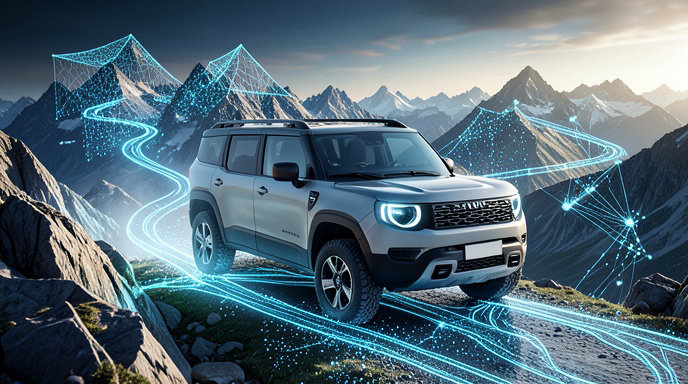
In the autonomous vehicle industry, the buzzword has shifted from miles driven to worlds simulated. A world model is essentially a neural simulator — an AI system that has learned how the world looks, moves, and reacts, and can then dream up new driving scenarios on demand.
Instead of waiting for a Rivian R1T to encounter a child chasing a ball into the street during a snowstorm at dusk, engineers can generate thousands of variations of that exact scenario overnight. They can change the weather, the traffic density, the road markings, or the behavior of other drivers, and test how Rivian's autonomy stack responds without putting anyone at risk.
This is critical because the hardest part of self-driving is not highway cruising, it's the long tail of rare edge cases. Industry leaders like Tesla, Waymo, and NVIDIA have all invested heavily in photorealistic simulation and generative world models for this reason. Rivian, until now, has been playing catch-up.
Turning Fleet Data Into A Training Goldmine
Where this acquisition gets truly powerful is in combination with Rivian's own data engine.
Every Rivian vehicle on the road — from the R1S and R1T to its Electric Delivery Vans for Amazon and the upcoming mass-market R2 — is equipped with cameras, radar, and Rivian's custom compute platform. That fleet is generating millions of miles of real-world driving data every month.
Third Dimension's technology can convert that raw fleet data into closed-loop training environments. In practice, that means Rivian can take a tricky disengagement where a driver had to take over, reconstruct it in 3D, and then let its virtual self-driving software retry the scenario thousands of times until it gets it right.
Sources familiar with the deal say Rivian plans to use the world models not just for validation, but for training its next-gen end-to-end neural network planner from scratch — using simulated miles to supplement real miles by a factor of 100 to 1.
A Bigger Bet On In-House Autonomy
The acquisition underscores a major strategic pivot for Rivian. Under CEO RJ Scaringe, the company has steadily moved autonomy development in-house after years of relying on suppliers. It launched the Rivian Autonomy Platform with enhanced highway assist features, built its own large driving model team, and expanded its AI labs in Palo Alto and London.
Bringing Third Dimension on board accelerates that timeline dramatically. Rather than licensing simulation tools from third parties like Applied Intuition or Wayve, Rivian now owns a core simulator purpose-built for its sensor suite and compute stack.
It also helps Rivian's economics. Training robust autonomy purely in the real world is brutally expensive and slow. High-fidelity simulation slashes development costs and allows rapid iteration — a necessity as Rivian prepares to launch hands-free, eyes-off features for R2, its $45,000 vehicle that needs to compete directly with Tesla's Full Self-Driving.
What Comes Next
Rivian is expected to integrate Third Dimension's team into its autonomy organization immediately, with a focus on building what insiders are calling a Rivian Neural Simulator. Early applications will likely include improved automatic emergency braking, smarter lane-change behavior, and expanded hands-free driving on highways by late 2026 and into 2027.
Longer term, the ambition is bigger: a fully learned world model that the car itself runs in real time to predict what other road users will do seconds into the future. That predictive capability is widely seen as essential for true Level 3 and Level 4 autonomy.
If Rivian can pull it off, Third Dimension could prove to be the small acquisition with outsized impact — turning Rivian from an EV underdog into a serious contender in the AI-driven race for self-driving.

Get All The Latest Updates Delivered Straight To Your Inbox For Free!