
Vessev Electric Hydrofoil Ferry That Almost Flies Could Redefine City Water Travel
TL;DR
- Vessev's VS-9 electric hydrofoil ferry lifts its hull completely out of the water on carbon-fiber foils, cruising at around 25 knots with far less energy, wake, and noise than diesel ferries.
- After extensive testing in Auckland, the 10-seat vessel has entered commercial trial service with operator Fullers360, serving as a testbed for zero-emission commuter routes.
- The company is now scaling up to a larger 100-passenger VS-18 model, positioning foiling electric ferries as a serious option for congested coastal cities worldwide.
How It Almost Flies
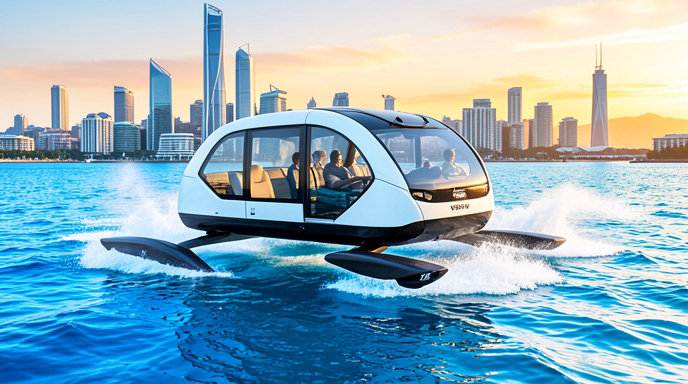
The trick behind Vessev's ferry is not more power, it's less drag. Like an airplane wing underwater, the VS-9 uses two hydrofoils - one forward, one aft - that generate lift as speed builds. At around 12 to 15 knots, the 9-meter carbon-fiber hull rises completely clear of the harbor chop and the boat effectively flies on its foils.
Once foiling, only the slender foil legs and propellers stay in the water. That cuts hydrodynamic drag by up to 80-90% compared to a conventional planing hull. The result is a cruise speed of 25 knots with the quiet hum of electric motors instead of roaring diesels, and almost no wake trailing behind.
Vessev's system is fully active, not passive. Onboard sensors and flight computers measure pitch, roll, height and wave conditions and adjust the foils up to 100 times per second. Passengers feel level, smooth flight even when the harbor is choppy - more like riding a small aircraft than a ferry.
Inside the VS-9: Built Like a Plane, Certified Like a Boat
Vessev, based in Auckland, New Zealand, was founded by former America's Cup engineer Eric Laakmann. The team borrowed heavily from sailing foils, aerospace composites, and electric drivetrains.
The VS-9 is 9.3 meters long, built almost entirely from carbon fiber to keep weight down. It carries 10 passengers plus crew in a panoramic cabin designed for premium commuter service. Twin electric motors drive optimized propellers on the aft foil, powered by a 100+ kWh battery pack.
Range is about 50 nautical miles at foiling cruise speed, with fast DC charging between runs. The foils themselves retract for docking in shallow water and for easy maintenance. Importantly for commercial use, the vessel has been going through Maritime New Zealand commercial certification during its trials in Auckland's Hauraki Gulf.
A Quieter, Smoother Commute
For commuters, the difference is immediate. Traditional fast ferries slam, vibrate, and roar. The VS-9 glides. Noise levels in the cabin are closer to a luxury EV than a boat, around 60-65 decibels at cruise, allowing normal conversation.
The active stabilization eliminates most seasickness-inducing roll and pitch. Boarding is faster thanks to the stable platform, and because there is minimal wake, the ferry can maintain high speed in wake-sensitive zones near marinas and waterfronts where conventional fast ferries must slow down. That can cut 10- to 20-minute harbor crossings nearly in half.
Operators also benefit. Electricity costs a fraction of marine diesel, and with far fewer moving parts - no gearboxes, no oil, no exhaust aftertreatment - maintenance is dramatically lower.
Zero-Emission Math That Actually Works
Ferries are among the hardest vessels to electrify because pushing a heavy hull through water at speed takes enormous energy. Hydrofoiling solves that physics problem.
By flying above the water, Vessev says the VS-9 uses up to 90% less energy per passenger-kilometer than a comparable diesel ferry at the same speed. That makes battery-electric range practical without a massive, heavy battery bank.
The environmental payoff is threefold: zero tailpipe CO2 and air pollutants, drastically lower underwater noise that disturbs marine mammals, and minimal wake energy that erodes shorelines and damages other boats. When charged on New Zealand's highly renewable grid, well-to-wake emissions are near zero.
In Auckland trials with Fullers360, New Zealand's largest ferry operator, data showed consistent foiling efficiency and reliability across thousands of nautical miles in real commercial conditions, including wind, chop, and full passenger loads.
Why Cities Are Paying Attention
Vessev's timing is critical. Coastal cities from Auckland to Seattle, Stockholm to Singapore are looking to shift commuters from congested roads to underused waterways, but diesel ferries face emissions bans and community opposition over noise and wake.
A small, fast, wake-less electric ferry changes the equation. Instead of a few large, infrequent diesel sailings, cities could run high-frequency, on-demand foiling shuttles that dock at small pontoons without massive terminals. Lower operating costs make off-peak service economically viable.
Vessev is already leveraging that interest. Following the VS-9 commercial pilot, the company has unveiled plans for the VS-18, an 18-meter, approximately 100-passenger foiling ferry designed for mainstream public transit routes, and has attracted international maritime investors and tourism operators.
Challenges remain - battery costs, charging infrastructure at wharves, and regulatory frameworks built for conventional hulls. But if Vessev can scale production and prove daily commercial reliability through 2026, the idea of flying to work across the water may soon feel completely normal.

Get All The Latest Updates Delivered Straight To Your Inbox For Free!