
Warhound Raises $200M to Create Genetically Engineered War Dogs With Anduril Tech
TL;DR
- Ben Lamm of Colossal Biosciences and Palmer Luckey of Anduril have co-founded stealth startup Warhound, reportedly raising $200M to genetically engineer enhanced working dogs for military, border, and police use.
- The program centers on gene-edited Belgian Malinois and German Shepherds engineered for strength, endurance, disease resistance and trainability, paired with Anduril's Lattice AI, augmented-reality handler headsets, and Ghost robotics ecosystem.
- The announcement has ignited a fierce ethical debate over bioengineered warfare, animal welfare, and germline editing, with bioethicists and animal-rights groups calling for federal oversight as Pentagon K-9 modernization accelerates.
A New Breed of Defense Startup Emerges From Stealth
Silicon Valley and Texas are no strangers to ambitious defense bets, but few are as provocative as Warhound.
According to multiple reports circulating this week, the stealth startup co-founded by Colossal Biosciences CEO Ben Lamm and Anduril Industries founder Palmer Luckey has raised $200 million in private funding to create genetically engineered dogs purpose-built for war, border security, and law enforcement.
The company, operating in stealth until now from facilities in El Segundo, California and Dallas, Texas, is said to be valued at well over $1 billion following the raise. Backers reportedly include 8VC, Founders Fund-affiliated investors, Anduril-linked capital, and Colossal co-founder Evan Haas's family office, though neither Lamm nor Luckey has publicly confirmed the full investor list.
If the funding figure holds, Warhound instantly becomes one of the best-capitalized biotech-defense hybrids in the United States — fusing synthetic biology with autonomous weapons systems at a moment when the Pentagon is pouring billions into human-machine teaming.
From De-Extinction to Super-Dogs
For Lamm, Warhound is a logical — if controversial — extension of his work at Colossal Biosciences, the $10B+ startup famous for attempting to resurrect the woolly mammoth, dodo, and dire wolf.
Colossal has pioneered multiplex gene editing, artificial wombs, and CRISPR-based trait selection in canids. The dire wolf project in particular demonstrated viable live births of heavily edited gray wolves in 2025, proving that large-scale edits for muscle mass, coat, size, and behavior could be carried into term.
Warhound is applying that same toolkit to domestic working breeds — primarily the Belgian Malinois, German Shepherd, and Dutch Shepherd, the three breeds that dominate U.S. military and police K-9 units.
Sources familiar with the program describe three core biological thrusts:
Enhanced Physiology: Edits targeting myostatin regulation for increased muscle density without sacrificing agility, EPAS1 and related pathways for high-altitude and heat endurance, and improved hip and elbow joint formation to combat dysplasia that retires nearly 30% of military dogs early.
Cognitive and Behavioral Tuning: Selection and fine-tuning of genes linked to focus, impulse control, trainability, scent-receptor density, and stress resilience. The goal is not an aggressive dog, insiders stress, but a calmer, hyper-focused animal that can work longer under gunfire, drone noise, and chaotic urban environments.
Medical Resilience: Built-in resistance to tick-borne disease, heatstroke, noise-induced hearing loss, and gastrointestinal issues common in deployment, plus accelerated wound healing. All dogs would be sterilized to prevent germline spread, according to company briefings.
Lamm has previously argued that gene editing for health and function is morally distinct from cloning novelties. Expect that argument to be central to Warhound's public defense.
Integrated With Anduril Weapon Systems
What separates Warhound from a traditional K-9 breeding program is Luckey's side of the equation: full integration into Anduril's Lattice battlespace operating system.
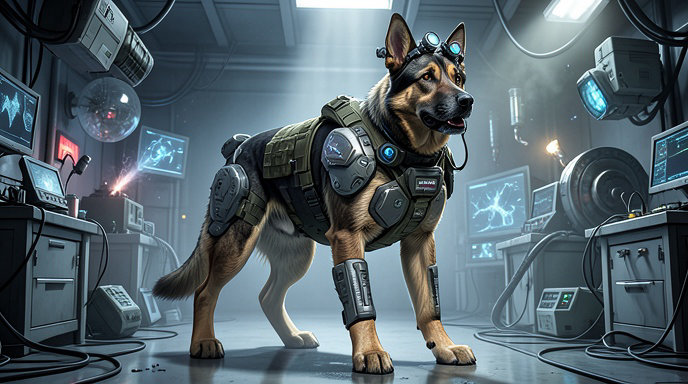
Each Warhound dog is envisioned as a living sensor node, outfitted with a next-generation tactical vest that includes:
- 360-degree cameras, thermal imaging, and chemical sniffers streaming directly into Lattice
- Bone-conduction two-way audio and haptic vibration cues, allowing silent, off-leash commands at distances over 1km
- GPS-denied navigation modules and mesh-network relays to extend connectivity for dismounted squads
- Health telemetry monitoring heart rate, core temperature, hydration, and fatigue in real time
Handlers, in turn, would use Anduril's EagleEye XR headsets — military-grade AR glasses derived from Luckey's work on the Army's IVAS program — to see what the dog sees, paint targets, and issue non-verbal commands via gaze and gesture.
Longer-term roadmaps reportedly include teaming dogs with Anduril's Ghost X4 quadruped robots and ALTIUS drones, creating mixed biological-robotic packs for tunnel clearing, base perimeter patrol, CBRNE detection, and subterranean search. One concept slide described as a "Wolfpack" envisions one human handler controlling two engineered dogs and three autonomous air and ground systems simultaneously.
Former special operations officials who have been briefed say the appeal is obvious: dogs remain unmatched at scent detection, confined-space entry, and non-lethal detainment, but they tire, overheat, and cannot easily communicate what they find. Solving those bottlenecks with biology plus AI could reshape infantry tactics.
A $200M Bet on the Pentagon's K-9 Shortage
Warhound's timing is strategic.
The U.S. Department of Defense maintains roughly 1,600 military working dogs, with thousands more in Customs and Border Protection, the TSA, and local police. Yet procurement is in crisis: over 80% of suitable dogs are imported from Europe, prices for a fully trained Malinois now exceed $80,000 to $150,000, and washout rates top 50%.
The Pentagon's 2026 K-9 modernization memos have explicitly called for domestic breeding resilience, longer service life, and tech-augmented canines. Warhound is positioning itself as the prime contractor for that future, offering a U.S.-bred, gene-verified, hardware-integrated alternative to the fragmented European market.
Analysts note the $200M raise mirrors Anduril's early playbook: raise big, build vertically integrated hardware and software, then lock in multi-year Programs of Record. If Warhound secures even a single IDIQ contract for next-gen multipurpose canines, the unit economics — $250,000 to $400,000 per deployed system including vest, software license, and lifetime veterinary support — could be transformative.
Law enforcement interest is also driving momentum. Several large metropolitan police departments and border agencies have faced K-9 shortages since 2023, and early Warhound pilots for fentanyl detection, cadaver recovery, and crowd-control alternatives are rumored for 2027.
The Ethical Firestorm Over Bioengineered Warfare
The backlash was immediate — and intense.
Bioethicists at Stanford, NYU, and The Hastings Center warned that engineering sentient animals specifically for combat crosses a new line, even beyond armed drones and robot dogs. Key concerns include consent, unpredictable off-target edits, shortened lifespans, chronic pain from musculoskeletal enhancement, and the normalization of germline engineering for military purposes.
Animal welfare organizations including PETA and the ASPCA condemned the project as militarized eugenics, arguing that dogs cannot consent to genetic alteration or battlefield risk, and calling on Congress to ban inheritable edits for working animals.
Others raise strategic fears: What happens if enhanced traits escape into pet populations? Could adversaries like China or Russia pursue parallel super-soldier canines with fewer safeguards? And who is liable when an AI-directed, gene-edited animal injures a civilian?
Lamm and Luckey allies counter that Warhound will reduce suffering: healthier joints, disease resistance, and better heat tolerance mean fewer early retirements and euthanasias, while silent haptic control means fewer bite incidents and clearer de-escalation. They also point to sterilization, veterinary ethics boards, USDA and FDA-CVM oversight, and a pledge not to engineer aggression or pain insensitivity.
The debate echoes earlier fights over Colossal's dire wolves and Anduril's autonomous weapons — but combined, they raise a novel question for 2026: Should synthetic biology be governed like arms manufacturing?
What Comes Next
Warhound remains officially in stealth, with no public website, no peer-reviewed papers, and no Pentagon contract confirmation as of publication.
People close to the founders say a public unveiling is planned for early 2027, alongside live demonstrations of Lattice-integrated dogs performing off-leash building clears and long-range explosive detection. Regulatory filings for veterinary clinical trials in Texas are expected in coming months, which could reveal far more about the specific edits under study.
Whether Warhound becomes the Anduril of biology or a cautionary tale of overreach will depend on three tests: can it prove safety and efficacy without cutting ethical corners, can it win over skeptical generals and handlers who trust bloodlines over labs, and can it survive the political storm that always follows when Silicon Valley rewrites life itself for war.
One thing is clear: the age of the bioengineered battlefield has already begun — and it barks.

Get All The Latest Updates Delivered Straight To Your Inbox For Free!