
DuckDuckGo Targets Schools as Google AI Restrictions Spark Backlash
TL;DR
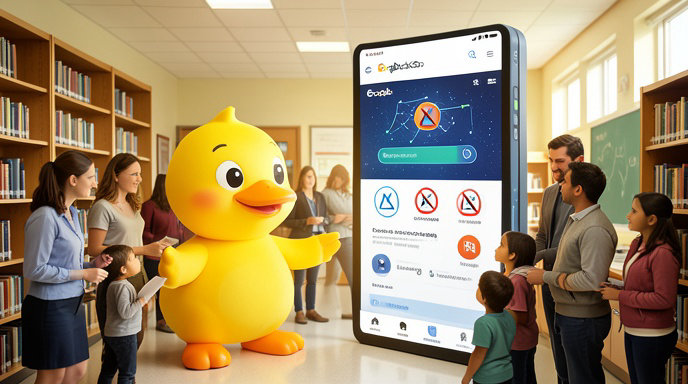
- DuckDuckGo is positioning its privacy-focused search tools as an alternative for schools concerned about Google’s expanding AI features and data practices.
- Its products include AI-assisted search options, Duck.ai, and controls intended to limit or avoid AI-generated answers.
- The education opportunity is real, but adoption will depend on independent testing, administrative controls, content quality, and whether schools actually view Google’s AI policies as restrictive.
The Privacy-First Search Engine Wants a Place in Classrooms
DuckDuckGo is making a familiar argument to schools and educators: search should not require students to surrender extensive personal data, and AI features should be optional rather than unavoidable.
The company’s pitch arrives as Google continues to build generative AI into Search, Workspace and Chrome. Google’s tools can summarize information, generate text and assist with research, but their expansion has also raised concerns among teachers, parents and administrators about privacy, accuracy, distraction and the role of AI in student work.
DuckDuckGo is not attempting to replace every Google service used by schools. Instead, it is targeting a narrower pain point: web search. Its browser and search engine offer privacy protections designed to limit tracking, while its AI products are presented as features users can choose to use—or avoid.
That distinction could appeal to schools seeking more control over how students interact with search and artificial intelligence.
Google’s AI Push Creates New Friction
Google has spent the past several years adding AI-generated answers and conversational tools to its search experience. Depending on a user’s location, account, device and settings, Google may place AI-generated summaries above traditional links or direct users toward products such as AI Overviews and Gemini.
For educators, the benefits are obvious. AI can help students brainstorm, simplify difficult concepts, translate material and find starting points for research. Teachers can also use it to prepare lesson plans, create exercises and adapt content for different reading levels.
The drawbacks are equally familiar. AI-generated answers can contain factual errors, omit important context or make it harder for students to distinguish primary sources from machine-produced summaries. Teachers also worry that generative tools can encourage plagiarism or allow students to bypass the learning process.
Google provides administrative controls and account-management tools through its education products, but schools do not always have the same level of control over the public web search experience. That gap has helped create demand for search products with simpler, more visible policies.
DuckDuckGo’s Alternative: Choice and Data Minimization
DuckDuckGo’s core selling point is that it does not build a personal search profile around users in the same way many large advertising platforms do. The company says it does not save or sell users’ search histories for targeted advertising, and its browser includes additional protections against online tracking.
Those policies can be attractive in schools, where administrators must consider student privacy, parental expectations and legal obligations. Limiting the amount of identifiable search data collected from minors can also reduce the risks associated with data breaches, profiling and secondary use.
DuckDuckGo does not promise a completely anonymous internet. Websites users visit can still collect information, and the company’s protections do not eliminate every form of online tracking. Search results can also include advertising and third-party content.
Still, the model gives educators a straightforward message: students can search the web without making a large technology company’s personalization system the center of the experience.
How Users Can Limit AI Features
DuckDuckGo has added AI capabilities of its own, including Duck.ai, an interface that lets users interact with selected third-party language models while DuckDuckGo says conversations are anonymized and not used to train the models.
The company has also introduced AI-assisted features within search, including tools that can provide additional context or direct answers. Importantly for schools, DuckDuckGo presents these features as optional rather than making AI the unavoidable default for every query.
Users can adjust DuckDuckGo’s settings to reduce or disable AI-assisted results where those controls are available. The exact options can vary by product, platform and account configuration, so administrators would need to test the experience on managed devices before deploying it widely.
That flexibility is central to DuckDuckGo’s education argument. A school might permit conventional web search while blocking Duck.ai, or allow AI tools only in supervised classes focused on research and digital literacy. Conversely, an institution could choose to enable AI assistance for teachers while restricting it for students.
The controls are useful, but they are not a complete school-management system. Schools would still need device policies, network filters, identity controls, age-appropriate safeguards and a way to monitor compliance.
The Education Market Is Already Crowded
DuckDuckGo faces a difficult competitive landscape. Google Search remains deeply embedded in schools, while Google Workspace for Education provides email, documents, classroom-management tools and administrative controls in one ecosystem.
Microsoft has also integrated AI into Bing, Copilot and its education products. Meanwhile, specialist companies are building search and tutoring tools designed specifically for students, teachers and academic research.
That means privacy alone may not be enough to win institutional contracts. Schools typically evaluate accessibility, filtering, speed, reliability, technical support, compatibility with existing systems and the quality of results. They may also require contractual commitments governing data retention, security and incident response.
DuckDuckGo’s simpler deployment could help it in some settings, especially where administrators want to change the default search engine without replacing an entire productivity platform. But search quality and operational support will matter more than a marketing message.
AI Controls Could Become a Procurement Requirement
The debate surrounding Google’s AI features points to a broader change in how schools assess technology. Administrators are increasingly asking not only whether a product includes AI, but also whether they can control when and how it appears.
Potential procurement questions include:
- Can AI-generated answers be disabled centrally?
- Are student queries stored, linked to identities or used for model training?
- Can administrators separate teacher and student permissions?
- Does the product clearly label generated content?
- Can users easily reach original sources?
- Are there protections against inappropriate or misleading results?
- Does the service meet applicable student-privacy requirements?
- Can the school audit settings and changes over time?
DuckDuckGo’s appeal is strongest on the first two questions. Its privacy positioning and optional AI features give schools a comparatively clear starting point. But institutions will still need evidence about performance, safeguards and long-term policy commitments.
The Risk of Treating “No AI” as a Complete Solution
Avoiding AI-generated search results can reduce some risks, but it does not solve every problem associated with online research. Traditional search results can also lead students to inaccurate, biased or harmful material. Search rankings are shaped by algorithms, commercial incentives and the quality of available sources.
Educators may therefore prefer teaching students how to evaluate information rather than simply blocking AI. That includes checking authorship, comparing independent sources, identifying sponsored material and distinguishing evidence from opinion.
A privacy-focused search engine can support that curriculum, particularly if it makes original links prominent and minimizes personalization. But it should be part of a broader digital-literacy program, not a substitute for one.
DuckDuckGo’s Bigger Opportunity
For DuckDuckGo, schools represent more than another user segment. An institutional foothold could introduce privacy-first search to students before they develop long-term habits around Google or Microsoft products.
The company also benefits from a moment of uncertainty. Many educators are not opposed to AI in principle; they are opposed to tools that appear without clear notice, lack reliable controls or make it difficult to understand how student data is handled.
DuckDuckGo can distinguish itself by emphasizing user choice: conventional search when students need links, optional AI when users deliberately request assistance, and privacy protections throughout the process.
Whether that message becomes a meaningful education business will depend on execution. Schools need documented controls, strong support and measurable results—not just assurances about privacy.
A Test of Trust, Not Just Search
Google’s expanding AI strategy has intensified a long-running debate over who controls the digital tools used in classrooms. DuckDuckGo is attempting to turn that debate into an opening for its own search engine and AI services.
Its proposition is relatively simple: give schools a search experience that collects less personal information and lets administrators decide whether AI appears at all.
That may resonate with educators frustrated by Google’s rapidly changing product policies. But schools will ultimately judge the alternative on practical terms: accuracy, accessibility, safety, manageability and cost.
If DuckDuckGo can demonstrate that its privacy claims and AI controls work reliably in real education environments, Google’s AI backlash could become a genuine growth opportunity. If not, its school strategy may remain a persuasive privacy pitch without becoming a serious challenger in the classroom.

Get All The Latest Updates Delivered Straight To Your Inbox For Free!