
Waymo and Uber Partnership Shake-Up Coming in January 2028
TL;DR
- Waymo’s current Uber arrangement is expected to change in January 2028, potentially allowing Waymo to compete directly with Uber in markets where the companies now cooperate.
- The shift could test whether Uber’s broad network of autonomous-vehicle partners can offset the loss of preferential access to Waymo’s technology and fleet.
- The outcome may help determine whether robotaxis become a platform business dominated by aggregators such as Uber, or a more vertically integrated industry led by autonomous-driving operators.
A partnership that helped bring Waymo’s autonomous vehicles to Uber’s ride-hailing platform is heading toward a potentially disruptive turning point.
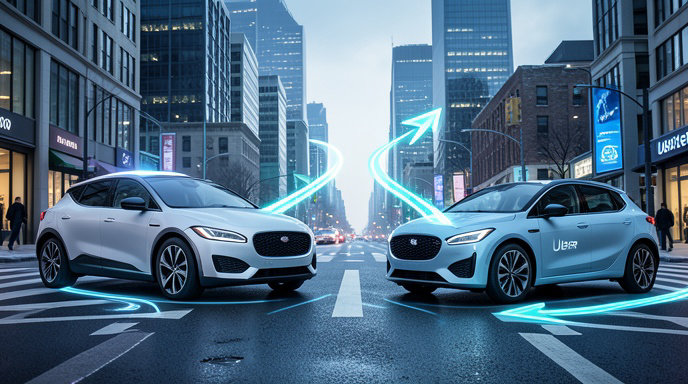
The companies’ existing arrangement is expected to change in January 2028, opening the possibility that Waymo will operate more directly in markets where Uber has helped distribute its robotaxi service. Instead of functioning primarily as a technology and fleet partner accessible through Uber, Waymo could increasingly become a competitor for the same passengers, trips and urban transportation contracts.
The change is still more than a year away, and the exact commercial structure has not been fully defined publicly. But its implications are already significant. It could reshape the balance between autonomous-driving companies and ride-hailing platforms, while forcing Uber to demonstrate that its partner strategy can deliver a competitive robotaxi network without depending too heavily on Waymo.
A partnership built around distribution
Uber and Waymo began working together to make autonomous rides available through Uber’s platform, initially focusing on Phoenix. Under the arrangement, riders could request eligible trips through Uber, while Waymo supplied the autonomous vehicles, operational technology and remote-support infrastructure needed to run the service.
The model offered advantages to both sides.
Waymo gained access to Uber’s large customer base, established payment system, mapping and dispatch infrastructure, and experience managing high-volume ride requests. Uber, meanwhile, could add autonomous vehicles without developing its own complete self-driving system or owning every part of the robotaxi operation.
For passengers, the relationship provided a relatively simple way to encounter autonomous rides inside an app they already used. It also allowed Waymo to expand its real-world operating experience while avoiding the need to build a separate mass-market ride-hailing platform from scratch.
That alignment becomes more complicated when the agreement’s restrictions or market protections change. If Waymo can offer competing service directly, Uber may no longer be the primary channel through which customers access Waymo vehicles in affected markets.
January 2028 marks a strategic inflection point
The January 2028 date should not necessarily be interpreted as an automatic breakup. The companies could extend, revise or replace portions of their arrangement. However, it represents a contractual and strategic inflection point: Waymo may gain more freedom to control its customer relationships and compete independently, while Uber may need to renegotiate its role in markets where the two companies have operated together.
The practical effect will depend on several factors, including market-specific terms, fleet availability, pricing, regulatory approvals and whether Waymo chooses to prioritize its own app, third-party platforms or a combination of channels.
Waymo does not need to abandon Uber entirely to compete with it. It could maintain Uber as one distribution channel while also accepting bookings through its own service or other platforms. That would give Waymo greater control over pricing, customer data and brand identity, but it would also require the company to invest more heavily in customer acquisition, support and marketplace operations.
Uber, for its part, could continue listing Waymo rides where commercial terms make sense. But the relationship would look less like a conventional partnership if Waymo were simultaneously competing for the same customers through its own channels.
Why direct competition matters
Traditional ride-hailing companies rely on network effects. More riders attract more drivers, while more drivers reduce wait times and improve coverage, encouraging additional riders to use the platform. Robotaxis weaken that model because the vehicles are not recruited through a driver marketplace.
A company operating autonomous vehicles can own or control the fleet, set operating policies and potentially sell rides through multiple channels. That gives Waymo an opportunity to become both a transportation operator and a technology platform.
Direct competition could also expose differences in the companies’ business models.
Waymo’s advantage is specialization. It has spent years developing and operating an autonomous-driving system, building high-definition mapping capabilities and learning how to manage driverless vehicles in defined service areas. Its service can be expanded market by market, with each new location requiring extensive testing, regulatory work and operational preparation.
Uber’s advantage is breadth. It already has a large rider base, a global app, sophisticated dispatch systems and relationships with human drivers, delivery couriers and multiple autonomous-vehicle developers. The company can potentially offer customers a mix of conventional rides and robotaxi options, rather than relying on a single autonomous fleet.
The coming shift will test whether specialization or aggregation creates more value as autonomous rides become more common.
Uber’s strategy: become the marketplace for autonomy
Uber has positioned itself as a neutral distribution layer for autonomous transportation. Rather than trying to build one self-driving system, the company has pursued relationships with multiple developers and vehicle manufacturers.
That strategy is intended to give Uber access to different types of autonomous vehicles, operating models and geographic markets. Partnerships involving companies such as Aurora, Motional and other autonomous-mobility firms have supported Uber’s effort to remain central to the ride-hailing experience even as the underlying vehicles change.
The logic is similar to an app store or travel marketplace. Uber can provide demand, payments, routing, customer support and fleet utilization, while technology partners provide the vehicles and autonomy stack.
The risk is that the most successful autonomous operators may eventually decide they no longer need an intermediary. If Waymo can attract riders directly, it may capture more of the economics from each trip and build a stronger relationship with customers. Other autonomous companies could make the same calculation as their services mature.
Uber therefore has an incentive to make its platform indispensable. It will need to offer partners enough demand and operational value to outweigh the cost of sharing revenue and customer information. It may also need to provide fleet management, charging coordination, insurance support and regulatory expertise that autonomous developers would struggle to duplicate on their own.
A diversified partner network is useful, but it is not automatically a substitute for Waymo
Uber’s relationships with other self-driving companies could become more important as the Waymo arrangement evolves. A larger partner network could allow Uber to maintain robotaxi coverage, increase vehicle availability and avoid relying on one provider.
Yet not all autonomous fleets are interchangeable.
Each company may have different vehicle designs, safety validation processes, geographic capabilities, deployment schedules and regulatory approvals. A partner that is ready to operate in one city may not be prepared for another. Some companies may focus on freight, trucking, delivery or specific commercial routes rather than general passenger rides.
Waymo also has a considerable operational head start in several markets. Running a driverless service is not simply a matter of installing software in a vehicle. Operators must build detailed maps, establish remote-assistance procedures, maintain vehicles, handle unusual road situations and demonstrate safety to regulators and the public.
Uber can aggregate partners, but it cannot instantly turn every autonomous developer into an equally mature ride provider. The company’s challenge will be ensuring that a diverse group of partners delivers a consistent experience in wait times, pricing, safety communication and customer support.
The economics of robotaxi competition
The 2028 transition could arrive as the robotaxi industry is still searching for a sustainable business model.
Autonomous vehicles eliminate the human driver’s share of a ride, potentially reducing one of the largest operating costs in ride-hailing. But they introduce other expenses: expensive sensor packages, specialized vehicle maintenance, remote operations, fleet depots, charging infrastructure, insurance and continuous software development.
High utilization will be critical. A robotaxi sitting idle is an expensive asset, so operators need dense demand and efficient dispatching. Uber can help by directing a large volume of requests to autonomous fleets. Waymo may benefit from operating directly if it can improve utilization and retain a larger portion of fare revenue.
The competitive question is whether higher margins from direct bookings will outweigh the customer-acquisition and marketplace costs that Uber currently absorbs. Waymo will also need to determine how much pricing control it wants and whether lower fares are necessary to build demand.
For riders, competition could bring more availability and lower prices, but not necessarily immediately. In the early stages, autonomous fleets remain limited, and companies may prioritize profitable service zones rather than broad coverage.
Regulation and public trust remain decisive
The commercial relationship between Waymo and Uber is only one part of the equation. Robotaxi expansion will continue to depend on regulators, local governments and public acceptance.
Autonomous operators must obtain permission to test and deploy vehicles, comply with reporting requirements and respond to safety concerns. A serious incident, software recall or operational failure could delay expansion across an entire market.
Changes to the Waymo-Uber relationship could also complicate accountability. Riders may interact with Uber’s app but enter a Waymo vehicle, creating questions about customer support, incident handling, refunds and responsibility when something goes wrong. Clear communication will be essential if multiple companies share responsibility for one trip.
The companies may also face pressure to explain how they use trip data, how they protect passenger privacy and how they handle interactions with emergency responders, police and local transportation agencies.
What the industry should watch before 2028
Several developments will help clarify the eventual impact of the partnership change.
First, Waymo’s geographic expansion will show whether it intends to become a broad consumer transportation brand or remain focused on carefully selected operating zones. A larger direct footprint would make competition with Uber more immediate.
Second, Uber’s autonomous partner network will reveal whether it can deliver meaningful scale. Announced partnerships matter less than the number of vehicles actually carrying passengers, the markets they serve and their reliability during peak demand.
Third, both companies will need to demonstrate improving economics. The industry has moved beyond the stage where technical demonstrations alone are enough. Investors and city officials will increasingly ask whether robotaxis can operate profitably, reduce congestion and complement public transit.
Fourth, pricing will become a major signal. If autonomous rides are consistently cheaper than comparable trips with human drivers, adoption could accelerate. If they remain premium services because fleets are scarce or operating costs are high, the market may grow more slowly.
A possible turning point for platform power
The Waymo-Uber relationship illustrates a central tension in autonomous transportation: Who owns the customer?
Ride-hailing platforms want to remain the primary interface for passengers, regardless of who supplies the vehicle. Autonomous operators want to capture more of the revenue and build direct relationships with riders. Vehicle manufacturers may ultimately want a role as well, particularly if they provide purpose-built robotaxi fleets.
The January 2028 change could make that tension more visible. If Waymo successfully builds direct demand while continuing to use Uber selectively, other autonomous companies may seek similar flexibility. If Uber’s marketplace proves essential to filling autonomous fleets, Waymo and its rivals may continue to rely on the platform despite having the technical ability to operate independently.
The likely result is not a clean division between “Waymo versus Uber.” It may be a hybrid market in which customers can book the same autonomous fleet through several apps, while operators and platforms compete over access, pricing and data.
The road to 2028
For now, Waymo and Uber remain aligned in their effort to make autonomous rides available to more passengers. But the structure of that cooperation is likely to become less predictable as Waymo expands and Uber develops a broader set of autonomous partnerships.
By January 2028, the companies may have negotiated a new arrangement, expanded into different markets or moved toward a more openly competitive relationship. Whatever form it takes, the transition will offer an important test of the first generation of robotaxi business models.
The companies that ultimately win may not be those with the most advanced driving software alone. Success could depend on who can combine safe autonomous operation with dense fleet utilization, strong customer relationships, regulatory credibility and a scalable economic model.
Waymo has the opportunity to turn technical leadership into a direct transportation business. Uber is betting that its marketplace, customer base and network of partners can keep it at the center of the autonomous shift. The outcome will help define whether the robotaxi industry is controlled by vehicle operators, technology developers, ride-hailing platforms—or a new combination of all three.

Get All The Latest Updates Delivered Straight To Your Inbox For Free!