
Everbloom’s Renoa: The First New Fiber in 25 Years Feels Surprisingly Familiar
TL;DR
- Startup Everbloom is developing renoa, a bio-based textile fiber it describes as the first major new fiber category in roughly 25 years.
- Renoa is designed to combine the softness and familiar hand feel of conventional apparel fibers with a potentially lower-impact production profile.
- Its success will depend on independent lifecycle data, reliable scale-up, competitive pricing and whether brands and consumers embrace a new material category.
A New Fiber With a Familiar Feel
For an industry accustomed to incremental improvements, Everbloom’s renoa is being positioned as something more ambitious: an attempt to introduce an entirely new textile fiber rather than another blend, coating or recycled version of an existing material.
The startup’s central proposition is deceptively simple. Renoa is meant to feel familiar.
That quality may be as important as the chemistry behind it. New materials often ask consumers to accept a compromise—an unusual texture, a less polished appearance, limited durability or a higher price. Everbloom is pursuing a different route: develop a fiber with the softness, drape and everyday comfort people already associate with mainstream clothing, while rethinking how that fiber is made.
The company describes renoa as the first major new fiber in approximately 25 years, a claim that reflects how difficult it is to displace established materials. Cotton, polyester, nylon, rayon and other widely used fibers benefit from mature supply chains, known manufacturing processes and extensive brand familiarity. A new entrant must compete against all of that at once.
Why New Fibers Are So Difficult to Launch
Textiles are not governed by performance alone. A fiber must work across spinning, weaving, knitting, dyeing, finishing, cutting and sewing. It must also satisfy brands’ requirements for consistency, color, durability and cost.
That creates a high barrier for startups. A promising laboratory sample is only the beginning. The material has to perform in industrial equipment, remain stable from batch to batch and be available in volumes large enough for commercial collections.
The last several decades have produced many textile innovations, including recycled synthetics, regenerated cellulose fibers, bio-based polymers and high-performance technical yarns. Yet relatively few have become broadly recognized as new, standalone categories. Most are sold as improved versions of familiar materials or remain confined to niche applications.
Everbloom’s ambition is therefore not merely to make an alternative fiber. It is to create a material that can enter the existing fashion system without requiring a complete redesign of that system.
The Texture Test
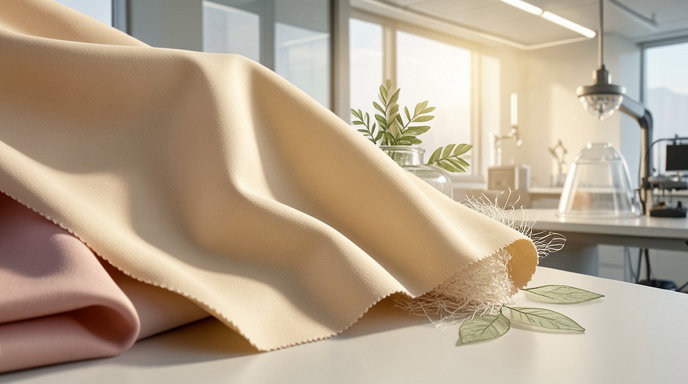
Renoa’s tactile qualities are central to its appeal. Everbloom’s positioning emphasizes a soft, familiar hand feel—an attribute that could help the material overcome one of the most immediate obstacles facing sustainable textiles.
Consumers do not experience fibers as chemical formulas. They experience them as shirts, dresses, underwear, sheets and other products that touch the skin. A material can have compelling environmental credentials and still struggle if it feels scratchy, stiff, clammy or noticeably different from what shoppers expect.
A familiar feel could make renoa easier for designers to use. If the fiber can be spun into yarns and fabrics with a recognizable softness and drape, brands may be able to incorporate it into existing silhouettes rather than designing around its limitations. That would make it more relevant to everyday apparel, where comfort and appearance typically outweigh technical novelty.
The tactile experience also gives Everbloom a possible way to distinguish renoa from materials marketed primarily through sustainability claims. Instead of asking shoppers to value the fiber because it is new, brands could present it as a desirable fabric first and a climate-conscious choice second.
Sustainability Benefits—and the Questions That Remain
Everbloom’s sustainability case will ultimately depend on how renoa is produced, what feedstocks it uses, how much energy and water its manufacturing requires and what happens to garments at the end of their useful lives.
Potential benefits could come from replacing more resource-intensive or fossil-based materials, reducing reliance on virgin inputs, or using a production process that generates fewer emissions or less waste. A fiber could also offer advantages if it is manufactured closer to its source materials, requires fewer hazardous chemicals or can be recycled more effectively.
But “bio-based” or “new” does not automatically mean low impact. Agricultural feedstocks can involve land, water and fertilizer demands. Manufacturing can be energy-intensive even when the original raw material is renewable. Transportation, dyeing, finishing and garment assembly can also account for a substantial share of a product’s footprint.
For that reason, renoa’s environmental promise will need to be supported by transparent lifecycle assessments. Useful comparisons should examine the entire system, including raw-material sourcing, fiber production, yarn formation, fabric processing, garment care and disposal. They should also identify the baseline: replacing virgin polyester, conventional cotton, nylon or another material can produce very different results.
Independent verification will matter as well. Brands and consumers are increasingly wary of broad sustainability language that cannot be tied to measurable outcomes. Clear data on greenhouse-gas emissions, water use, chemical inputs, durability and end-of-life options would help determine where renoa delivers a genuine advantage.
The Scale-Up Challenge
Commercial textile production is unforgiving. Mills are optimized for speed and repeatability, and even small changes in fiber length, strength, moisture behavior or friction can affect production.
Everbloom will need to demonstrate that renoa can run through existing or readily adaptable equipment. That includes proving that the fiber can be spun consistently, withstand mechanical stress and accept dyes and finishes without losing its defining characteristics.
Scale will be another test. Fashion companies need dependable supply, not occasional pilot quantities. A material that performs well in a limited demonstration may face entirely different challenges when production expands from kilograms to tonnes and beyond.
Price could be decisive. Established fibers benefit from decades of infrastructure and enormous production volumes. New materials often begin with higher costs, making them difficult to adopt beyond premium or experimental collections. Everbloom may therefore need a combination of manufacturing efficiencies, brand partnerships and patient capital to close the gap.
What Familiarity Could Mean for Fashion
If renoa feels close enough to existing fabrics, its most important effect may be cultural rather than technical. It could make material innovation less visible to the consumer.
That might sound counterintuitive. Breakthrough materials are often marketed through their difference: unusual textures, futuristic finishes or visibly technical performance. Renoa’s opportunity lies in the opposite direction. Its success could come from allowing a new underlying material to behave like something people already understand.
For designers, that familiarity could reduce risk. Collections would not necessarily need to be built around the fiber’s novelty. For retailers, it could simplify merchandising and product descriptions. For shoppers, it could remove the perception that choosing a more sustainable fabric means accepting a less comfortable garment.
The result could be a gradual shift in the material mix rather than a dramatic transformation. Renoa might first appear in limited collections, premium basics or products where softness is especially important. If performance and economics hold up, it could then expand into larger categories.
A New Fiber Is Only the Beginning
Even a successful fiber does not solve fashion’s broader environmental problems. Clothing production also depends on overproduction, short product lifetimes, complex global supply chains, chemical processing, energy use and waste. A lower-impact fiber cannot compensate for garments that are made in excess and quickly discarded.
Durability will be particularly important. A material that has a lower production footprint but wears out quickly may offer fewer benefits over the life of a garment. Conversely, a comfortable, long-lasting fiber could reduce replacement rates and make products more valuable to consumers.
End-of-life performance is another unresolved issue. Renoa’s sustainability profile will be stronger if products made from it can be collected, separated and recycled at meaningful scale. Blends may improve performance or reduce cost, but they can also make recycling more difficult. The details of how renoa behaves in blended fabrics will therefore influence its long-term usefulness.
The Road Ahead
Everbloom’s challenge is to turn an appealing material proposition into an industrial platform. That requires more than a convincing swatch. It requires evidence that renoa can be made consistently, processed efficiently, worn comfortably, priced competitively and assessed honestly.
The “first new fiber in 25 years” description sets a high bar. It suggests a category-level breakthrough rather than a single product improvement, which means the company will be judged on the breadth of its applications and the credibility of its environmental claims.
Still, the emphasis on familiarity may be strategically smart. Fashion does not always need consumers to embrace something that feels radically different. Sometimes the more powerful innovation is one that fits naturally into existing habits.
If Everbloom can pair renoa’s soft, recognizable feel with measurable environmental gains and dependable production, the material could offer brands something rare: a new fiber that does not demand an entirely new way of dressing.

Get All The Latest Updates Delivered Straight To Your Inbox For Free!