
Meta Warns Data Center Backlash Could Slow Future AI Expansion
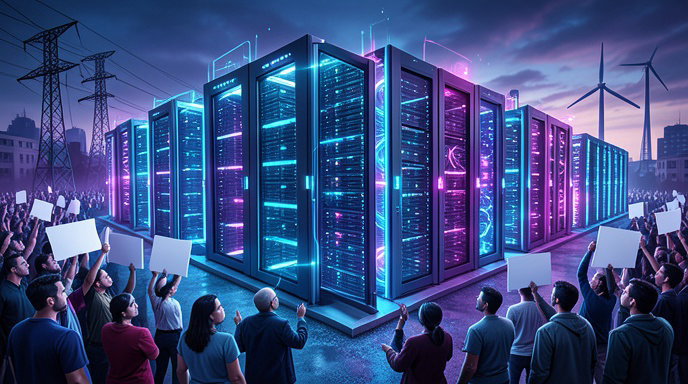
TL;DR
- Meta says growing political and community resistance to large data centers could delay or complicate future AI infrastructure investments.
- Energy demand, water use, land development and pressure on roads and utilities are turning data-center projects into major local political issues.
- The warning highlights a new constraint on the AI race: access to computing may depend as much on public acceptance and power availability as on capital and chips.
Meta Warns Data Center Backlash Could Slow Future AI Expansion
Meta is warning that opposition to large data centers could make it harder to build the infrastructure needed for its next generation of artificial-intelligence services.
In a recent regulatory disclosure, the company identified political and community resistance to data-center construction as a risk to its business and long-term investment plans. The warning comes as Meta accelerates spending on servers, networking equipment and specialized AI systems, while seeking enough computing capacity to train and operate increasingly powerful models.
The company’s concerns reflect a broader shift in the AI race. For years, the competition was defined largely by access to advanced chips, engineering talent and investment capital. Increasingly, technology companies must also secure electricity, water, land, transmission capacity and local approval—resources that can be difficult to obtain quickly and are often controlled or scrutinized by state and municipal authorities.
Growing Resistance to Mega-Projects
Data centers have become some of the largest industrial developments in many communities. Modern AI facilities can occupy hundreds of acres and require major substations, high-voltage connections, backup generators, cooling systems and new roads or utility lines.
That scale has fueled resistance from residents, environmental groups and local officials. Critics argue that the economic benefits promised by operators do not always match the burden placed on communities. Data centers can generate substantial tax revenue and construction employment, but they typically create fewer permanent jobs than traditional manufacturing facilities of comparable size.
Opposition has appeared in several forms, including challenges to zoning changes, demands for environmental reviews, objections to tax incentives and calls for limits on water consumption or backup-generator emissions. In some areas, residents have also questioned whether local power supplies should be committed to technology companies while households and smaller businesses face rising electricity costs.
Meta’s warning does not suggest that the company is abandoning its data-center expansion. Rather, it acknowledges that projects may face longer approval timelines, higher costs and greater uncertainty as opposition becomes more organized.
The Infrastructure Behind AI
AI systems require far more computing power than conventional online services. Training large models involves thousands or even millions of high-performance processors operating for extended periods. Serving those models to users also requires a large, continuously available network of servers.
Meta has been investing heavily in this infrastructure as it develops its Llama family of models and incorporates generative AI into Facebook, Instagram, WhatsApp and its advertising systems. The company has announced and pursued large data-center projects in the United States, including major developments intended to support AI workloads.
These facilities are not simply warehouses filled with computers. They require a dependable electricity supply, often at a scale comparable to that of a small city or industrial complex. They also need cooling equipment to prevent servers from overheating, along with redundant power systems that can keep operations running during grid disruptions.
As AI workloads expand, older facilities may need to be upgraded or supplemented with new campuses. That increases pressure on regional power grids and utility providers, particularly in areas where transmission infrastructure was not designed for rapidly growing industrial demand.
Energy and Water Concerns
Electricity use is one of the most visible sources of controversy. Data-center operators generally seek long-term access to large amounts of power, sometimes requiring utilities to build new substations or transmission lines. Communities are increasingly asking whether those costs will be paid by the companies themselves or passed on to other customers through utility rates.
The environmental impact depends heavily on the source of that electricity. Facilities powered by fossil-fuel-heavy grids can increase emissions, while projects connected to renewable energy may still require backup power and grid expansion. Companies including Meta have made long-term clean-energy commitments, but critics note that matching annual electricity consumption with renewable-energy purchases does not necessarily mean a facility is powered by renewable sources at every hour of the day.
Water use is another point of contention. Many data centers rely on water-based cooling systems, particularly in hot climates. Consumption can rise during heat waves, precisely when communities may already be facing pressure on water supplies.
Operators have been developing air-cooling, closed-loop and other lower-water technologies, but those approaches can involve higher costs or greater electricity use. The trade-off has made water usage a central issue in local permitting debates.
Land, Noise and Local Services
The physical footprint of AI infrastructure is also changing the character of communities. Large campuses can replace farmland, forests or undeveloped land. Residents may object to the loss of open space, construction traffic and the industrial appearance of buildings that can stretch for hundreds of thousands of square feet.
Data centers can also produce a persistent low-frequency hum from cooling equipment and backup systems. Although operators are required to meet local noise rules, nearby residents have challenged projects over concerns about quality of life.
The projects place additional demands on public services. Roads may need to be widened, emergency-response capabilities upgraded and water or sewer systems expanded. Construction can temporarily strain housing markets and local labor supplies, while tax abatements offered to attract development can reduce the immediate fiscal benefit to a municipality.
These disputes are making data-center development more politically sensitive. A project that might once have been evaluated primarily as an economic-development opportunity is now also being judged as an energy, environmental and land-use decision.
A New Risk for Meta’s AI Strategy
Meta has the financial resources to build at a scale that few companies can match. Its advertising business generates the cash needed to fund billions of dollars in infrastructure spending, and Chief Executive Mark Zuckerberg has repeatedly emphasized the importance of expanding AI capacity.
But capital alone cannot solve every bottleneck. Even a company willing to spend aggressively may be unable to move forward if a utility cannot provide power, regulators reject a permit or residents force a project into lengthy litigation.
Delays could affect Meta in several ways. The company might need to lease capacity from third-party operators, move projects to more favorable locations or spend more on power and cooling systems. Each option could raise costs and slow the deployment of new AI features.
A shortage of data-center capacity could also affect the pace at which Meta trains and updates its models. Companies that can secure infrastructure earlier may gain an advantage in model development, product launches and the ability to offer AI services at lower prices.
The warning therefore has implications beyond individual construction projects. It suggests that the availability of physical infrastructure may become a strategic limit on the growth of AI businesses.
The Broader Industry Problem
Meta is not alone in confronting these pressures. Microsoft, Google, Amazon and specialized cloud providers are all expanding data-center networks to meet demand for generative AI. Those companies are competing for the same limited supplies of electricity, land, construction expertise and advanced computing equipment.
The competition is already reshaping energy planning. Utilities are receiving requests for large new connections, while governments are debating how much generation and transmission infrastructure should be built for data centers. In some regions, officials are considering special tariffs, connection rules or requirements that operators fund grid upgrades.
The resulting debate is exposing a tension at the heart of the AI boom. AI companies present data centers as essential national and economic infrastructure, but communities may view them as private industrial projects seeking public resources.
That tension could become more pronounced if electricity prices rise or if residents believe data centers are receiving preferential treatment. It may also intensify as governments weigh AI’s potential benefits against its environmental costs.
Finding a More Acceptable Path
Technology companies are responding by pursuing more efficient chips, improved server designs and cooling systems that require less power and water. They are also signing renewable-energy agreements, exploring on-site generation and seeking locations with stronger grid capacity.
Those measures may reduce the environmental impact of individual facilities, but they are unlikely to eliminate opposition. Communities may still object to the scale of new campuses, the use of tax incentives or the effects on land and local infrastructure.
Companies could face growing pressure to disclose detailed information about power demand, water consumption, emissions and expected tax contributions before receiving approval. They may also need to negotiate more directly with local governments and residents rather than treating public opposition as a secondary issue.
For Meta, the challenge is balancing speed with social and political acceptance. Building too slowly could leave the company behind rivals in the AI market. Moving too aggressively could produce legal disputes, reputational damage and more expensive projects.
The Next Bottleneck in the AI Race
Meta’s warning points to an important change in the economics of artificial intelligence. The next phase of expansion will not be determined solely by who has the best model or the largest supply of chips. It will also depend on who can build and operate massive computing facilities without triggering unacceptable costs for communities and power systems.
If public opposition continues to grow, AI companies may have to spread development across more locations, use smaller facilities or invest more heavily in efficiency. Any of those strategies could raise costs and slow the pace of expansion.
The AI industry is still attracting enormous investment, and demand for computing remains strong. But the physical world is imposing limits that cannot be solved with software alone. Meta’s disclosure is a sign that securing community support may become as important to future AI growth as securing financing, talent and semiconductors.

Get All The Latest Updates Delivered Straight To Your Inbox For Free!