
OpenAI’s ‘AI Compute Campuses’: Can a New Name Fix Data Center Backlash?
TL;DR
- Reports that OpenAI may call future data centers “AI compute campuses” have not been publicly confirmed by the company.
- The proposed rebranding reflects a broader fight over the electricity, water, land, and infrastructure required to run increasingly powerful AI systems.
- Communities are unlikely to accept new terminology as a substitute for detailed disclosures, enforceable environmental limits, and meaningful local input.
The Naming Battle Behind AI’s Infrastructure Boom
OpenAI’s rapid expansion has created a new communications challenge: How do companies describe the enormous physical infrastructure needed to train and operate advanced AI models without provoking even more public opposition?
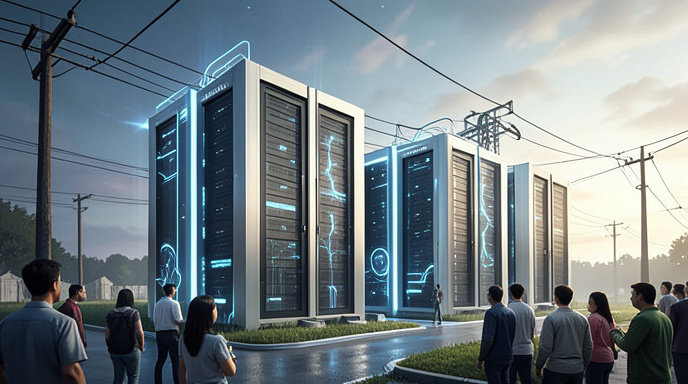
According to reports circulating around the company’s data-center strategy, OpenAI may begin referring to large-scale facilities as “AI compute campuses.” The proposed language would present these sites not simply as data centers, but as broader technology hubs supporting computing, research, energy systems, networking, and possibly future industrial development.
OpenAI has not publicly established “AI compute campuses” as an official companywide term. That distinction matters. The phrase may reflect internal or industry discussions rather than a finalized rebranding campaign.
Even so, the debate illustrates a growing problem for the AI industry. As model development becomes more computationally intensive, companies need vast quantities of electricity, cooling capacity, fiber connectivity, land, and construction materials. The infrastructure is increasingly visible—and so are its costs.
Why “Data Center” Has Become a Loaded Term
Data centers have long been essential to cloud computing, online video, banking, and enterprise software. In many communities, however, the term now evokes a different set of concerns: massive power demand, industrial-scale construction, water use, noise, and pressure on local utility systems.
AI has intensified those concerns because AI-focused facilities can require unusually dense computing equipment. Specialized chips generate substantial heat, while the need to train and serve large models can keep servers operating around the clock. A single project can also trigger new substations, transmission upgrades, backup generation, cooling systems, and road construction.
Calling such a facility a “campus” may sound more expansive and less industrial. It can suggest a research center, an innovation district, or a technology ecosystem rather than a warehouse filled with energy-hungry machines.
That distinction could help companies explain the economic role of these projects. It could also backfire if residents see the language as an attempt to make a controversial facility sound more benign.
The Scale of OpenAI’s Infrastructure Ambitions
OpenAI is involved in a broader push to expand AI computing capacity in the United States and internationally. Its infrastructure plans have been linked to large investments, partnerships, and the Stargate initiative, which was announced with the goal of supporting major AI infrastructure development.
The company’s computing requirements extend beyond its own offices. OpenAI relies on cloud and infrastructure partners, including Microsoft, while pursuing additional capacity through other commercial arrangements. The result is a distributed network of facilities rather than one conventional headquarters-style data center.
The infrastructure race has also drawn technology companies, cloud providers, chipmakers, utilities, and private-equity-backed developers into a competition for sites and power. Projects are being proposed in regions with available land, favorable electricity prices, tax incentives, and access to transmission networks.
That competition has made AI infrastructure a local political issue. Decisions that once took place largely inside corporate procurement departments now involve city councils, utility regulators, state governments, water authorities, and residents.
Energy Demand Is the Central Flashpoint
The most immediate concern is electricity.
AI data centers can consume far more power than typical office buildings or conventional server facilities. Their demand may be relatively constant, making them attractive customers for utilities but challenging additions to grids that are already balancing residential, industrial, and renewable-energy needs.
Utilities and developers often argue that new projects can bring investment, construction jobs, tax revenue, and improvements to regional infrastructure. They also say large customers can help finance new generation and transmission capacity.
Critics question who ultimately pays for those upgrades. If a utility builds infrastructure for a private AI facility, regulators must determine whether the costs are borne by the company, shared among ratepayers, or recovered through a combination of public incentives and long-term contracts.
There is also a question of how the electricity is generated. A data center may be marketed as powered by renewable energy through credits or contracts while still drawing electricity from a regional grid that includes fossil-fuel generation. Residents and environmental groups increasingly want companies to explain the difference between accounting for clean energy and physically matching consumption with clean power.
Water Use Adds a Local Dimension
Cooling is another major source of concern. Many data centers use water-based systems to remove heat, although designs vary widely. Some employ air cooling, closed-loop systems, reclaimed water, or newer liquid-cooling technologies. Others may reduce direct water use while increasing electricity consumption.
The effect depends heavily on geography and design. A facility in a water-stressed region can provoke opposition even if its annual consumption is small compared with agriculture or municipal use. Residents may object not only to the volume of water but also to the timing of withdrawals, the source of the water, and the conditions attached to permits.
Companies have begun emphasizing water-efficient cooling and commitments to replenish or restore water resources. Those pledges can be difficult for the public to evaluate without facility-level data.
A broad corporate figure for global water use does not answer the questions communities care about most: How much water will this site use each day? What happens during drought? Is potable water involved? Who has priority during shortages? What are the reporting and enforcement mechanisms?
Transparency Will Matter More Than Branding
A terminology change cannot resolve those questions. If anything, a softer name could increase skepticism unless it is accompanied by more information.
Communities are likely to seek disclosures covering:
- Expected electricity demand at launch and at full build-out
- The source and carbon intensity of the facility’s power
- Water consumption, wastewater handling, and drought plans
- Backup generators and fuel storage
- Noise, heat, traffic, and construction impacts
- Tax incentives, subsidies, and infrastructure commitments
- Local hiring and economic benefits
- Plans for decommissioning or repurposing the site
- Independent monitoring and public reporting
The industry’s current reporting practices are not always consistent. Companies may disclose projected power capacity while withholding actual consumption, or describe water systems in broad terms without publishing operational data. That makes it difficult for residents and regulators to compare proposals.
A “campus” label could be credible if it reflects a genuinely broader development with research facilities, public infrastructure benefits, and transparent environmental performance. It will be less credible if it merely replaces “data center” on planning documents while the underlying project remains unchanged.
The Risk of Greenwashing by Vocabulary
Rebranding is common when an industry’s traditional terminology becomes politically difficult. But language can create reputational risk when it appears designed to soften public reaction rather than clarify reality.
“AI compute campus” has a plausible technical meaning. A large site may contain multiple buildings, power systems, cooling plants, networking operations, testing facilities, and support infrastructure. In that sense, “campus” may be more precise than “data center.”
The problem arises when the new term obscures the project’s most consequential characteristics. A campus can still be an energy-intensive industrial installation. A technology hub can still draw heavily on scarce water supplies. A research-oriented description does not automatically make the environmental footprint smaller.
Residents and advocacy groups are increasingly familiar with this pattern. They may interpret polished language as a sign that a company is prioritizing perception before accountability. The same criticism has appeared across industries when “industrial park,” “innovation district,” or “clean technology facility” descriptions have been used for projects with substantial resource demands.
What OpenAI and Its Partners Could Do Differently
If OpenAI adopts the new terminology, it could make the term meaningful through concrete commitments.
First, the company could publish facility-level environmental data rather than relying on global averages. That would include projected and actual electricity use, peak demand, water consumption, emissions, and cooling performance.
Second, OpenAI and its partners could disclose the full public cost of each project. Tax breaks, discounted land, utility investments, and transmission upgrades should be presented alongside job numbers and private capital commitments.
Third, projects could include enforceable limits. Water-use caps, drought restrictions, noise standards, renewable-energy requirements, and deadlines for infrastructure upgrades would give residents more than voluntary promises.
Fourth, companies could establish independent oversight. Public dashboards, third-party audits, and community advisory boards would make it easier to test whether project claims match operational reality.
Finally, developers could be more candid about uncertainty. AI demand forecasts are changing quickly. A facility initially presented as a modest installation may expand substantially as model usage grows. Planning documents should explain the maximum potential build-out, not only the first phase.
The Broader Question: Who Benefits From AI Growth?
The controversy is not solely about terminology or even environmental impact. It is also about the distribution of benefits and burdens.
AI companies and investors may gain enormous value from new computing capacity. Local communities, meanwhile, may face higher infrastructure costs, competition for power, pressure on housing, or constraints on water resources. The number of permanent jobs created by highly automated facilities may be smaller than the scale of the investment suggests.
That does not mean data centers provide no local benefits. Construction can support regional contractors, facilities can expand tax bases, and infrastructure upgrades may improve reliability. But those benefits need to be measured against long-term costs rather than advertised as automatic outcomes.
The political response will likely depend on whether residents believe they have a meaningful role in the process. Consultation after a site has effectively been selected is unlikely to satisfy communities. Public hearings, environmental reviews, and utility proceedings will matter more if they can alter project terms.
A New Name Is Not a New Social Contract
OpenAI may eventually make “AI compute campus” a standard part of its infrastructure vocabulary. The term could help describe a new generation of facilities that combine computing, energy, cooling, networking, and research operations.
But it cannot, by itself, resolve the backlash surrounding AI infrastructure. The public debate is driven by measurable questions: how much power a facility consumes, how much water it uses, what emissions it creates, who pays for grid upgrades, and whether local residents share in the benefits.
If the new terminology is paired with detailed disclosure and enforceable commitments, it may help explain the evolving role of these sites. If it is used mainly to make data centers sound less controversial, it will probably deepen mistrust.
For OpenAI and the wider AI industry, the lesson is straightforward: public acceptance will not be won by vocabulary alone. The companies building the next generation of AI infrastructure will need to demonstrate that their facilities are not only powerful, but also transparent, accountable, and compatible with the communities that host them.

Get All The Latest Updates Delivered Straight To Your Inbox For Free!