
Palmer Luckey Calls for Jensen Huang’s Return, Warning Nvidia Shake-Up Weakens America
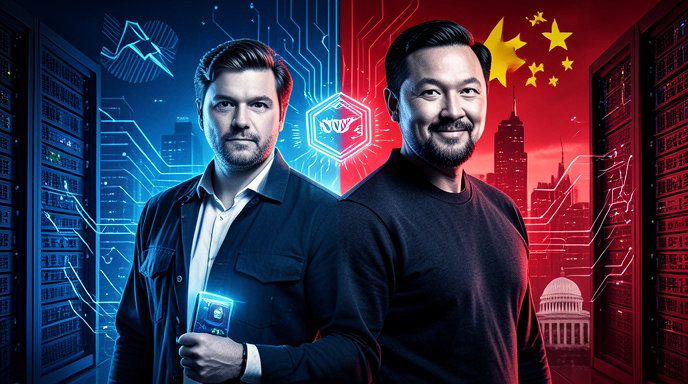
TL;DR
- Palmer Luckey says removing Jensen Huang from Nvidia’s leadership would benefit China and weaken the United States’ position in artificial intelligence.
- Huang remains Nvidia’s co-founder and CEO; no confirmed company announcement has established that he has been ousted.
- The dispute highlights how Nvidia’s chips, software ecosystem and leadership have become central to the U.S.-China technology rivalry.
A warning with geopolitical consequences
Anduril founder and CEO Palmer Luckey is arguing that Jensen Huang’s removal from Nvidia would be far more than a corporate leadership change. In Luckey’s telling, China would be “thrilled” by the development because Huang has become one of the most important figures in America’s artificial-intelligence industry.
The claim reflects the unusually strategic role Nvidia now occupies. Once best known for graphics processors, the company has become the leading supplier of the accelerated-computing hardware used to train and operate many of the world’s most advanced AI systems. Its chips, networking products and CUDA software platform sit at the center of a technology stack that supports cloud providers, research laboratories, defense contractors and major consumer technology companies.
That makes Huang’s position a matter of interest well beyond Silicon Valley. Any leadership disruption at Nvidia could affect investor confidence, customer planning and Washington’s broader effort to preserve the United States’ advantage over China in advanced computing.
No confirmed ouster
The premise requires an important distinction: criticism of an alleged or hypothetical Nvidia shake-up should not be confused with confirmation that Huang has been ousted.
Huang co-founded Nvidia in 1993 and has served as its chief executive for decades. Public discussion of succession, board decisions or executive changes can quickly turn into online claims that a leader has been removed, but those claims require confirmation from the company, regulatory filings or multiple credible news organizations.
Without such confirmation, Luckey’s remarks are best understood as an argument about the consequences of removing Huang—not evidence that Nvidia has actually dismissed him. Huang’s continued influence over Nvidia’s strategy, product roadmap and relationships with customers remains central to the discussion.
Why Huang matters to Nvidia
Huang’s importance is tied not only to his title but also to the company’s long-term technical direction. Nvidia spent years building a platform around GPUs, developer tools and specialized software. That preparation positioned the company to benefit when machine learning shifted from a research niche into a foundational technology for search, cloud services, robotics, cybersecurity and defense.
The CUDA ecosystem has been particularly important. It gives developers tools for using Nvidia hardware and has helped create a large installed base of engineers, applications and services built around the company’s architecture. Competitors can design powerful processors, but matching Nvidia requires more than producing a fast chip. They also need software compatibility, developer adoption, manufacturing capacity, networking and reliable supply.
Huang has consistently presented Nvidia as a full-stack computing company rather than a chip designer alone. That strategy helped the business expand from graphics into data centers, AI accelerators, high-speed networking and enterprise software.
Luckey’s argument is that a sudden leadership change could threaten this coordination at the moment when the company’s execution is most important.
China’s AI ambitions
China is investing heavily in domestic semiconductor production and artificial-intelligence infrastructure. Companies including Huawei and a growing group of Chinese chip designers are working to reduce their dependence on American technology, while Beijing continues to support local development through industrial policy, research funding and government procurement.
U.S. export controls have restricted China’s access to some of Nvidia’s most advanced processors. The controls are intended to slow the development of military and surveillance capabilities that could be enabled by cutting-edge AI, but they have also encouraged China to accelerate efforts to build alternatives.
Luckey’s “thrilled” characterization fits into that broader competition. A weakened Nvidia could create an opening for Chinese companies to narrow the performance gap, attract customers that can no longer rely on the American supplier and expand the market for domestic hardware and software.
Still, the outcome would not depend on one executive alone. Nvidia’s position is supported by thousands of engineers, a global supplier network, long-standing customer relationships and a deep software ecosystem. Leadership matters, but structural advantages would not disappear overnight.
The stakes for Washington
The Nvidia debate also exposes the tension in U.S. technology policy. Washington wants American companies to remain the global leaders in AI while limiting the ability of strategic competitors to access the same capabilities.
That goal has produced increasingly complex export rules. Nvidia has had to design and sell modified products for restricted markets, navigate changing licensing requirements and balance commercial opportunities against national-security concerns. Every policy change can affect revenue, supply-chain planning and the pace at which competitors develop substitutes.
The government also faces a second challenge: maintaining the manufacturing capacity needed to support AI growth. Nvidia designs its processors but relies on partners for fabrication, packaging and other parts of the supply chain. The United States is investing in domestic semiconductor production, yet the most advanced manufacturing remains distributed across a highly specialized international network.
A leadership crisis at Nvidia would therefore arrive amid existing pressure from regulators, customers and geopolitical rivals.
A succession question with market consequences
Nvidia’s extraordinary growth has increased attention on succession planning. Huang is one of the technology industry’s most recognizable leaders, and his public presence has become closely associated with the company’s identity. Investors and customers may reasonably ask how Nvidia would preserve its strategy if he stepped aside voluntarily, became unavailable or was replaced.
A well-prepared succession plan could reassure markets. A sudden and poorly explained transition could have the opposite effect, particularly if it suggested disagreement over Nvidia’s investment priorities, export-control strategy or relationship with major AI companies.
Luckey’s appeal for Huang’s return is consequently part of a larger argument about continuity. He is portraying Huang as a strategic asset whose value extends beyond quarterly earnings and product announcements. In that view, removing him during an intensifying technology rivalry could send a damaging signal to allies, customers and employees.
Critics can reasonably challenge that assessment. No company should be dependent on one executive, especially one with Nvidia’s scale. Strong governance requires a board and management team capable of sustaining innovation through leadership changes. Treating a single executive as indispensable can also obscure risks involving valuation, competition, supply chains and regulatory exposure.
The broader technology race
The confrontation between the United States and China is increasingly being fought across several layers of the technology stack. Advanced chips are one layer, but the contest also includes semiconductor equipment, cloud computing, data centers, AI models, talent, energy and software.
Nvidia’s role is unusual because its products touch so many of those areas at once. Its accelerators power hyperscale data centers, national laboratories, autonomous systems and emerging generative-AI applications. That gives the company commercial influence and strategic significance that few private technology firms have previously enjoyed.
For U.S. policymakers, the challenge is to strengthen the ecosystem without allowing national-security concerns to damage the very companies that provide America with an advantage. For Nvidia, the challenge is to remain innovative while operating under restrictions that may encourage overseas customers to seek alternatives.
For China, the priority is to use the restrictions as motivation to build a complete domestic supply chain. The more time Chinese companies have to develop competitive processors and software, the less effective American leverage may become.
What comes next
Whether or not Nvidia experiences an actual leadership change, the controversy is likely to intensify discussion about the company’s succession plans and its place in U.S. national strategy.
Huang’s continued leadership would provide stability, but it would not resolve the underlying challenges. Nvidia must continue delivering more capable hardware, expand its software ecosystem, manage enormous customer demand and respond to competitors. It must also navigate export rules that can change with little warning.
Luckey’s warning captures the high stakes, even if its most dramatic premise remains unverified. Nvidia is no longer merely a successful semiconductor company. It is a central platform provider for the AI economy and one of the most important American companies in the technology competition with China.
That is why any question surrounding Huang’s future is being interpreted not only through the lens of corporate governance, but also as a question about America’s technological strength.

Get All The Latest Updates Delivered Straight To Your Inbox For Free!