
Palmer Luckey’s 3-Day Emergency Prep Advice: Why the Anduril Founder Says Every American Should Be Ready
TL;DR
- Anduril founder Palmer Luckey says Americans should be able to operate for at least three days with food, water, medicine, and other essentials.
- The advice reflects a longstanding emergency-preparedness standard, not necessarily a prediction of an imminent disaster.
- Luckey’s outspoken “prepper” reputation and work in defense technology have made a routine preparedness recommendation unusually attention-grabbing.
Luckey’s practical case for preparedness
Palmer Luckey, the founder of defense-technology company Anduril Industries, is known for expressing strong views on military technology, national security, and personal resilience. His recommendation that Americans maintain at least three days of food, water, and medicine has drawn renewed attention because it combines a familiar emergency-planning guideline with Luckey’s unapologetically “prepper” worldview.
The central idea is straightforward: households should be able to function independently for roughly 72 hours if normal services are disrupted. That could happen after a severe storm, earthquake, wildfire, cyberattack, infrastructure failure, public-health emergency, or other crisis.
Luckey’s argument is less about predicting a specific catastrophe than about reducing dependence on systems that may not recover immediately. Electricity, communications, transportation, payment networks, grocery deliveries, and pharmacies can all become unreliable during emergencies. A modest household reserve can provide time and flexibility while authorities and utilities respond.
Why three days has become the standard
The three-day benchmark is widely used by emergency-management agencies because the first 72 hours of a crisis are often the most difficult. Roads may be blocked, emergency responders may be overwhelmed, and supply chains may not yet have been restored.
Federal and local preparedness campaigns have commonly encouraged households to keep enough supplies to remain self-sufficient for several days. The exact recommendation varies by location and risk. People living in areas prone to hurricanes, winter storms, earthquakes, wildfires, or flooding may reasonably prepare for longer disruptions.
Three days is therefore best understood as a minimum starting point rather than a universal limit. A family with young children, older adults, pets, medical equipment, or members who require refrigerated medication may need a more substantial plan.
What a basic emergency supply should include
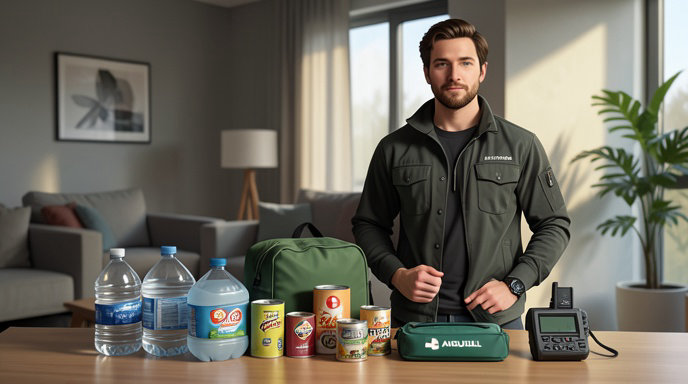
Food and water are the foundation of any emergency kit. Emergency planners generally recommend storing water for drinking and basic sanitation, along with shelf-stable food that requires little or no cooking. Ready-to-eat meals, canned goods, energy bars, dried foods, and baby supplies can all be useful, provided households regularly check expiration dates and account for dietary needs.
Medicine is another critical component. People who take prescription drugs should discuss emergency supplies with a doctor or pharmacist and keep an up-to-date list of medications, dosages, and allergies. A first-aid kit, pain relievers, disinfectant, spare glasses, and essential personal-care items can also become important when pharmacies are closed or transportation is disrupted.
Other practical items include flashlights, batteries, power banks, a battery- or hand-crank radio, cash, blankets, basic tools, masks, sanitation supplies, and copies of important documents. Households should also consider pet food, infant formula, mobility aids, and supplies for people with disabilities.
Preparedness is more than storing supplies
A well-designed emergency plan can matter as much as a physical stockpile. Families should decide how they will communicate if mobile networks are congested, identify meeting locations, and learn which local shelters or evacuation routes are available.
People should also know how to shut off utilities safely, use fire extinguishers, and receive official alerts. A written contact list is useful if phones lose power or digital services become unavailable.
Luckey’s broader message is that resilience requires practice. A generator, radio, or water filter is only helpful if people know how to operate it. Testing equipment, rotating stored food and water, and reviewing the plan periodically can prevent avoidable failures during a real emergency.
Why Luckey’s comments are getting attention
Preparedness advice is not unusual, but Luckey’s profile gives it a different context. He founded Oculus VR before Facebook acquired the company and later established Anduril, which develops autonomous systems, surveillance platforms, and other defense technologies. His public persona combines enthusiasm for advanced technology with a skepticism that critical systems will always work as expected.
That combination has helped make him a prominent voice in discussions about technological vulnerability and national security. When a defense entrepreneur who focuses on autonomous weapons and battlefield systems also advocates household emergency supplies, audiences may interpret the advice as more ominous than a standard government checklist.
Luckey has also cultivated an image that embraces contingency planning rather than dismissing it as excessive. Supporters see that approach as realistic, particularly as extreme weather, cyber incidents, and geopolitical tensions expose weaknesses in essential infrastructure. Critics may view the rhetoric as alarmist or as an extension of the Silicon Valley and defense-industry tendency to frame every risk through worst-case scenarios.
The practical case does not depend on a catastrophe
The strongest argument for a three-day supply is not that a major collapse is inevitable. It is that many ordinary disruptions can last long enough to create serious problems.
A winter storm can close roads and interrupt deliveries. A hurricane can leave communities without electricity for days. A wildfire can force an evacuation with little warning. A localized water-contamination event can make tap water unsafe. Even a temporary communications or payment outage can prevent people from buying necessities.
Basic preparation can reduce pressure on emergency services and allow first responders to focus on people in immediate danger. It can also help households avoid dangerous travel during storms or panic buying after a warning is issued.
Avoiding the pitfalls of “prepper” culture
Emergency preparation is most useful when it remains proportional, affordable, and evidence-based. Building a reserve does not require purchasing expensive survival equipment, stockpiling weapons, or assuming that society is about to collapse.
A practical approach starts with ordinary household needs. Families can gradually buy extra shelf-stable food during routine shopping trips, store water safely, keep chargers and flashlights accessible, and maintain a small amount of cash. Plans should be adapted to local hazards rather than based on generalized fears.
Preparedness should also account for neighbors and community networks. During major emergencies, cooperation can be more valuable than any individual stockpile. Checking on older residents, sharing information, and understanding local response plans all improve resilience.
A low-cost form of resilience
Luckey’s recommendation ultimately rests on a simple principle: a small amount of preparation can buy valuable time. Three days of supplies will not solve every emergency, and it cannot replace public infrastructure or professional responders. It can, however, help households manage the first phase of a disruption without immediately depending on outside assistance.
For Luckey, that self-reliance fits naturally with his views on technology, defense, and national resilience. For everyone else, the advice can be treated less as a warning of imminent disaster and more as a practical checklist: keep water, food, medicine, light, power, information, and a plan close at hand.

Get All The Latest Updates Delivered Straight To Your Inbox For Free!