
Pentagon Approves $250 Million Loan to Help 6K Build U.S. Battery Materials Factory
TL;DR
- The Pentagon has conditionally approved a loan of up to $250 million to 6K, supporting construction of a U.S. battery-materials manufacturing facility.
- 6K’s UniMelt microwave-plasma process is designed to produce advanced cathode materials more efficiently while reducing dependence on overseas suppliers.
- The project could strengthen domestic battery and defense supply chains, although the financing remains conditional and must clear final requirements before funds are distributed.
The U.S. Department of Defense has conditionally approved a loan of up to $250 million for 6K, a Massachusetts-based battery-materials startup seeking to expand domestic production of key materials used in lithium-ion batteries.
The financing is intended to support a large-scale manufacturing facility for cathode active materials, or CAM. These materials are central to a battery’s performance, cost, energy density and lifespan. They are also a major vulnerability in the U.S. battery supply chain, which remains heavily dependent on foreign mining, refining and processing capacity.
The commitment is conditional rather than a final disbursement. 6K must satisfy remaining technical, financial and regulatory requirements before the loan can close and the funds can be released.
A new approach to battery-materials production
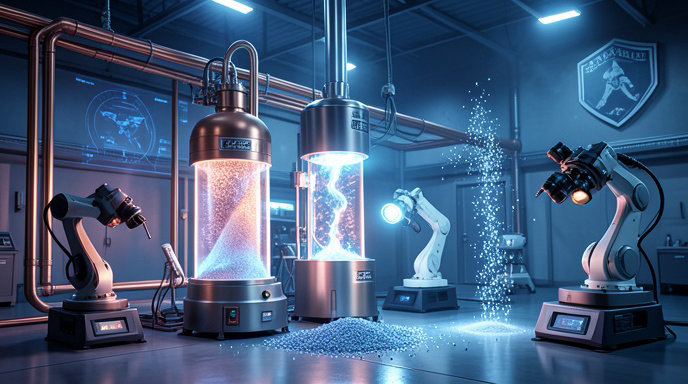
6K’s manufacturing platform, known as UniMelt, uses microwave-generated plasma to process powders and other feedstocks at extremely high temperatures. The company says the technology can produce engineered materials in a continuous-flow system rather than relying on conventional batch-based processing.
That distinction is important because traditional production of cathode materials can require multiple processing stages, long furnace cycles and significant energy consumption. It can also generate substantial waste and rely on complex international supply chains.
6K says UniMelt can combine several steps in a more compact production system. The company’s process is designed to control particle size, morphology and chemical composition—characteristics that influence how efficiently battery cells charge, discharge and retain capacity.
The technology is intended for materials including nickel-manganese-cobalt chemistries, lithium iron phosphate and other advanced battery compounds. The company has also highlighted potential applications in aerospace, additive manufacturing and specialty metals.
Building domestic cathode capacity
The proposed facility would give the United States additional capacity to manufacture battery materials domestically instead of importing finished cathode powders or sending precursor materials overseas for processing.
Cathode production is one of the most strategically important parts of the battery supply chain. While the United States has expanded battery-cell and vehicle manufacturing, it still has limited domestic capacity for several of the refined materials needed to make those cells.
China remains the dominant supplier across much of the global battery-materials industry, including refining, precursor production and cathode manufacturing. Other parts of the supply chain are concentrated in countries such as Indonesia, South Korea and Japan.
That concentration creates risks for automakers, energy-storage developers and defense contractors. Disruptions caused by trade restrictions, geopolitical tensions, shipping problems or shortages of critical minerals could affect the availability and price of batteries.
A domestic CAM plant would not eliminate those risks, particularly because many raw materials would still come from global mining and refining networks. It could, however, give U.S. manufacturers another source of processed battery materials and reduce reliance on overseas production for a critical manufacturing step.
Why the Pentagon is involved
The loan is part of a broader effort by the federal government to expand domestic capacity for technologies considered important to national security. Batteries are increasingly relevant to military systems, including drones, portable power equipment, communications systems, autonomous platforms and electric vehicles.
The Department of Defense has been using a combination of grants, contracts, loan programs and public-private partnerships to support production of strategic materials and components. The goal is not only to promote commercial clean-energy manufacturing but also to ensure that defense programs have access to resilient supplies during periods of crisis.
6K’s project fits that strategy because the same materials used in commercial electric vehicles and grid-storage systems can also support specialized defense applications. Higher-energy-density batteries can enable longer-range unmanned systems, lighter soldier equipment and more capable portable power systems.
The Pentagon’s involvement may also help 6K attract private capital and commercial customers. Battery-materials plants are expensive to build, and companies must typically secure long-term purchase agreements before committing to full-scale production.
From laboratory technology to industrial production
The biggest challenge for 6K will be scaling UniMelt from pilot and demonstration systems to reliable, high-volume manufacturing.
Battery customers require extremely consistent materials. Small variations in particle size, chemical composition, moisture content or impurity levels can affect cell performance and manufacturing yields. A process that works in a laboratory or pilot line must therefore demonstrate stable output over long operating periods.
The project must also compete with established overseas producers that already operate large facilities and benefit from mature supply networks. Even if UniMelt lowers energy use or simplifies production, a new U.S. plant could face higher labor, construction and operating costs.
The company will need to prove that its process can deliver competitive pricing while meeting the quality specifications required by cell manufacturers and defense contractors. Equipment reliability, raw-material availability and customer qualification timelines will be equally important.
The significance of microwave-plasma processing
Microwave plasma is already used in several industrial and materials-processing applications, but applying it to battery materials at commercial scale presents technical and economic challenges.
The potential advantage is process intensity. By creating a highly controlled, high-temperature reaction environment, plasma systems can rapidly transform feedstocks into precisely engineered powders. If the process uses less energy and requires fewer production steps than conventional methods, it could reduce both the cost and environmental footprint of cathode manufacturing.
A smaller or more modular plant design could also make it easier to add capacity near battery-cell factories or other customers. That could shorten transportation routes and reduce the need to move sensitive powdered materials across international borders.
Those benefits remain claims that must be demonstrated at commercial scale. The plant’s actual energy consumption, throughput, yield, maintenance requirements and emissions profile will determine whether the technology delivers a meaningful advantage over established manufacturing methods.
Part of a wider U.S. battery strategy
The loan follows a series of federal initiatives aimed at building a domestic battery ecosystem. These efforts have included support for critical-mineral extraction, refining, cathode and anode materials, battery cells, recycling and electric-vehicle manufacturing.
The Inflation Reduction Act has also encouraged North American production by tying certain consumer and commercial incentives to domestic or allied-country sourcing requirements. Those rules have increased pressure on automakers and battery manufacturers to diversify supply chains.
For the United States, materials production is particularly important because cell factories cannot operate independently of upstream suppliers. A country may build gigafactories, but without reliable access to cathode, anode, electrolyte and separator materials, it remains exposed to foreign bottlenecks.
6K’s planned facility would address one part of that gap. It would not solve the broader shortage of domestic mining and refining capacity, but it could add an important link between processed minerals and finished battery cells.
What happens next
The $250 million approval is conditional, meaning 6K must complete the remaining steps required by the Pentagon’s financing program. Those steps may include final engineering reviews, environmental and permitting work, financial conditions, customer commitments and other due diligence.
The schedule for construction and production will depend on when the loan closes, how quickly the company secures additional financing and how long it takes to qualify the plant’s materials with battery manufacturers.
If completed, the facility could become a test of whether an American startup can use a novel production platform to compete in one of the battery industry’s most capital-intensive segments. Success would provide 6K with a commercial base while giving the Pentagon a domestic source of materials relevant to both energy and defense technologies.
The broader impact will depend on execution. A conditional loan approval is an important vote of confidence, but the project must still move from financing agreement to construction, then from pilot production to consistent commercial output. If it achieves those milestones, 6K’s factory could help turn a vulnerable portion of the U.S. battery supply chain into a more resilient domestic capability.

Get All The Latest Updates Delivered Straight To Your Inbox For Free!