
Pentagon’s $250 Million Loan to 6K Could Transform U.S. Battery Manufacturing
TL;DR
- The Pentagon has conditionally approved a loan of up to $250 million to 6K to expand U.S. production of battery materials and other strategic powders.
- 6K’s UniMelt microwave-plasma process could reduce reliance on overseas refining while improving manufacturing efficiency, materials quality, and supply-chain resilience.
- The funding is expected to support larger-scale production for next-generation batteries, although final closing, project execution, and commercial demand remain important conditions.
A conditional Pentagon commitment of up to $250 million to battery-materials startup 6K could give the United States a significant new tool in its effort to rebuild domestic battery manufacturing.
The financing is aimed at helping North Andover, Massachusetts-based 6K scale production of advanced battery materials using its UniMelt microwave-plasma manufacturing platform. The company says the technology can produce powders used in lithium-ion batteries and other demanding industrial applications with less energy, fewer processing steps, and a smaller environmental footprint than many conventional methods.
The commitment does not represent an immediate transfer of the full amount. It is a conditional approval, meaning 6K must satisfy remaining financial, technical, regulatory, and project-related requirements before the loan can close and funds can be drawn.
Still, the proposed investment reflects Washington’s growing focus on materials processing as a critical part of national security. Building battery cells in the United States is not enough if the minerals, refined powders, cathode materials, anode materials, and specialty inputs required to make those cells remain dependent on overseas suppliers.
A Strategic Bet on Battery Materials
The Pentagon’s involvement places 6K within a broader effort to secure domestic sources of materials needed for electric vehicles, grid storage, defense systems, and portable electronics.
Much of the global battery supply chain is concentrated in Asia, particularly in China, which dominates several stages of mineral refining and battery-material production. Even when raw materials are mined in North America or allied countries, they may still be shipped abroad for chemical processing, conversion into battery-grade powders, or final manufacturing.
That dependence has become a concern for U.S. policymakers. Disruptions, export controls, geopolitical tensions, and rapidly rising demand could all expose weaknesses in the supply chain.
By supporting a U.S.-based materials producer, the Pentagon is seeking more than additional battery capacity. It is backing the industrial infrastructure that determines where and how critical materials are converted into usable products.
How 6K’s UniMelt Process Works
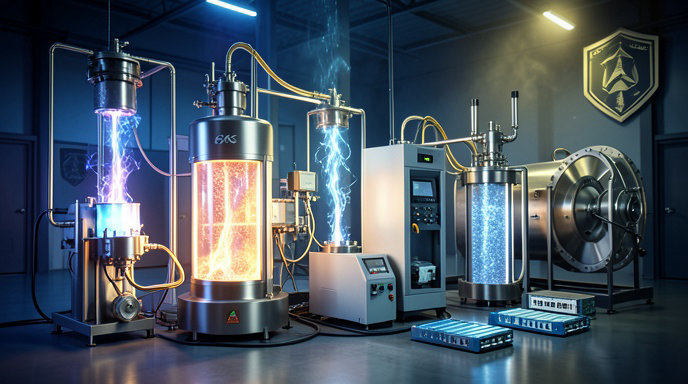
6K’s UniMelt system uses microwave-generated plasma to process powders at extremely high temperatures. The company’s approach is designed to produce uniform, high-performance materials while combining several conventional production steps into a more integrated process.
Traditional battery-material manufacturing can involve multiple stages of precipitation, drying, calcination, milling, and coating. Those stages often require substantial heat, water, energy, and factory space. They can also generate waste streams that require additional treatment.
6K says its plasma platform can be adapted to produce a range of engineered materials, including cathode active materials, anode materials, metal powders, and ceramic or specialty powders. The company has positioned the technology as a flexible manufacturing system rather than a process limited to one battery chemistry.
That flexibility could become increasingly valuable as automakers and energy-storage companies pursue different chemistries, including lithium iron phosphate, nickel-rich cathodes, silicon-enhanced anodes, and solid-state battery materials.
The technology’s commercial significance will ultimately depend on factors such as production throughput, cost per kilogram, product consistency, equipment uptime, and the ability to meet qualification standards established by battery and automotive customers.
Scaling From Demonstration to Production
The proposed loan would help 6K move from pilot and demonstration-scale operations toward larger commercial production. The company has previously described plans to expand its manufacturing footprint and develop domestic capacity for advanced materials.
Scaling battery-material production is one of the most difficult steps in the industry. A process that works in a laboratory or small pilot line must operate continuously at industrial volumes while maintaining tight control over particle size, chemical composition, morphology, and purity.
Those specifications are crucial. Small variations in cathode or anode powders can affect a battery’s energy density, charging performance, cycle life, safety, and manufacturing yield.
The funding could help pay for production equipment, facility expansion, process development, workforce growth, and the supporting infrastructure required to operate a larger plant. It could also help 6K qualify its materials with battery manufacturers and other industrial customers.
Domestic Manufacturing and Supply-Chain Resilience
The potential impact extends beyond 6K itself. A larger U.S. materials operation could support a network of upstream and downstream suppliers, including mineral processors, equipment manufacturers, chemical companies, battery-cell producers, and recycling firms.
Producing more battery materials domestically could shorten transportation routes and reduce exposure to international shipping disruptions. It could also make it easier for U.S. battery manufacturers to source materials that meet federal-content requirements tied to clean-energy incentives.
The Inflation Reduction Act has encouraged domestic and allied-country production through tax credits and sourcing rules. Those policies are intended to build a battery ecosystem in North America and reduce dependence on entities linked to China and other restricted jurisdictions.
However, building that ecosystem requires more than mines and cell factories. Specialized materials plants are a critical link between raw resources and finished batteries. Without sufficient domestic conversion and processing capacity, U.S. battery factories may continue to rely on imported powders even when the cells themselves are assembled domestically.
Potential Benefits for Next-Generation Batteries
6K’s platform could be particularly relevant as battery developers move beyond standard, mature materials.
Current lithium-ion batteries commonly rely on graphite anodes and cathode chemistries such as nickel-manganese-cobalt or lithium iron phosphate. Emerging designs may use silicon, lithium metal, advanced ceramics, high-nickel compounds, or other engineered materials to improve energy density, charging speed, durability, or safety.
These materials often require precise control over particle structure and composition. Manufacturing flexibility could allow suppliers to adapt more quickly as cell designers test new chemistries.
The technology may also have applications outside electric vehicles. Stationary energy-storage systems, defense platforms, aerospace systems, and specialized electronics each have different performance requirements. Some prioritize cost and cycle life, while others emphasize energy density, temperature tolerance, or resistance to harsh operating conditions.
A domestic producer capable of making multiple classes of advanced powders could therefore serve a wider market than a company focused on a single battery product.
Energy and Environmental Considerations
6K has promoted UniMelt as a more energy-efficient alternative to conventional powder-processing methods. The company has said that its process can reduce energy use and emissions by shortening production flows and using high-temperature plasma in a targeted manner.
Those claims will need to be evaluated at commercial scale. Industrial energy performance can differ substantially from pilot results, particularly once a factory operates continuously and includes material handling, gas systems, emissions controls, and other auxiliary equipment.
Environmental advantages could nevertheless become an important competitive factor. Battery manufacturers face growing pressure to reduce the carbon intensity of their materials, limit water consumption, and document the origin and environmental impact of their inputs.
A process that produces qualified materials with less energy, fewer steps, and lower waste could help customers meet those requirements. It could also reduce operating costs if the savings remain visible after the system is scaled.
The Risks Behind the Opportunity
The Pentagon’s conditional approval is a major vote of confidence, but it does not eliminate the risks associated with building a new materials business.
The first challenge is execution. Large industrial projects routinely encounter delays involving construction, equipment installation, permitting, financing, and customer qualification.
The second is market adoption. Battery companies are cautious about changing materials because new powders can affect cell performance and factory yields. A promising production process still must demonstrate years of reliable quality and competitive economics before customers commit to high-volume purchases.
The third is competition. Established suppliers in China, South Korea, Japan, Europe, and North America are continuing to expand their own battery-material operations. Some benefit from existing customer relationships, mature supply chains, and large-scale factories.
Finally, battery chemistry is evolving quickly. Demand for one material can change as automakers adjust vehicle strategies, lithium prices fluctuate, or manufacturers choose different cell designs. 6K’s ability to serve multiple applications may help reduce that risk, but diversification also creates additional technical and commercial complexity.
What the Conditional Approval Means
A conditional commitment should not be confused with a completed loan or a direct grant. Before financing is finalized, the project must generally satisfy requirements related to due diligence, documentation, performance expectations, environmental review, and other government conditions.
The final structure may determine how quickly 6K can expand and how much private capital is attracted alongside the federal financing. Government-backed lending can reduce the risk perceived by commercial investors, but it does not guarantee that a project will meet its schedule or reach profitability.
The announcement is nevertheless significant because it signals that advanced materials manufacturing is being treated as a strategic capability. The Pentagon is not merely seeking finished batteries; it is targeting the industrial processes that make modern batteries possible.
A Test of U.S. Industrial Policy
6K’s financing proposal illustrates the changing nature of U.S. industrial policy. Federal support is increasingly directed toward companies that sit between basic research and mass production—businesses with technologies that may be too capital-intensive for conventional venture funding but too early-stage for ordinary project finance.
That middle ground is especially important in battery manufacturing. Research institutions can develop promising materials, and large corporations can build factories, but commercial success also requires companies capable of translating laboratory processes into repeatable industrial production.
If 6K uses the funding to build a reliable domestic supply of advanced powders, the project could become a model for similar investments in critical materials. If costs, yields, or customer adoption fall short, it would underscore the difficulty of using public capital to accelerate emerging industrial technologies.
The Road Ahead
The next milestones will include the completion of the federal loan process, final project approvals, facility and equipment expansion, and qualification of 6K materials with commercial customers.
Investors and policymakers will also be watching for evidence that the UniMelt platform can achieve competitive production costs at scale. Important indicators will include capacity additions, customer agreements, manufacturing yields, energy consumption, and the pace at which 6K moves from sample production to recurring commercial orders.
The $250 million commitment alone will not remake the U.S. battery industry. But it could help establish a domestic manufacturing base for a part of the supply chain that has received less attention than mines, battery cells, or electric vehicles.
If 6K can translate its microwave-plasma process into dependable, high-volume production, the Pentagon-backed loan could do more than expand one startup. It could help demonstrate that advanced battery materials can be developed, processed, and manufactured in the United States at the scale required for the next generation of energy storage.

Get All The Latest Updates Delivered Straight To Your Inbox For Free!