
S&P Considers Nvidia Credit Downgrade Amid Governance and Key-Man Risk
TL;DR
- S&P Global Ratings’ potential move to AA- would signal concern about Nvidia’s governance structure and dependence on a small group of senior executives.
- A downgrade would not necessarily threaten Nvidia’s liquidity, but it could raise borrowing costs and test investor confidence in the company’s long-term resilience.
- The decision would carry significance beyond Nvidia, highlighting the risks of rapid growth, concentrated leadership and heavy capital spending across the AI industry.
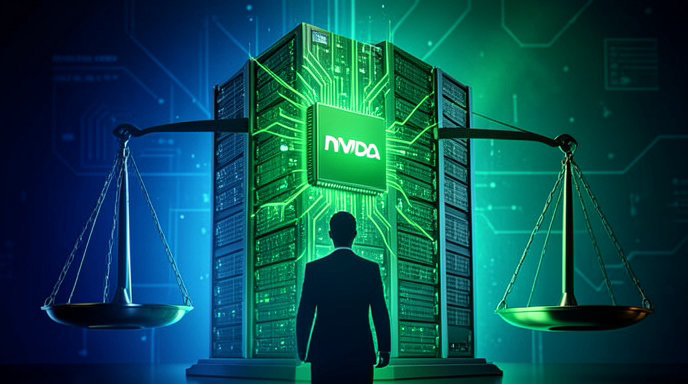
A possible credit-rating downgrade for Nvidia is putting renewed attention on a question that has often been overshadowed by the company’s extraordinary financial performance: how durable is its success if leadership, governance or execution falters?
S&P Global Ratings is reportedly considering lowering Nvidia’s credit rating to AA-, citing concerns related to corporate governance and the company’s reliance on key executives. The potential action would not amount to a warning that Nvidia is facing a near-term financial crisis. Rather, it would suggest that the rating agency sees growing structural risks that could affect the chipmaker’s credit quality over time.
The details of any S&P review, including its timing and final rationale, would be critical. A rating decision can influence how lenders, bond investors and institutional shareholders assess a company’s financial strength, even when the business remains highly profitable and cash-rich.
Why the Rating Matters
Credit ratings are designed to measure a company’s ability to meet its financial obligations. Nvidia’s strong balance sheet, substantial cash generation and dominant position in accelerated computing have helped support its high credit standing.
A move to AA- would still place Nvidia firmly within the high-grade investment category. It would not imply that the company is in distress or that debt repayment is immediately at risk. However, the downgrade would indicate that S&P believes Nvidia’s risk profile has weakened relative to similarly rated companies.
The practical effects could include modestly higher borrowing costs, tighter terms on future debt issuance or greater scrutiny from fixed-income investors. For a company with Nvidia’s cash-generation capacity, the immediate financial impact could be limited. The reputational effect may be more significant, particularly if investors interpret the downgrade as evidence that the company’s rapid expansion has introduced new vulnerabilities.
Governance Concerns Come Into Focus
Nvidia’s transformation from a graphics-chip specialist into the central supplier of the generative-AI infrastructure boom has placed enormous influence in the hands of its senior leadership. Chief Executive Jensen Huang remains one of the technology industry’s most prominent figures, closely associated with Nvidia’s strategy, product roadmap and relationships with major customers.
That visibility can be an asset, but it can also create key-person risk. When a company’s identity and strategic direction are strongly tied to one executive or a small leadership group, investors may question whether the organization could maintain its momentum through an unexpected departure, illness or change in leadership.
A credit-rating agency may also examine the depth of Nvidia’s succession planning, the independence and effectiveness of its board, executive compensation, shareholder rights and the company’s disclosure practices. Such issues do not necessarily indicate misconduct. They reflect the broader challenge of governing a company whose market value and strategic importance have expanded at extraordinary speed.
The key question is whether Nvidia has built institutional systems capable of matching its scale. Stronger succession planning, clearer accountability and robust board oversight could reduce concerns. Conversely, evidence that decision-making remains overly concentrated could reinforce them.
The Key-Man Risk Behind the Debate
Nvidia’s dependence on Huang is partly a consequence of the company’s history. He co-founded Nvidia and has guided it through several major strategic shifts, including the move from gaming graphics to data-center acceleration and AI computing.
His role has helped create consistency at a time when Nvidia has had to make enormous investments in software, networking, hardware design and customer support. Yet the same concentration can make investors worry about continuity.
Key-man risk is particularly relevant in technology companies because product cycles are short and competitive advantages can erode quickly. Nvidia’s position depends not only on its chips, but also on its CUDA software ecosystem, engineering talent, supply-chain relationships and close ties with cloud-service providers and AI developers.
A change at the top would not automatically undermine those assets. Still, markets could react sharply if investors believed that a leadership transition might slow product decisions, weaken customer relationships or create internal strategic disputes.
Financial Strength Provides a Buffer
Nvidia’s financial performance gives it considerable protection against the direct consequences of a rating change. Its AI-related sales growth has generated substantial operating cash flow, while demand from cloud providers and large technology companies has supported heavy investment in production capacity and infrastructure.
That financial strength means the company is less dependent on debt markets than many industrial or infrastructure businesses. Nvidia could potentially fund a significant portion of its expansion internally, reducing the immediate importance of a small change in its credit spread.
Even so, credit ratings influence more than the cost of a single bond offering. They can affect counterparties, supplier negotiations, commercial agreements and the willingness of investors to assign a premium valuation to the company. A downgrade could therefore matter if it becomes part of a broader narrative that Nvidia’s growth is becoming more difficult to manage.
Investor Confidence Could Be the Bigger Issue
For equity investors, the most important consequence may be psychological rather than mechanical.
Nvidia’s valuation has depended heavily on expectations that AI demand will remain strong, that the company can continue launching leading products and that its competitive moat will endure. A downgrade could prompt investors to reassess those assumptions, especially if it arrives alongside evidence of slowing orders, rising customer concentration or intensifying competition.
The market may also distinguish between a downgrade caused by temporary financial pressures and one driven by governance concerns. The latter can be harder to resolve because it raises questions about culture, succession and oversight rather than simply debt levels or quarterly results.
On the other hand, investors may view AA- as a relatively limited adjustment if Nvidia continues to generate strong cash flow and retain technological leadership. In that scenario, the decision could become a reminder that even financially powerful companies are not immune to governance scrutiny.
Implications for the AI Industry
The potential review would have significance beyond Nvidia. The company has become one of the central pillars of the global AI buildout, supplying the processors and networking systems used by cloud providers, model developers and enterprise customers.
A reassessment of Nvidia’s credit quality could encourage investors to examine the financial resilience of the broader AI supply chain. Questions may arise about the ability of customers to sustain enormous infrastructure spending, the durability of chip demand and the extent to which AI companies rely on a small number of hardware and cloud suppliers.
It could also intensify debate about concentration in the AI market. Nvidia’s dominance has generated exceptional economic power, but it has also made the industry more dependent on one company’s product cycles, manufacturing arrangements and leadership decisions.
Competitors such as AMD, Intel and specialized accelerator developers may point to governance and concentration risks as part of the case for a more diversified AI hardware ecosystem. Meanwhile, cloud companies are investing in custom silicon to reduce their dependence on external suppliers, although Nvidia’s software platform remains a substantial barrier to displacement.
What Nvidia Could Do Next
Nvidia could address rating-agency concerns through clearer succession planning, expanded board oversight and more detailed communication about how strategic responsibilities are distributed across its executive team.
The company may also seek to demonstrate that its competitive advantages are institutional rather than personal. Evidence could include deeper leadership benches, broader ownership of product strategy, continued investment in software and stronger disclosure about risk management.
For investors, the most important indicators will likely be the rationale accompanying any S&P decision, the agency’s outlook and whether other rating firms take similar action. A stable outlook after a downgrade would suggest that S&P views the change as a recalibration of risk. A negative outlook could indicate that further pressure remains possible.
The company’s financial statements, debt levels, cash flow and capital-allocation decisions will continue to matter. But governance quality and executive succession may receive greater attention than they did during Nvidia’s period of explosive growth.
A Test of Maturity
Nvidia’s potential review comes at a consequential moment. The company has moved from being a highly successful semiconductor designer to a systemically important supplier for the AI economy. That transition brings financial rewards, but it also raises expectations for governance, transparency and institutional resilience.
An AA- rating would still represent considerable credit strength. The significance of the move would lie less in the label itself than in what it says about the standards Nvidia must meet as its influence expands.
If the company can show that its strategy, innovation and customer relationships are supported by a broad leadership structure and disciplined oversight, the concerns may prove manageable. If not, the review could become an early warning that Nvidia’s greatest challenge is no longer establishing AI leadership, but making that leadership durable beyond any single executive.

Get All The Latest Updates Delivered Straight To Your Inbox For Free!