
Trump Challenges Intelligence Claims Over Jensen Huang Alleged Spy Affair
TL;DR
- Publicly available evidence does not substantiate claims that Alice Huang was a Chinese spy or that she had an alleged relationship with Jensen Huang.
- Any reported conflict between Donald Trump’s comments and U.S. intelligence assessments remains unverified without official documents or on-the-record sources.
- The allegations underscore the risks of turning intelligence claims involving private individuals into public political narratives.
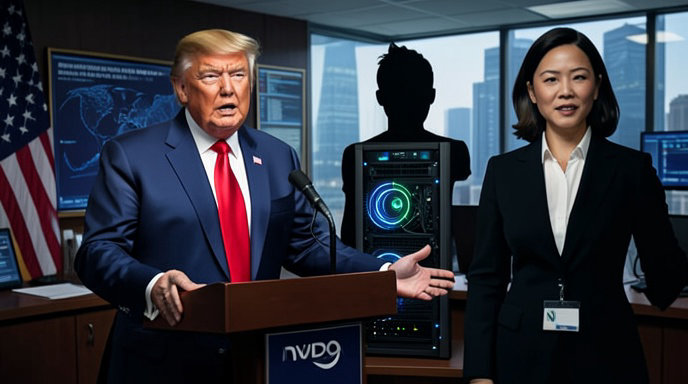
A controversial account involving Nvidia co-founder and CEO Jensen Huang, his wife Alice Huang, former President Donald Trump and alleged Chinese intelligence activity has drawn attention online. The claims suggest that Trump dismissed concerns about an alleged relationship involving Jensen Huang and Alice Huang, saying it did not create a national security threat.
Other reports, however, have purportedly attributed a far more serious assessment to U.S. intelligence officials: that Alice Huang was regarded as a Chinese spy.
Those assertions, if accurately reported, would represent a sharp conflict between a public political statement and the conclusions of the U.S. intelligence community. But the central allegations remain difficult to verify. No publicly released intelligence assessment, court filing or official investigation has established that Alice Huang worked for Chinese intelligence, and the available claims should not be treated as proven facts.
The Allegations at the Center of the Dispute
The controversy revolves around two separate propositions. The first is the alleged relationship involving Jensen Huang and Alice Huang and the question of whether it raised national security concerns. The second is the claim that intelligence officials privately assessed Alice Huang as an agent or asset of the Chinese government.
Public discussion has often blended those issues together, making it unclear whether the alleged relationship itself was viewed as a security risk or whether the concern stemmed from purported links to Chinese intelligence, business networks or political influence operations.
That distinction matters. A personal relationship, even one involving a prominent technology executive, is not by itself evidence of espionage. Likewise, an intelligence assessment—if one exists—would not automatically establish criminal conduct. Intelligence agencies routinely evaluate people based on incomplete information, and their assessments can include varying degrees of confidence.
What Trump Reportedly Said
Trump’s reported position was that the alleged relationship did not present a national security threat. That view appears to challenge the premise that Alice Huang’s alleged connections warranted government intervention or heightened scrutiny.
The statement also raises questions about what information was available to Trump when he made it, whether he was referring to a specific investigation and whether his comments were based on intelligence briefings, law-enforcement findings or personal and political judgments.
Without a transcript, official statement or authenticated recording providing the full context, it is difficult to determine precisely what Trump meant. Public remarks about intelligence matters can also omit caveats that are included in classified assessments, such as confidence levels, competing explanations or unresolved questions.
The Reported Intelligence Assessment
The opposing account says U.S. intelligence officials assessed Alice Huang as a Chinese spy. That claim has significant implications, but it has not been substantiated publicly through identifiable government records.
A credible assessment of that kind would normally be expected to generate a documentary trail, such as a declassified report, congressional testimony, court filing, sanctions designation or statement from a named official. None of those forms of evidence has been clearly established in the claims circulating publicly.
It is also important to distinguish between being described as a “spy,” being investigated for possible intelligence ties and being considered a person of interest. Those terms carry very different meanings. Intelligence reporting may identify a person as a potential intermediary, influence target or contact without concluding that the individual knowingly worked for a foreign government.
Why the Nvidia Connection Matters
The allegations have attracted attention partly because of Jensen Huang’s position at Nvidia, one of the most strategically important semiconductor companies in the world.
Nvidia’s graphics processors and artificial-intelligence accelerators are central to the global technology race. The United States has imposed export controls intended to restrict China’s access to advanced computing systems, while Nvidia has repeatedly adjusted its product strategy to comply with changing rules.
That makes any credible allegation involving foreign intelligence activity and a senior Nvidia figure potentially significant. Concerns about technology transfer, corporate influence, insider access and political pressure are already major issues in the semiconductor industry.
At the same time, Nvidia’s importance makes it especially vulnerable to sensational or politically motivated claims. Allegations involving its leadership can affect investors, employees, customers and regulators even when they have not been proven.
The Broader U.S.-China Technology Tensions
The dispute comes amid increasingly intense competition between Washington and Beijing over semiconductors, artificial intelligence and advanced manufacturing.
U.S. officials have warned that Chinese intelligence services seek access to sensitive technologies through cyber operations, recruitment, partnerships, academic exchanges and business relationships. Chinese officials have rejected many U.S. accusations and have criticized American export controls as an effort to contain China’s technological development.
Against that backdrop, allegations about a prominent technology executive can quickly become part of a larger geopolitical narrative. But geopolitical tension does not eliminate the need for evidence. Claims about espionage can damage reputations and complicate diplomatic relations, particularly when they involve private citizens who have not been charged with wrongdoing.
The Need for Evidence and Context
The most important unanswered question is whether any government agency formally concluded that Alice Huang worked for Chinese intelligence. So far, the allegation appears to rest on unattributed reporting or claims that cannot be independently confirmed.
Several details would be needed to evaluate it responsibly:
- Which intelligence agency made the assessment?
- When was it made, and with what level of confidence?
- Was the assessment shared with Congress, law enforcement or the White House?
- Did it concern confirmed activity, suspected contacts or a broader counterintelligence review?
- Was Alice Huang ever charged, sanctioned or publicly identified by the U.S. government?
Until those questions are answered, describing Alice Huang as a Chinese spy risks presenting an unverified allegation as fact.
What the Dispute Says About Intelligence in Politics
The episode also illustrates the tension between classified intelligence and public political debate. Presidents and senior officials may receive information that cannot be disclosed publicly, while journalists and the public must evaluate claims using incomplete evidence.
That imbalance can create opportunities for selective disclosure. A politician may cite intelligence to support a public position without revealing its source, while critics may invoke unnamed officials to challenge that position without producing documentation.
Neither approach provides a reliable substitute for transparency. Where possible, claims should be supported by official records, named sources, corroborating evidence and clear explanations of what is known versus suspected.
Implications for Nvidia and the AI Industry
For Nvidia, the controversy adds another layer of scrutiny to an already complex relationship with Washington and Beijing. The company faces pressure to comply with export restrictions, protect sensitive technology and maintain access to major international markets.
Any genuine counterintelligence investigation involving a senior executive would likely trigger questions about corporate governance, disclosure obligations and national-security safeguards. But absent verified evidence, the immediate risk is reputational rather than regulatory.
The broader AI industry faces a similar challenge. As advanced computing becomes strategically important, executives and companies will increasingly be judged not only on commercial performance but also on their relationships, international operations and exposure to foreign influence.
Conclusion
The reported clash between Trump’s public comments and alleged U.S. intelligence findings presents a dramatic national-security story, but the available information does not establish the central accusations. The alleged relationship involving Jensen Huang and Alice Huang, and the claim that Alice Huang was assessed as a Chinese spy, require substantially stronger evidence before they can be treated as confirmed developments.
For now, the episode is best understood as an unverified dispute involving politics, intelligence and the world’s most important semiconductor company. Its significance will depend on whether credible documentation, official testimony or independently corroborated reporting emerges to clarify what investigators actually believed—and what, if anything, they proved.

Get All The Latest Updates Delivered Straight To Your Inbox For Free!