
Trump Floats Tim Cook as Potential Successor to Nvidia CEO Jensen Huang
TL;DR
- President Donald Trump has reportedly floated Apple Chairman Tim Cook as a possible successor to Nvidia CEO Jensen Huang in a Truth Social post.
- The suggestion is highly speculative: Cook leads Apple’s board after serving as CEO, while Huang remains Nvidia’s co-founder and long-standing chief executive.
- A leadership change involving either executive could have major implications for Apple, Nvidia, artificial intelligence and the global semiconductor industry.
A surprising piece of leadership speculation has put two of the technology industry’s most recognizable executives in the same succession conversation.
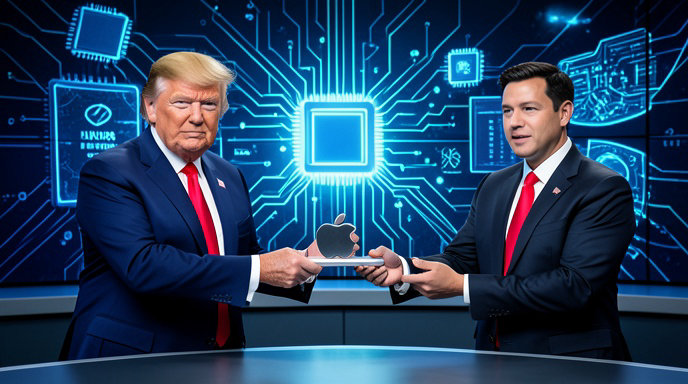
President Donald Trump reportedly suggested on Truth Social that Apple Chairman Tim Cook could replace Nvidia CEO Jensen Huang. The idea immediately drew attention because Cook and Huang occupy very different positions in the technology ecosystem: Cook is closely associated with Apple’s global consumer-device business, while Huang has guided Nvidia’s transformation from a graphics-chip company into the dominant supplier of hardware and software for artificial intelligence.
The reported post did not amount to a formal announcement from Nvidia, and there is no indication that Huang is preparing to leave the company. Nor has Apple indicated that Cook is seeking an operating role elsewhere. The speculation therefore appears to be political and personal commentary rather than evidence of an active succession process.
Two of Silicon Valley’s Most Influential Leaders
Cook became Apple’s chief executive in 2011, succeeding co-founder Steve Jobs. A veteran of Apple’s operations organization, Cook was widely credited with strengthening the company’s supply chain, expanding its international manufacturing network and turning the iPhone into the foundation of a broader services and devices ecosystem.
Apple announced in 2025 that Cook had moved from the CEO position to executive chairman, with John Ternus taking over as chief executive. In his chairman role, Cook remains an influential figure at Apple, but his responsibilities differ from those of a day-to-day operating chief.
Huang co-founded Nvidia in 1993 and has led the company throughout its rise in graphics processing, gaming, data centers and artificial intelligence. Under his tenure, Nvidia’s processors became essential infrastructure for training and running many of the world’s most advanced AI models.
That ascent has made Huang one of the most prominent executives in the semiconductor sector. His public appearances, product launches and long-term strategic bets have helped shape Nvidia’s identity as much as its technology has.
Why the Suggestion Is So Unexpected
Cook and Huang have complementary reputations, but their management backgrounds are markedly different.
Cook is known for operational discipline, supply-chain management, product execution and cultivating Apple’s tightly integrated hardware-and-services model. Huang is recognized as a technical founder, a charismatic product evangelist and an architect of Nvidia’s platform strategy, which combines chips, networking, systems and software.
Replacing Huang would therefore involve more than choosing a conventional corporate administrator. Nvidia’s competitive position depends heavily on its CUDA software ecosystem, relationships with cloud providers and AI developers, and ability to maintain a rapid product cadence against rivals such as AMD, Intel and custom-chip designers.
The reported suggestion also raises a practical question: whether an executive whose public career is centered on Apple could fit Nvidia’s founder-driven culture and highly specialized semiconductor business.
No Evidence of an Nvidia Succession Plan
There is currently no confirmed indication that Nvidia’s board has selected Cook, or any other candidate, to replace Huang. Nvidia has not announced that Huang is stepping down, and the company’s public communications continue to present him as its leader.
CEO succession planning is standard practice at major companies, particularly those whose market value and strategic direction are closely linked to a single executive. But a succession plan is not the same as an imminent transition. Nvidia’s board would ordinarily be expected to evaluate internal and external candidates, consider technical and operational expertise, and assess how a new CEO could preserve investor confidence.
Any leadership change would also likely be closely watched by customers and partners. Major cloud companies, AI developers and enterprise technology buyers have made multibillion-dollar investments based partly on Nvidia’s product roadmap and software compatibility.
What Cook Could Bring to Nvidia
If Cook were ever considered for an operating role at Nvidia, his strongest potential advantages would be organizational and strategic rather than technical.
He has experience managing a vast global supply chain, negotiating with manufacturing partners and scaling premium hardware products. Those skills could be relevant to Nvidia as it works with foundries, advanced packaging providers, memory suppliers, server manufacturers and cloud companies to meet extraordinary demand for AI accelerators.
Cook also has experience navigating geopolitical tensions involving technology manufacturing and international trade. That background could be valuable as semiconductor companies contend with export restrictions, government incentives and efforts to build domestic chip production.
However, the transition would carry substantial risks. Nvidia is not simply a hardware vendor. Its success increasingly depends on a software platform, developer ecosystem and research-driven product strategy. A successor without deep familiarity with accelerated computing and AI infrastructure could face a steep learning curve.
What Nvidia’s Future Leadership Could Mean for AI
The identity of Nvidia’s next leader, whenever that transition occurs, could influence the pace and direction of the AI hardware market.
A successor who closely follows Huang’s strategy might continue emphasizing full-stack systems, networking and software. Another leader might focus more heavily on enterprise partnerships, custom silicon, automotive applications or diversification beyond data-center AI.
The company also faces increasing competition. AMD is expanding its AI accelerator portfolio, while major cloud providers are developing their own chips to reduce dependence on Nvidia. Startups and established semiconductor companies are targeting specialized inference hardware, networking and advanced packaging.
Nvidia’s ability to preserve its lead will depend not only on chip performance, but also on pricing, availability, energy efficiency and the strength of its software ecosystem. Leadership continuity could help reassure customers, while a dramatic change could prompt rivals and buyers to reassess their strategies.
Implications for Apple
The reported speculation also highlights Cook’s unusual position at Apple.
As executive chairman, Cook remains one of the company’s most experienced leaders and its most recognizable strategic figures. Apple’s decision to appoint Ternus as CEO marked a generational transition, but Cook’s continued presence provides institutional knowledge during a period of major change in artificial intelligence, services, custom silicon and global regulation.
A move to Nvidia would be a major departure from Apple’s leadership structure and could raise questions about Apple’s board governance and long-term strategy. It would also remove an executive with deep knowledge of Apple’s suppliers, government relationships and international operations.
Apple and Nvidia are both benefiting from the AI boom, but in different ways. Nvidia supplies much of the infrastructure used to develop AI systems, while Apple is seeking to integrate AI features into its devices and software while maintaining control over its hardware and user experience.
Trump’s Broader Technology Focus
The reported Truth Social post fits into Trump’s broader interest in high-profile technology companies, domestic manufacturing and the strategic importance of semiconductors.
The semiconductor industry has become a central issue in U.S. economic and national-security policy. Advanced chips are critical to artificial intelligence, defense systems, cloud computing and communications, while their production remains concentrated among a relatively small number of companies and regions.
Trump has frequently commented publicly on corporate decisions, executive leadership and technology investments. Such remarks can attract substantial market attention even when they do not reflect formal negotiations or company policy.
For investors and industry executives, the distinction between political commentary and corporate action is therefore important. A public suggestion does not establish that a board is considering a candidate, that an executive is available or that a succession process has begun.
The Bigger Question Is Leadership Continuity
The central issue is not whether Cook is actually preparing to take over Nvidia. There is no confirmed evidence of such a plan. The more consequential question is how Nvidia would sustain its momentum after Huang eventually leaves.
Huang’s influence is unusually broad. He helped define Nvidia’s product direction, built its developer ecosystem and consistently positioned the company at the center of major technology shifts. Any successor would need to maintain relationships with customers and employees while convincing the market that Nvidia’s strategy remains intact.
Cook’s name is compelling precisely because he is one of the few technology leaders with comparable experience running a global hardware company at enormous scale. But the similarities end there. Apple’s consumer ecosystem and Nvidia’s AI infrastructure platform operate under different economic models, competitive pressures and technical demands.
For now, the reported suggestion remains an intriguing example of how closely executive leadership and technology strategy are intertwined. Unless Nvidia or Cook provides further information, it should be treated as speculation—not as evidence of an impending change at the top of the AI chip industry.

Get All The Latest Updates Delivered Straight To Your Inbox For Free!