
Uber and Zipline Launch Drone Delivery in Texas, Targeting 1 Million Daily Deliveries
TL;DR
- Uber and Zipline are bringing autonomous drone delivery to Texas, beginning a rollout designed to make fast, small-order delivery available through Uber Eats.
- The companies plan to expand the service to dozens of additional U.S. cities, with Zipline targeting the capacity to complete as many as 1 million deliveries per day by the end of 2029.
- The program could reduce delivery times and road traffic, but its broader impact will depend on regulation, public acceptance, safety, weather resilience, and the ability to integrate drones into crowded urban airspace.
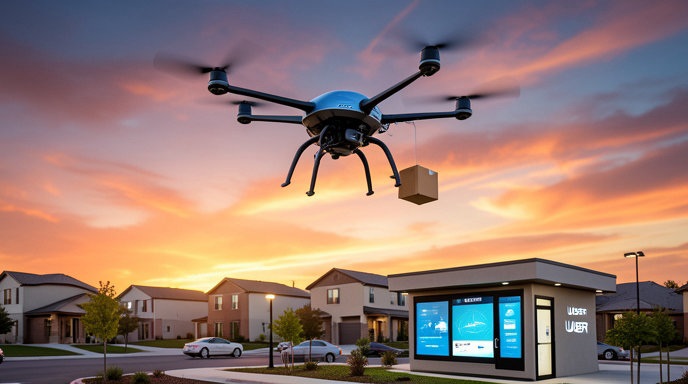
Uber and Zipline are moving drone delivery from pilot projects toward a large-scale commercial operation, starting in Texas and preparing for expansion across dozens of additional cities.
The partnership combines Uber’s consumer delivery marketplace with Zipline’s autonomous aircraft and logistics infrastructure. Customers are expected to order eligible products through Uber Eats, while Zipline drones handle the airborne portion of the journey from participating restaurants, retailers, pharmacies, and other merchants.
The ambition is substantial: Zipline says its next-generation network could ultimately support as many as 1 million deliveries per day by the end of 2029. Reaching that level would require a major expansion of aircraft, launch sites, charging systems, airspace coordination, and merchant participation.
Texas Becomes the Starting Point
Texas is serving as an early test market for the Uber-Zipline service. The companies have identified the state as a suitable launch environment because of its large metropolitan areas, dispersed suburban development, growing technology sector, and relatively favorable conditions for testing new transportation systems.
The initial service is expected to focus on lightweight orders that can be moved more efficiently by air than by car. That could include restaurant meals, groceries, convenience items, health products, and other small packages.
Rather than sending drones from a centralized warehouse, Zipline’s model is designed to place aircraft and launch equipment close to participating businesses. This approach could reduce the distance between the merchant and customer while allowing the drone network to serve multiple locations throughout a metropolitan area.
The service will not replace conventional Uber Eats delivery for every order. Weight, size, distance, weather, airspace restrictions, and the availability of a nearby Zipline launch point will determine whether an order is eligible for drone delivery.
How Zipline’s Autonomous System Works
Zipline has developed several generations of autonomous delivery aircraft. Its newer systems are designed to operate with limited human intervention while retaining remote oversight for safety and unusual situations.
The aircraft typically use a fixed-wing design for efficient longer-distance flight, combined with systems that allow them to operate in constrained delivery areas. Zipline’s technology is intended to support precise drop-offs without requiring the aircraft to land directly at a customer’s home.
For residential deliveries, the drone can lower a package to a designated location using a tethered mechanism. This allows the aircraft to remain airborne while the order is placed on a driveway, lawn, or another approved delivery area. The method is designed to reduce the need for landing zones and help the aircraft operate in suburban environments.
Autonomous navigation systems manage routing, altitude, obstacle avoidance, and return-to-base procedures. Human operators can monitor flights and intervene when required, although the long-term economics of the service depend on each operator overseeing multiple aircraft rather than manually piloting every delivery.
Uber Supplies the Customer Network
For Uber, the partnership offers a way to broaden its delivery platform beyond cars, bicycles, and scooters.
Orders placed through Uber Eats can be matched with Zipline’s aircraft when the customer, merchant, package, and route meet the operational requirements. Uber’s software can manage order placement, payments, customer communication, delivery tracking, and the transition between different transportation methods.
The integration also gives Zipline access to an established consumer marketplace. Instead of building a separate ordering application and recruiting customers city by city, Zipline can use Uber’s existing merchant relationships and user base.
That could be particularly valuable in dense markets, where a drone may complete a short delivery faster than a car navigating traffic. It may also help restaurants and retailers serve customers outside their immediate walking or driving radius without adding another conventional delivery vehicle to the road.
The Path to One Million Deliveries a Day
Zipline’s target of 1 million daily deliveries by the end of 2029 represents one of the most aggressive scaling goals in the commercial drone industry.
The company’s strategy depends on deploying large numbers of aircraft and “Zip Hubs” near high-demand merchants and neighborhoods. These hubs would allow drones to be loaded, launched, recovered, inspected, and recharged with minimal downtime.
Achieving the target would require more than simply manufacturing aircraft. Zipline would need to build a network capable of coordinating thousands of simultaneous flights, processing packages quickly, maintaining reliable connectivity, and responding to weather or temporary airspace closures.
The company would also need to expand beyond a limited number of pilot neighborhoods. That means securing local approvals, gaining customer trust, establishing delivery zones, and proving that the economics work at scale.
A million deliveries per day would still represent only a portion of the broader food, retail, and parcel-delivery market. However, it would make autonomous aircraft a meaningful part of urban logistics rather than a niche service used for demonstrations or specialized medical shipments.
Faster Delivery and Less Road Traffic
The most immediate benefit for customers could be speed. A drone can travel directly between a merchant and a delivery location, avoiding road congestion and reducing the number of steps between order preparation and arrival.
For short-distance deliveries, that could make hot food arrive sooner and allow retailers to offer rapid delivery without deploying as many cars. Pharmacies and health providers could also use the network for time-sensitive products, although medical deliveries may require additional controls and packaging standards.
The environmental impact is more complicated. Replacing car trips with electric drones could reduce fuel consumption, road congestion, and vehicle emissions. The benefit will depend on factors including drone energy use, flight distances, delivery density, the source of electricity, and whether a drone replaces a dedicated car trip or is used for an order that would otherwise have been bundled with other deliveries.
Noise is another consideration. Electric drones are quieter than conventional aircraft, but a large network operating throughout the day could still change the soundscape of neighborhoods.
Urban Airspace Will Become a Bigger Issue
The expansion of drone delivery will place new demands on the systems used to manage low-altitude airspace.
Unlike high-altitude commercial aviation, delivery drones will operate close to buildings, trees, roads, utility lines, and people. As more companies deploy aircraft, operators will need reliable methods for identifying drones, sharing routes, avoiding conflicts, and handling emergencies.
Federal aviation rules govern many aspects of commercial drone operations, but local governments and communities also influence where launch facilities can be built and how flights are conducted. Noise limits, privacy concerns, zoning rules, and restrictions around schools, airports, stadiums, and other sensitive locations could affect the pace of expansion.
A mature drone-delivery network will likely require a combination of automated traffic-management software, standardized identification systems, geofencing, remote supervision, and clear procedures for lost communications or unexpected obstacles.
Weather and Reliability Remain Practical Challenges
Texas offers a large potential market, but it also presents operational challenges. High winds, thunderstorms, extreme heat, heavy rain, and occasional winter weather can disrupt drone flights.
A delivery service must decide when conditions are safe enough to operate and how to handle orders when a flight is canceled after preparation. Customers may accept occasional delays, but widespread unreliability could limit adoption.
Aircraft maintenance will also become more complex as fleets grow. Drones must be inspected, repaired, charged, and kept available during peak ordering periods. Batteries, propulsion systems, communications equipment, and delivery mechanisms all need to perform consistently across repeated daily flights.
The companies will therefore be judged not only by their fastest deliveries but also by their completion rates, customer support, refund policies, and ability to integrate drone orders smoothly with conventional delivery options.
Privacy, Safety, and Public Acceptance
Drone delivery brings privacy concerns that do not arise in the same way with cars or sidewalk couriers. Aircraft may pass over homes and capture visual or sensor data needed for navigation. Operators will need clear policies governing what information is collected, how long it is retained, and who can access it.
Safety will be central to public acceptance. Residents will want reassurance that drones can avoid people, animals, power lines, and other aircraft, and that packages will not fall or be delivered to unsafe locations.
The tethered delivery approach is intended to reduce risks associated with landing, but customers and property owners may still have concerns about aircraft flying overhead or lowering packages near homes.
Public acceptance could vary substantially by neighborhood. Some residents may welcome faster delivery and fewer cars, while others may object to noise, visual clutter, or the presence of automated aircraft above private property.
A New Competitive Front in Delivery
The Uber-Zipline partnership places pressure on other delivery companies to develop or expand aerial logistics capabilities.
Amazon, Walmart, Wing, DoorDash, and specialized drone operators have all explored forms of autonomous delivery, though their approaches differ in aircraft design, merchant relationships, launch infrastructure, and geographic focus.
Uber’s advantage is its large consumer platform and broad merchant network. Zipline’s advantage is its experience building autonomous delivery systems and operating aircraft for commercial and medical logistics.
The partnership also gives both companies a way to test whether drone delivery can become a routine part of everyday commerce. If the service proves reliable and cost-effective, drones could become one option inside a larger delivery network that also uses cars, bicycles, scooters, lockers, and human couriers.
The Economics Will Determine the Outcome
The long-term viability of drone delivery will depend on cost per order rather than technological novelty.
Drone operations can reduce labor and vehicle expenses for certain routes, but they require investment in aircraft, launch hubs, batteries, maintenance, software, insurance, regulatory compliance, and remote operations centers.
The model works best when drones can perform many deliveries from a compact area with minimal downtime. High order density, predictable routes, lightweight packages, and short turnaround times will be important to achieving attractive economics.
Pricing will also influence demand. If drone delivery carries a substantial premium, it may appeal mainly to customers who value speed. If it can be offered at prices comparable to conventional delivery, adoption could be broader.
Uber and Zipline will need to balance customer fees, merchant costs, promotional incentives, and operational expenses while demonstrating that the service can generate sustainable margins.
From Pilot Program to Everyday Infrastructure
The Texas launch is an important test of whether autonomous delivery can move beyond limited demonstrations and become part of the daily transportation system.
Success will be measured through more than the number of flights. The companies will need to show that customers repeatedly choose drone delivery, merchants can prepare orders without disrupting operations, aircraft can operate safely in real-world conditions, and local communities are willing to host the necessary infrastructure.
If those pieces come together, the expansion to dozens of additional cities could mark a turning point for last-mile logistics. Meals, groceries, and small retail orders could increasingly travel through a hybrid network in which software decides whether the fastest route is by road or by air.
Zipline’s 1 million-delivery target remains an ambitious forecast, not a guaranteed outcome. But the Uber partnership gives the company a direct connection to consumer demand and a potential path to scale. The next several years will show whether autonomous drones can become a practical everyday delivery tool—or remain a promising technology constrained by regulation, economics, and the realities of urban airspace.

Get All The Latest Updates Delivered Straight To Your Inbox For Free!