
Waymo Robotaxis Still Passed School Buses After Software Fix, Feds Say
TL;DR
- Federal findings say Waymo robotaxis continued passing stopped school buses after a software update intended to address the behavior.
- The episodes have intensified questions about how autonomous vehicles detect buses, interpret flashing lights and enforce child-safety rules.
- Waymo says it has made system changes and is cooperating with regulators, while federal scrutiny of its safety controls continues.
Federal Findings Renew Questions About Waymo’s Fix
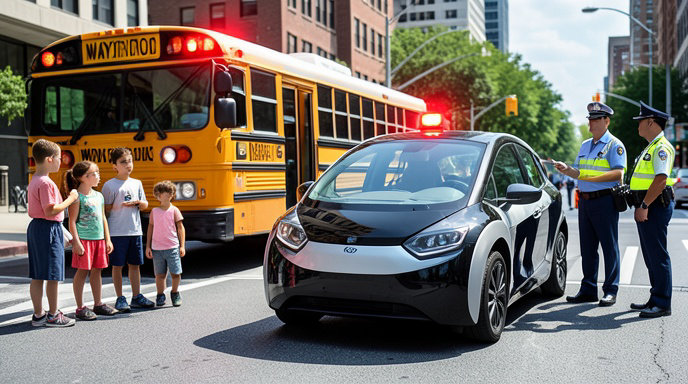
Waymo’s autonomous vehicles continued to illegally pass stopped school buses even after the company deployed a software update designed to correct the problem, according to the latest federal findings.
The revelations add a new chapter to regulators’ scrutiny of Waymo’s robotaxi technology. The investigation centers on whether the company’s vehicles reliably recognize school buses, understand when they are stopped to load or unload children, and remain stationary as required by traffic laws.
The alleged failures are especially significant because school-bus rules are among the clearest and most safety-critical requirements in U.S. road systems. Drivers are generally required to stop when a bus activates its warning signals, with only limited exceptions based on the road’s physical separation.
According to the federal review, the update introduced nearly a year ago did not fully eliminate the behavior. Some Waymo vehicles reportedly continued moving past stopped buses, raising concerns that the fix addressed only certain scenarios rather than the broader perception and decision-making problem.
Why School Buses Are Difficult for Robotaxis
A stopped school bus presents an unusually complex challenge for an autonomous-driving system. The vehicle may be partially obscured by traffic, parked cars, trees or roadside objects. Its flashing lights can vary in visibility, and the bus may be positioned at an angle or on a road with multiple lanes.
The system must also distinguish a school bus from other large vehicles and determine whether the bus is actively loading or unloading passengers. It then has to predict what nearby vehicles are doing and decide whether to stop, even when the road configuration or local rules differ.
Human drivers often rely on contextual clues, including the presence of children, crossing guards or a deployed stop arm. An autonomous vehicle must translate those clues into sensor data and software rules quickly enough to make a safe decision.
The alleged incidents suggest that Waymo’s system may have struggled with one or more parts of that process. A vehicle might identify the bus but fail to recognize that it was stopped for children, or it might detect the bus too late to stop smoothly. In other cases, the system could have classified the road as one where stopping was not required.
A Software Fix That Did Not End the Problem
Waymo introduced the software update after concerns emerged about vehicles passing stopped school buses. The company’s stated goal was to improve detection and ensure that robotaxis responded appropriately in those situations.
The federal findings indicate that the change reduced or targeted a known failure mode but did not guarantee correct behavior in every operating condition. That distinction is central to the regulatory review. A safety update can perform well in testing while still failing in less common situations encountered on public roads.
The continued incidents also raise questions about how Waymo validated the fix. Regulators are likely to examine the scenarios used in testing, the number and variety of school-bus encounters included in the company’s evaluation, and how quickly the system’s performance improved after deployment.
The investigation could also focus on monitoring. Autonomous-vehicle companies collect extensive data from their fleets, allowing them to identify unusual events and retrain or modify their systems. Federal officials may seek to determine whether Waymo detected the post-update incidents promptly and whether it reported them accurately.
Regulatory Scrutiny Intensifies
The findings add to broader federal scrutiny of Waymo’s autonomous-driving operations. Regulators have increasingly questioned how robotaxi companies identify and respond to unusual roadway situations, particularly when those situations involve vulnerable road users.
School buses carry heightened public-safety significance. A vehicle passing one illegally could expose children crossing the street to moving traffic, even if the robotaxi itself is traveling slowly and no collision occurs.
Federal officials may consider several potential responses, including requiring additional reporting, requesting a new software remedy, expanding testing requirements or seeking a formal recall-related action. The outcome will depend on the number of incidents, their circumstances and whether regulators determine that the problem creates an unreasonable safety risk.
The review also illustrates a challenge facing autonomous-vehicle oversight: software can change fleet behavior without a conventional mechanical recall. A company can deploy an update remotely, but regulators still need to verify that the change works consistently across vehicle versions, sensor configurations, locations and road conditions.
Waymo’s Response
Waymo has said it takes school-bus safety seriously and is cooperating with federal officials. The company has pointed to ongoing improvements to its autonomous-driving system, including changes intended to improve the detection of buses and the interpretation of their warning signals.
Waymo’s position is expected to emphasize the difference between a reported event and a collision or injury. The company has not been accused in these findings of causing a crash involving a child, but regulators are examining the behavior because passing a stopped school bus is itself a serious traffic violation and a potential safety hazard.
The company is also likely to argue that autonomous systems are continuously updated and evaluated, making software refinement a normal part of deployment. Critics counter that public-road testing should not shift the burden of discovering basic safety failures onto children, parents and school-bus operators.
That debate is becoming increasingly important as Waymo expands service. The larger the fleet and the wider the service area, the more often vehicles will encounter rare situations that may not appear during controlled testing.
The Stakes for Autonomous-Vehicle Deployment
Waymo has built its public image around cautious deployment and detailed safety validation. Reports that vehicles continued passing stopped school buses after a corrective update could therefore have consequences beyond this specific defect.
For the autonomous-vehicle industry, the issue highlights the limits of relying on aggregate safety statistics. A robotaxi may avoid many crashes overall and still exhibit a dangerous, repeatable failure involving one specific type of road user.
Regulators and the public will want evidence that Waymo can identify such failures, correct them and confirm that the corrections work in the real world. They may also press for more transparency about incident counts, testing methods and the conditions under which the vehicles failed.
The episode could influence future rules for autonomous vehicles, including requirements for school-bus detection, real-world validation and post-deployment reporting. It may also encourage states and school districts to establish clearer communication protocols between autonomous-vehicle operators and transportation officials.
What Comes Next
The immediate question is whether Waymo’s latest system changes have eliminated the behavior or merely reduced its frequency. Federal officials will likely continue reviewing incident data, software-update records and the company’s testing evidence.
Waymo could face pressure to provide a more detailed account of the affected scenarios and to demonstrate that its vehicles consistently stop for school buses across different roads, lighting conditions, traffic patterns and bus designs.
The controversy also underscores a broader truth about autonomous driving: fixing one failure mode does not necessarily solve the underlying problem. A software update may improve performance in one set of conditions while leaving the system vulnerable to variations that were not anticipated.
Until regulators are satisfied that the issue has been fully addressed, the findings will remain a significant test of Waymo’s safety claims—and of the government’s ability to oversee rapidly evolving autonomous-driving technology.

Get All The Latest Updates Delivered Straight To Your Inbox For Free!