
The Dangers of AI Overreach: Understanding "AI Psychosis" in the Workforce
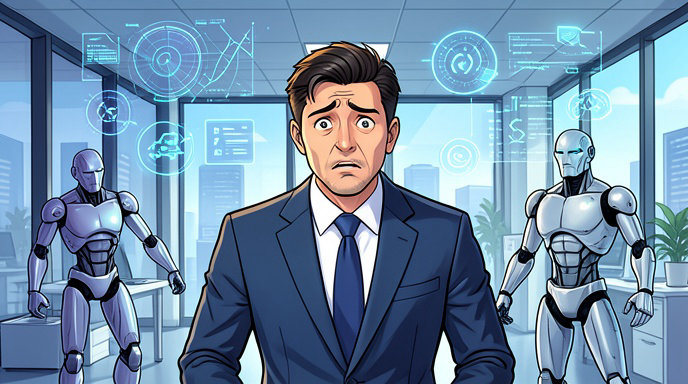
TL;DR
- Aaron Levie says tech leaders can fall into “AI psychosis” when they overestimate what AI can do after seeing only polished demos, not the messy work required to make systems reliable.
- The warning lands as companies keep cutting jobs and reshaping teams around AI, including recent claims that ClickUp replaced 22% of its workforce with AI agents.
- The broader lesson is that AI can boost productivity, but replacing human judgment too quickly can create operational, cultural, and strategic risk.
The Dangers of AI Overreach: Understanding "AI Psychosis" in the Workforce
A fast-growing phrase is capturing the current anxiety around workplace automation: “AI psychosis.” In Aaron Levie’s usage, the term is not a clinical diagnosis but a critique of how executives can become overly convinced that AI agents are ready to replace human labor at scale after seeing only idealized outputs. Levie, the CEO of Box, argues that leaders are often too far removed from the “last mile” of work to understand the hidden effort required to make AI useful in production.
That distance matters because real enterprise work is rarely a neat demo. It usually involves reviewing outputs, handling exceptions, correcting errors, and building guardrails before a tool can be trusted in a customer-facing or mission-critical workflow.
Why Levie says CEOs are especially vulnerable
Levie’s argument is that executives are prone to confusing a convincing prototype with a deployable system. He says CEOs often interact with AI in short bursts, such as generating a draft or a prototype, and then assume the agent can handle the entire workflow end to end.
That mismatch can lead to exaggerated confidence in automation. As Levie put it, leaders may focus on the polished result and miss the “10 or 20 steps” needed to produce that result consistently in a real business environment. His suggested antidote is simple: use AI extensively enough to understand both its strengths and its limitations.
The ClickUp layoffs and the automation debate
The warnings are arriving at a moment when some companies are openly tying workforce reductions to AI adoption. The prompt references recent layoffs at ClickUp, where 22% of the workforce was reportedly replaced by AI agents, underscoring how quickly firms are moving from experimentation to restructuring.
That kind of move is fueling a broader debate in tech: are companies replacing workers because AI is genuinely capable, or because executives believe it is capable before the evidence is there? Levie’s critique suggests the latter can happen when leadership gets seduced by the promise of automation without fully accounting for implementation costs, quality control, and the need for human oversight.
Tech layoffs and the pressure to do more with less
The AI push is unfolding against a wider backdrop of tech industry layoffs and cost cutting. Some companies are using AI as a direct substitute for labor, while others are cutting jobs to fund AI investment or to reorganize around new tools.
Goldman Sachs estimated in April that AI is responsible for about 16,000 job losses each month, according to the reporting cited in the source material. Even if the exact role of AI in each layoff is difficult to isolate, the direction of travel is clear: companies are increasingly treating AI as a force that can compress teams and accelerate output.
Why “replace” is often harder than “augment”
Levie’s broader view is that AI is more likely to augment workers than fully replace them. He has also suggested that AI agents may increase demand for employees by making it easier to start more ambitious tasks, which then still require humans to complete, verify, and manage.
That distinction is important. Automation can speed up parts of a workflow, but enterprises still need people to define the task, evaluate the result, handle edge cases, and ensure accountability. In practice, the value of AI may depend less on eliminating labor than on shifting where human effort is spent.
The real risk of AI overreach
The risk is not simply that AI fails. It is that decision-makers overcommit before the technology is ready, then restructure teams around assumptions instead of operations. When that happens, companies can end up with brittle systems, lower quality, and gaps in responsibility that only become visible after layoffs or service failures.
There is also a cultural risk. If employees see AI framed as a near-total substitute for their work, adoption can turn from a productivity initiative into a morale problem. That can make it harder to extract the benefits of AI even where the technology is genuinely useful.
What the current debate is really about
At its core, the “AI psychosis” debate is a warning against mistaking enthusiasm for readiness. Levie’s comments suggest that the most successful companies will be the ones that treat AI as a powerful but incomplete tool, not a magic replacement for expertise, judgment, and supervision.
For now, the industry is still searching for the right balance. The companies that get it wrong may move fastest at first, but they also risk discovering that the human work they removed was doing more than they realized.

Get All The Latest Updates Delivered Straight To Your Inbox For Free!