
Volvo's Expansion in the U.S. Secured by Trump Administration Decision
TL;DR
- The Trump Administration is allowing Volvo to keep selling connected cars in the U.S. through a specific authorization, despite rules targeting Chinese-linked vehicle technology.
- The decision gives Volvo room to proceed with its U.S. manufacturing expansion, including additional production in South Carolina and a new hybrid model.
- The case highlights the tension between national security regulation and foreign-owned investment in the U.S. auto industry.
Volvo’s U.S. Expansion Gets Breathing Room
Volvo Cars has secured approval from the U.S. government to continue selling vehicles equipped with Chinese-linked connected technology, giving the company a crucial reprieve as it navigates tighter American restrictions on foreign automotive software and data systems.
The move is especially important because Volvo is primarily owned by China’s Geely Holding, placing it squarely within the scope of new U.S. rules aimed at limiting connected vehicles tied to China and Russia.
Why the Decision Matters
The Commerce Department’s connected-vehicle rules are designed to restrict software and hardware from so-called “countries of concern,” with the stated goal of reducing cyber and data-security risks. Those rules have been widely viewed as a major obstacle for Chinese-owned automakers hoping to operate in the U.S. market.
Volvo’s authorization stands out because it suggests the company was able to persuade regulators that its governance structure, technology controls, and data-security practices meet U.S. concerns sufficiently for continued sales. That makes Volvo one of the few Chinese-owned automakers with a meaningful pathway to remain active in the U.S. market.
What Volvo Is Planning in the U.S.
Volvo is not just trying to preserve its current business; it is also pushing ahead with expansion plans in the United States.
The company has said it intends to produce a new hybrid model by the end of the decade and to manufacture its XC60 SUV in South Carolina by late 2026. Reuters reporting cited by other outlets also indicates Volvo plans to keep investing in U.S. production despite shifting policy conditions.
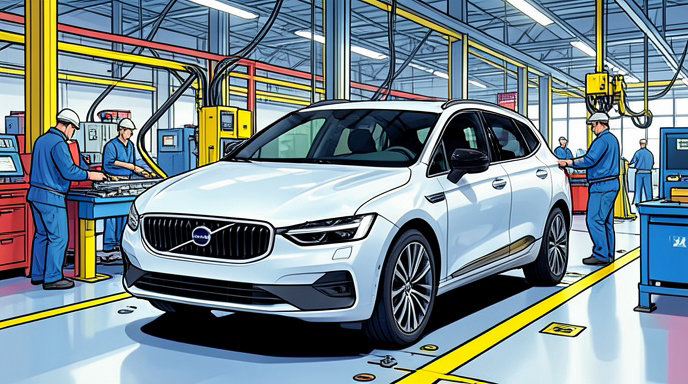
Volvo already has a manufacturing footprint in South Carolina, which gives it a domestic production base that many imported automakers lack. That local presence is now becoming more strategically important as rules around connected vehicles and supply-chain security tighten.
The Regulatory Backdrop
The Biden-era connected-vehicle restrictions set the stage for this conflict, but the Trump Administration’s approach appears to be more selective in how it applies enforcement and exemptions.
Reports indicate that Trump officials have signaled openness to Chinese automakers building factories in the U.S., even as broader national-security restrictions remain in place. That combination has created a complicated policy environment: the government is still scrutinizing Chinese-linked automotive technology, but it is also willing to consider case-by-case approvals when companies argue they are contributing to U.S. manufacturing and jobs.
A Sign of a Bigger Industry Shift
Volvo’s case may become an important precedent for other automakers with Chinese ownership, Chinese supply-chain exposure, or software dependencies linked to China. The core issue is no longer just where a vehicle is assembled; regulators are also looking closely at where the software, connectivity systems, and data pathways originate.
For automakers, that means the future of U.S. market access may depend as much on compliance architecture and software governance as on factory investment. Volvo’s approval suggests that a strong U.S. manufacturing story can help, but it is not enough on its own without a convincing security case.
What Happens Next
The immediate implication is that Volvo can keep selling connected vehicles in the U.S. while continuing to scale its American operations. The broader question is whether other foreign-owned automakers can secure similar treatment, or whether Volvo’s authorization is a narrow exception tied to its particular governance and compliance profile.
As the model-year deadlines for connected-vehicle restrictions move closer, companies with international ownership structures will likely face even more pressure to prove that their technology stacks are insulated from foreign government influence. Volvo’s experience shows that the U.S. market remains open, but only for firms able to navigate a much more demanding regulatory landscape.

Get All The Latest Updates Delivered Straight To Your Inbox For Free!