
America's Drone Walls vs China's Scale: Why US Bans Won't Stop the Global Robot Race
TL;DR
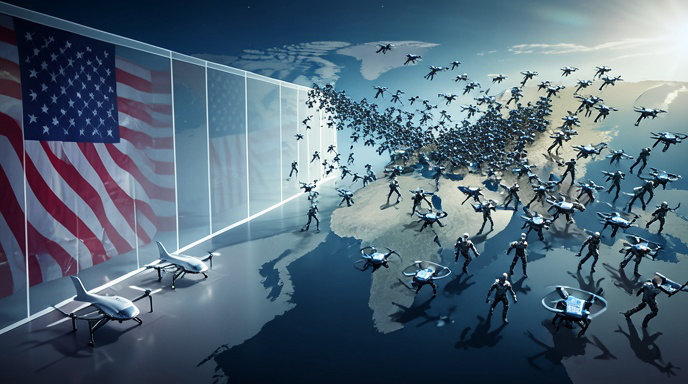
- The U.S. has erected a multi-layered wall against Chinese drones and robots — from FCC bans and the American Security Drone Act to tariffs exceeding 100% — effectively shutting DJI and other Chinese makers out of the federal and increasingly the commercial market.
- The barriers are backfiring at home: American alternatives remain far more expensive, less capable, and unable to scale, leaving police, farmers, filmmakers, and even the Pentagon facing higher costs and supply shortages.
- While Washington closes its market, Beijing is winning the rest of the world — using unmatched manufacturing scale, aggressive pricing, and factories in Southeast Asia to dominate emerging markets across Asia, Africa, Latin America, and the Middle East.
Washington Is Building a Fortress Against Foreign Robots
For years, American skies were dominated by a single name: DJI. The Shenzhen-based giant controls an estimated 70-80% of the global commercial drone market and more than 90% of the consumer market in the U.S. itself. Its drones became the default tool for everyone from Hollywood crews to county sheriffs to wheat farmers mapping their fields.
That era is ending by design. Over the past 18 months, Washington has moved from targeted restrictions to a near-total blockade.
The foundation was the National Defense Authorization Act (NDAA) for Fiscal Year 2024 and 2025, which included the American Security Drone Act — banning federal agencies from buying or operating drones made in China and other covered nations. In parallel, the Federal Communications Commission placed DJI and Autel Robotics on its Covered List, a designation that blocks authorization of new models. A provision in the FY2025 NDAA went further, mandating that DJI and Autel must be automatically added to the FCC’s ban list within a year unless a national security agency affirmatively proves they are not a risk — a review that has stalled and left new DJI imports in legal limbo.
Add to that the tariff wall. Under the second Trump administration, Section 301 tariffs and new reciprocal tariffs have pushed duties on Chinese drones and robotics components to as high as 145% at their peak in early 2025, before settling around 30-50% after temporary truces. U.S. Customs and Border Protection has also been quietly detaining shipments of DJI drones at ports since late 2024, citing the Uyghur Forced Labor Prevention Act.
The message is clear: the U.S. government no longer wants critical aerial and ground robotics infrastructure to be dependent on its chief geopolitical rival. The same logic is now expanding to ground robots, with Chinese quadrupeds and humanoids from Unitree, UBTECH, and Agibot facing similar scrutiny over data security and lidar sensors.
The Unintended Consequences: Higher Prices, Fewer Options
On paper, the bans are meant to nurture a homegrown drone industry. In practice, America’s industrial base isn’t ready to fill the void.
The Pentagon’s Blue UAS Cleared List — the roster of vetted, American-made alternatives — has grown to about two dozen models, but industry analysts and public safety agencies say the same thing: they cost 5 to 10 times more than their Chinese equivalents, often with shorter flight times, fewer payload options, and clunkier software.
Skydio, the largest U.S. consumer and enterprise drone maker, has pivoted almost entirely to military and enterprise customers and shuttered its consumer business. Other players like BRINC, Teal, and Vantage Robotics are promising but produce at a fraction of DJI’s volume. DJI can manufacture millions of units a year; the entire U.S. drone industry produces in the tens of thousands.
The pain is being felt far from Washington. A 2025 survey by the Association for Unmanned Vehicle Systems International found that more than 70% of first responder programs relied on DJI drones. Police and fire departments in states like Texas and Florida report having to ground fleets or pay $15,000-$25,000 for a U.S. drone that does the job of a $2,000 DJI Mavic. In agriculture, where drones now spray crops across millions of acres in the Midwest, farmers warn that losing access to DJI’s Agras series could raise costs and cut yields.
Critics argue the U.S. is repeating the mistakes of its 5G crackdown on Huawei — banning the market leader without having a competitive replacement ready, ultimately raising costs for domestic users while doing little to slow China’s global progress.
Scale Is The Ultimate Weapon
This is where China’s real advantage kicks in. Washington can wall off its own market, but it cannot wall off the world.
China produces more than 60% of the world’s industrial robots and over 80% of consumer drones. Its supply chain is vertically integrated in a way no other country can match — from batteries and motors to flight controllers and AI chips, all clustered within a few hours’ drive in the Pearl River Delta. That density allows companies like DJI and Unitree to iterate faster and produce cheaper than any Western rival.
When faced with U.S. restrictions, Chinese firms are not retreating; they are rerouting. DJI has ramped up sales in Southeast Asia, the Middle East, and Latin America, where price-sensitive governments and businesses eagerly adopt its technology for infrastructure inspection, delivery, and security. In Indonesia and Thailand, DJI agriculture drones now dominate rice fields. In Saudi Arabia and the UAE, Chinese drones are central to smart city and oilfield monitoring projects under Belt and Road-linked deals.
Chinese robotics firms are also mastering tariff circumvention. Companies are shifting final assembly to Vietnam, Malaysia, and Hungary, or licensing designs to joint ventures in third countries to legally change the country of origin. Unitree’s Go2 quadruped robot, which retails for around $1,600 in China, is now being sold through European distributors for under $3,000 — still less than half the price of a comparable Boston Dynamics or U.S.-built model.
The result is a two-track global market: a high-cost, security-vetted ecosystem inside the U.S. and its closest allies, and a massive, fast-growing, China-powered ecosystem everywhere else.
Why America Could Lose the Race It’s Trying to Win
The danger for the U.S. is not just that its drone ban is painful — it’s that it may be strategically counterproductive.
Technology races are won on volume and data. Every drone sold is a flying sensor that generates real-world flight data, which in turn trains better autonomy, obstacle avoidance, and AI. By ceding 90% of the global market to Chinese firms, the U.S. risks allowing China to set the de facto standards for drone communications, swarming algorithms, and humanoid robot platforms in the same way it set standards for DJI’s transmission protocol.
There is also the innovation feedback loop. DJI reinvests its massive consumer profits into R&D for enterprise and military-grade systems. Cutting it off from U.S. dollars hurts, but with sales booming in the Global South, its R&D budget remains enormous — estimated at over $2 billion annually. Meanwhile, U.S. startups, protected from competition but starved of scale, struggle to achieve the manufacturing learning curve that makes products cheaper and more reliable over time.
Some national security hawks argue the short-term pain is worth it to prevent a future where every American police department and power plant is dependent on hardware that could be bricked or surveilled by Beijing. That concern is not hypothetical — the Department of Homeland Security has repeatedly warned that Chinese-made drones could be used to exfiltrate sensitive mapping data.
But without a serious industrial policy to match the bans — including subsidies, streamlined certification, and massive procurement to help U.S. firms achieve scale — the walls risk becoming a fortress with no army inside.
The Global Robot Race Has Already Left the U.S. Border
The ultimate irony is that the U.S. effort to contain China may be accelerating the very decoupling it fears, but on China’s terms.
As American barriers rise, Chinese companies are becoming more global, not less. They are building factories in Indonesia, service centers in Brazil, and research partnerships in the Gulf. They are tailoring products for markets Washington largely ignores — affordable crop-spraying drones for Africa, $10,000 humanoids for Southeast Asian factories.
In the race to put robots in every field, warehouse, and police precinct on Earth, scale beats sanctions. America can choose who flies in its own skies, but it can no longer dictate who flies everywhere else — and right now, the rest of the world is still buying Chinese.

Get All The Latest Updates Delivered Straight To Your Inbox For Free!