
Apple Overhauls EU App Store Fees with 5% Commission for External Apps
TL;DR
- Apple is replacing its per-install Core Technology Fee (CTF) for apps distributed outside the App Store in the EU with a flat 5% commission on those apps’ sales, effective immediately for new agreements.
- The new structure eliminates the €0.50 per-install charge for most developers, but requires eligibility: developers must have at least 1 million annual installs across the EU to pay the 5% commission, and the fee applies only to sales generated through third-party marketplaces, not to App Store sales.
- Apple is also relaxing rules for alternative app stores, including removing the requirement for marketplace operators to maintain a bank guarantee and allowing them to offer only their own apps, in a bid to ease Digital Markets Act compliance.
A New Era for EU Developers: The 5% Commission Explained
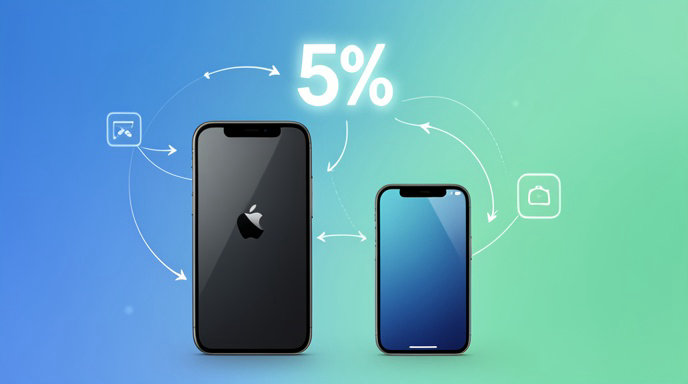
In a significant shift that rewrites the financial playbook for European app developers, Apple has announced a major overhaul of its fee structure for apps distributed outside its own App Store. The Cupertino-based giant is scrapping the controversial per-install Core Technology Fee (CTF) in favor of a simpler, revenue-based model: a flat 5% commission on sales generated by apps distributed via third-party marketplaces. This move, aimed squarely at appeasing regulators and simplifying compliance with the Digital Markets Act (DMA), is being hailed by some as a pragmatic concession and by others as a clever revenue-preservation tactic.
For over a year, developers in the EU have navigated a complex web of fees that were introduced to comply with the DMA. The old system charged a €0.50 fee for every install after the first million, a structure that drew widespread criticism for penalizing free apps and creating unpredictable costs for high-volume distribution. The new model, detailed in updated Apple Developer Program terms, replaces this entirely with a commission based on a percentage of the developer’s net revenue from those external sales.
How the New Fee Structure Works
Under the revised terms, the 5% commission applies to digital goods and services sold within an app that is distributed through an approved alternative marketplace. The key distinction is that this commission is not charged on sales made through Apple’s own App Store, which continues to carry its standard commission (typically 15% to 30% for small businesses and standard apps). The 5% fee is strictly for the "external" channel.
The eligibility criteria are straightforward but carry a significant threshold. The 5% commission only kicks in for developers who surpass 1 million annual installs across the EU in a given calendar year. For those below this threshold, the fee is effectively zero. Once the threshold is crossed, the commission applies to all sales made through third-party storefronts for the remainder of that year. This is a stark departure from the old CTF, which charged per install regardless of the app's monetization strategy.
Notably, Apple has also eliminated the "install" calculation from the equation entirely. A user who downloads a free app via a third-party store and never makes a purchase generates no revenue for Apple. The company only gets paid when the developer gets paid. This aligns Apple's interests with the developer's success, rather than with the virality of a free download.
Relaxed Rules for Alternative Marketplaces
Beyond the fee change, Apple is loosening the operational shackles on third-party marketplace operators. Previously, to launch an alternative store, companies had to secure a €1 million standby letter of credit from a bank, a barrier that many smaller developers found insurmountable. This requirement has been removed.
Furthermore, Apple now permits marketplace operators to offer a catalog consisting solely of their own apps. The old rules mandated that a marketplace must host apps from third-party developers to be considered a genuine "marketplace." This relaxation allows large developers like Spotify or Epic Games to create a dedicated storefront for their own suite of apps without needing to onboard unrelated developers, dramatically reducing the logistical and legal overhead.
Apple has also simplified the process for linking out to external websites for payment processing. Developers no longer need to apply for a specific "entitlement" to display a link to their website; the capability is now automatically available to all developers in the EU who have opted into the new terms.
The Strategic Calculus: Compliance vs. Revenue
The financial implications for Apple are nuanced. While the per-install fee generated a steady, predictable revenue stream from high-volume free apps, the 5% commission is more volatile. However, industry analysts point out that the change is strategically brilliant for maintaining revenue from successful apps.
Consider a hypothetical social media app with 10 million EU installs and €20 million in annual digital sales. Under the old system, the CTF would have cost €4.5 million (9 million installs x €0.50) plus the standard marketplace commission. Under the new system, the developer pays only 5% on the €20 million (€1 million), a drastic reduction. However, for a niche app with 2 million installs and only €100,000 in sales, the old fee would have been €500,000 (a loss), while the new fee is a mere €5,000. Apple is effectively forgoing punitive fees on low-earners to lock in a stable percentage of high-earners.
This move directly addresses the European Commission's concerns that the CTF was a "disguised penalty" that discouraged developers from taking advantage of the DMA's sideloading provisions. By shifting to a sales-based commission, Apple can argue that it is simply charging for the value of its developer tools and marketplace distribution, a position that is harder for regulators to attack.
What This Means for Developers
For startups and indie developers, the news is overwhelmingly positive. The removal of the install fee eliminates the "success tax" that previously punished apps that went viral. A developer can now distribute a free app through a third-party store with zero financial risk until they actually generate revenue.
For established players building their own marketplaces, the removal of the bank guarantee is a game-changer. It lowers the barrier to entry from a capital-intensive venture to a software development project. Combined with the ability to host only their own apps, large companies can now create "branded stores" that function as direct-to-consumer channels, bypassing Apple's 30% cut entirely while still paying the nominal 5% platform fee.
However, developers must still weigh the trade-offs. Choosing the new terms means forfeiting the ability to use Apple's in-app purchase system for external apps, and they must still display Apple's "Alternative Distribution" warning screens. The 5% commission is also not a blanket waiver—it applies to all sales, including those made through a developer's own website if the app links out to it, as long as the app was initially installed via a third-party marketplace.
The Road Ahead: DMA Compliance and Market Reaction
The European Commission has yet to issue a formal ruling on the revised terms, but the move is widely seen as a preemptive strike to avoid formal non-compliance charges. By removing the most contentious element—the per-install fee—Apple is addressing the core complaint of many developers who testified to regulators.
The broader tech community is watching closely. If the new terms are accepted, it could set a precedent for how Apple structures its business in other regulated markets. It also signals that Apple is willing to negotiate on fee structures when faced with existential regulatory threats, even if it means conceding on specific mechanics.
For now, the ball is in the developers' court. The new terms are available immediately in the EU, and developers have a 30-day window to decide whether to switch from the old CTF terms to the new 5% commission model. The choice is clear: stay with a predictable, albeit complex, per-install system, or embrace a simpler, revenue-aligned future that finally makes third-party distribution a financially viable option for everyone.

Get All The Latest Updates Delivered Straight To Your Inbox For Free!