
Defense Tech Hadrian Raises $1.37B to Revolutionize Submarine Manufacturing
TL;DR
- Hadrian secured a record $1.37 billion in Series D funding at an $8 billion valuation, making it the largest private round ever raised by a defense tech startup.
- The company’s automated "lights-out" factories will focus on high-precision components for submarines, missiles, and other critical defense platforms to break chronic supply chain logjams.
- The round was led by prominent deep-tech investors including Andreessen Horowitz, Lux Capital, and RTX Ventures, signaling a major shift toward software-driven, autonomous manufacturing in the U.S. defense industrial base.
The $1.37B Bet on Machines That Never Sleep
When the U.S. Navy needs a titanium housing for a Virginia-class submarine’s sonar array, it doesn’t just wait weeks—it waits months, sometimes over a year. The bottleneck isn’t a lack of engineering talent; it’s the antiquated, manual machine shops that still produce many of the most critical components for American defense platforms. Hadrian, a Torrance, California-based startup, just raised a staggering $1.37 billion to change that calculus permanently.
The funding round—the largest ever for a defense tech company—values Hadrian at $8 billion. It marks a definitive moment where Silicon Valley’s obsession with automation has collided head-on with the Pentagon’s most urgent manufacturing crisis. The company isn’t building a new fighter jet or a hypersonic missile. It’s building the machines that build the machines, and investors are betting that this unglamorous niche is the most valuable real estate in national security.
The Submarine Supply Chain Nightmare
To understand why Hadrian commands an $8 billion valuation, you have to look at the numbers coming out of the U.S. submarine industrial base. The Navy is trying to build three Virginia-class submarines per year, but shipyards are currently managing less than half that. The primary culprit isn’t welding or hull assembly—it’s the "long-lead" precision components: engine mounts, periscope housings, valve bodies, and the thousands of intricate metal parts that must meet tolerances measured in microns.
Today, most of these parts are produced by a fragmented network of mom-and-pop machine shops. Many rely on 40-year-old CNC machines, manual inspection, and a workforce that is retiring faster than it can be replaced. Lead times for complex aerospace-grade aluminum or titanium parts routinely stretch to 50 weeks. Hadrian’s thesis is simple: replace the human-centric factory floor with a fully autonomous system that uses AI to design machining paths, robotic arms to load and unload parts, and real-time sensors to measure quality down to the micrometer.
Inside Hadrian’s "Lights-Out" Factory
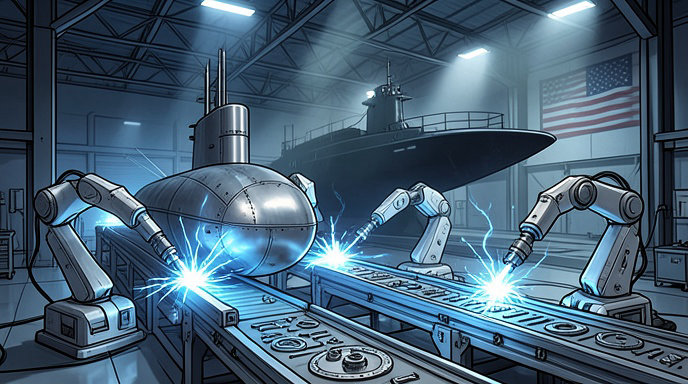
The company’s flagship facility in San Diego is a glimpse into the future of defense manufacturing. There are no humans on the factory floor. Instead, a fleet of robotic cells runs 24/7 in complete darkness—hence the term "lights-out" manufacturing. The system is driven by a proprietary software stack that ingests CAD models from defense primes and automatically generates the optimal machining strategy.
This isn’t just about speed; it’s about radical transparency. Hadrian’s software tracks every chip removed, every tool wear cycle, and every quality measurement in real time. The Pentagon can log into a dashboard and see exactly where a critical submarine part is in the production queue, down to the second. This digital thread is a massive leap from the current reality, where parts often disappear into a black hole of spreadsheets and phone calls.
The company claims it can reduce lead times from 50 weeks to under 3 weeks for certain components. For the Navy, that isn’t just an efficiency metric—it’s a strategic capability. If a submarine needs an unplanned repair part, Hadrian can produce it in days, not months, without requiring the original manufacturer to spin up a production line.
Investor Lineup: A Who’s Who of Deep Tech and Defense
The $1.37 billion round was co-led by Andreessen Horowitz (a16z) and Lux Capital, with significant participation from RTX Ventures, the venture arm of defense prime Raytheon Technologies. This is a notable signal: a legacy prime investing in a startup that threatens to disrupt the very supply chain it relies on.
Other participants included 8VC, Founders Fund, and Coatue Management. The presence of RTX is strategic—they see Hadrian not as a competitor, but as a critical enabler for their own missile and sensor programs. Hadrian’s founder, Chris Power, has emphasized that the company’s goal is not to build end-items but to become the "AWS of precision manufacturing"—a utility that all defense primes can plug into.
The sheer size of the round is also a statement. In a market where most defense startups struggle to raise a $50 million Series B, Hadrian’s $1.37 billion haul signals that institutional investors now view autonomous manufacturing as a foundational technology, similar to semiconductors or cloud computing.
Why This Matters for American Defense Industrial Capacity
The implications extend far beyond submarines. The Pentagon has spent years warning about the erosion of the U.S. defense industrial base. The war in Ukraine and tensions in the Pacific have exposed a harsh reality: America cannot produce munitions, spare parts, or platforms fast enough to sustain a high-intensity conflict.
Hadrian’s model addresses the root cause of this fragility: the loss of skilled machinists and the lack of modern capital investment in factories. By removing the human bottleneck, the company makes it economically viable to reshore production of critical components that had been outsourced to low-cost countries. The software also allows for rapid reconfiguration—the same factory that makes submarine parts today can be retooled to make missile fins next month.
This flexibility is the holy grail for the Pentagon, which has long sought "agile manufacturing" capabilities. Hadrian’s factories are essentially giant 3D printers for metal, but with the speed and precision of CNC machining. The company is also working on vertical integration of raw materials, securing domestic sources for specialty alloys to avoid reliance on foreign suppliers.
The Road Ahead: Scaling from Pilot to Fleet
Hadrian is currently producing parts for several classified programs and has contracts with all three major submarine builders: General Dynamics Electric Boat, Huntington Ingalls Industries, and the Naval Nuclear Propulsion Program. The new capital will be used to expand from two operational factories to at least six, with new sites planned in Texas and Ohio.
The company also plans to build a "megafactory" dedicated exclusively to submarine components, capable of producing over 10 million parts per year. This scale is necessary to close the Navy’s submarine production gap, which currently stands at over 20 boats behind schedule.
However, challenges remain. Scaling a lights-out factory is notoriously difficult—any software bug or tooling error can halt an entire automated line. Hadrian must also navigate the Pentagon’s rigorous cybersecurity and supply chain requirements, which often slow down adoption of new tech.
Still, the funding round provides a massive war chest to overcome these hurdles. As Chris Power noted in a recent interview, "The U.S. doesn't have a labor problem in defense manufacturing. It has a physics and software problem. We’re solving the software side, and the machines handle the physics."
A New Era for Defense Tech
The record round is a clear signal that the venture capital community views defense manufacturing not as a cyclical government contractor market, but as a high-growth technology sector. Hadrian is leading the charge, proving that the most critical infrastructure for national security is no longer the chip fab—it’s the autonomous machine shop.
For the submariners waiting on parts, and for the Pentagon planners calculating munitions stockpiles, Hadrian’s success could be the difference between a fleet that is on time and one that is perpetually delayed. The $1.37 billion is a down payment on a future where American defense manufacturing is fast, transparent, and resilient—and it can’t come soon enough.

Get All The Latest Updates Delivered Straight To Your Inbox For Free!