
Flock Safety Under Fire: CEO Calls for Compromise Amid Growing Surveillance Backlash
TL;DR
- Flock Safety CEO Garrett Langley is pushing for a national compromise on AI license plate reader regulation as backlash intensifies over the company's 80,000+ camera network across 5,000+ U.S. communities.
- Privacy advocates, civil liberties groups, and several cities warn the system enables warrantless mass surveillance, with concerns over data retention, police misuse, and sharing with federal agencies.
- The controversy has sparked contract cancellations and new state-level legislation, highlighting a growing national divide over how to balance AI-powered public safety tools with Fourth Amendment protections.
A Camera on Every Corner
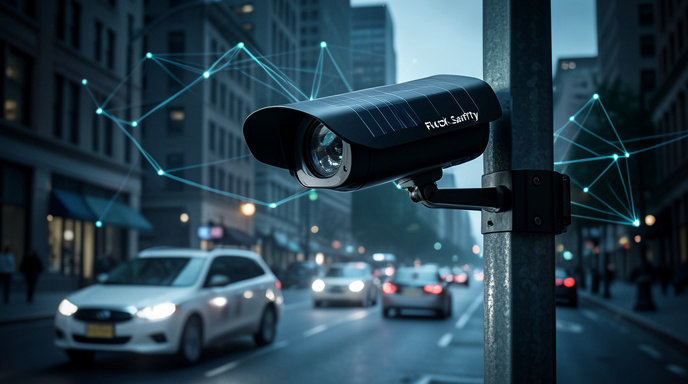
Flock Safety started with a simple pitch: solar-powered cameras that help police solve crime by capturing license plates, vehicle make and model, and color. In just a few years, that pitch has turned into one of the largest privately-operated surveillance networks in American history. As of summer 2026, Flock says its Falcon cameras are live in more than 5,000 communities across 42 states, scanning billions of vehicles per month.
That scale is exactly why the company is now at the center of a national firestorm. What was once sold as a tool to find stolen cars and AMBER Alert subjects is now being described by critics as a de facto national tracking system — one that can reconstruct where anyone has driven, without a warrant.
The Backlash Boils Over
The outcry has accelerated in recent months. The ACLU and Electronic Frontier Foundation have renewed warnings that Flock's network allows police to retroactively track individuals' movements for up to 30 days, the company's standard retention period, without judicial oversight.
Several flashpoints have fueled the debate:
In Denver, Oakland, and parts of Illinois, city councils have voted to pause or block new Flock contracts following public protests. In Norfolk, Virginia, a federal lawsuit challenging warrantless use of Flock data is moving toward trial after a judge denied the city's motion to dismiss. And reporting this summer revealed that data from Flock cameras was accessed in investigations that extended far beyond violent crime, including immigration enforcement and low-level offenses, contradicting the company's stated focus.
Critics also point to audit logs showing instances of officers searching the Flock database for personal reasons or without a clear investigative nexus, raising fears about misuse at scale. Unlike traditional police cameras, Flock's system is searchable by any authorized user on the network, and its AI-powered vehicle fingerprinting can identify cars even when plates are obscured or missing.
The CEO's Plea for Compromise
Facing mounting pressure, Flock founder and CEO Garrett Langley has shifted from defense to negotiation. In a series of interviews and a recent op-ed, Langley acknowledged that the industry has outpaced regulation and called for a federal framework to govern automatic license plate reader technology.
Langley's proposed compromise includes three pillars: a standardized 30-day data deletion limit codified into law, mandatory third-party audits and transparent usage policies for every agency, and a ban on sharing data with federal agencies for immigration enforcement without a warrant or court order.
"We can't have 18,000 different police departments making up 18,000 different rules for a technology that touches everyone," Langley said in an interview this month. "If we want to keep communities safe and protect civil liberties, we need clear, consistent guardrails that everyone can trust."
He has also argued that Flock is more accountable than its predecessors because it is a private vendor that can enforce uniform privacy controls, unlike fragmented legacy systems. The company points to its built-in audit trail, role-based access, and requirement that agencies publish transparency portals as evidence.
Why Privacy Advocates Aren't Buying It
For civil liberties groups, voluntary guardrails are not enough. They argue that Flock's business model itself is the problem: blanketing neighborhoods, shopping centers, and HOAs with cameras that feed into a centralized, searchable database.
The core concern is what experts call "dragnet surveillance." Even if you are never suspected of a crime, your car may be logged dozens of times a day. Over weeks, that data creates a detailed map of your life — where you work, worship, protest, and seek medical care.
"Flock is building the infrastructure for mass location tracking that the Supreme Court has already warned violates a reasonable expectation of privacy," said one senior attorney with the ACLU. "A private company setting its own retention policy is not a substitute for the Fourth Amendment."
Advocates are pushing instead for laws that would require a warrant to search historical ALPR data, mandate deletion within 24 to 72 hours unless flagged as evidence, and give communities the right to opt out entirely. California's proposed DELETE Act and Illinois' updated Biometric and Surveillance reforms, both advancing in August, would impose some of the strictest limits yet.
The Bigger Question: Safety vs. Surveillance
Flock and law enforcement officials counter that the technology is working. The company cites cases where its cameras helped locate abducted children, solve homicides, and recover stolen vehicles within hours. Police departments in Atlanta, Fort Worth, and Charlotte have publicly credited Flock with double-digit reductions in auto theft and carjackings.
That effectiveness is precisely what makes the debate so difficult to resolve. Polling consistently shows Americans are torn — they want tools that reduce crime, but are deeply uncomfortable with persistent government tracking.
The outcome in the Flock fight will likely set the precedent for the next generation of AI surveillance, from facial recognition to drone monitoring. Whether Langley's middle-ground proposal gains traction in Washington or is dismissed as damage control may determine if the U.S. gets a unified national standard — or a patchwork of bans, lawsuits, and unchecked expansion.
For now, the cameras are still rolling, and the compromise remains elusive.

Get All The Latest Updates Delivered Straight To Your Inbox For Free!