
Hyperscalers Face Energy Bill Shock as Natural Gas Prices Predicted to Triple for AI Data Centers
TL;DR
- A new forecast warns that natural gas prices could triple by 2027-2028 in key U.S. markets like PJM and parts of the Midwest and Mid-Atlantic, driven by surging AI data center demand, tight supply, and LNG export growth.
- Hyperscalers including Microsoft, Google, Amazon, and Meta that are increasingly relying on dedicated natural gas turbines to bypass grid bottlenecks now face billions in unexpected operating costs and stranded asset risks.
- The potential price shock is forcing a rethink of AI infrastructure strategy, accelerating interest in alternative power sources, long-term fixed-price contracts, and more energy-efficient data center designs to control future costs.
A Looming Price Spike in America's Gas Heartland
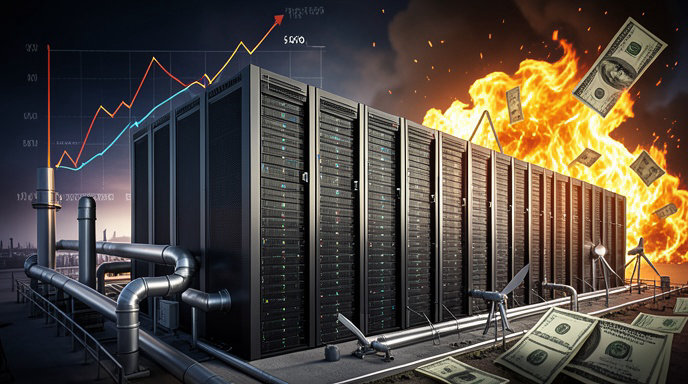
The era of cheap and abundant natural gas powering the AI boom may be coming to an abrupt end. A stark new forecast circulating this week warns that benchmark natural gas prices in several U.S. regions critical to data center expansion could triple within the next 18 to 24 months.
Analysts point to a perfect storm converging on the U.S. energy market. On the demand side, the explosive growth of AI data centers is adding unprecedented load to the grid, with projections showing data centers could consume up to 9-12% of total U.S. electricity by 2028, up from around 4% today. At the same time, U.S. liquefied natural gas (LNG) exports are hitting record highs, pulling domestic supply onto the global market. On the supply side, production growth in the Appalachian Basin and Permian has flattened, while pipeline constraints and depleted storage levels leave little buffer.
The most severe impact is expected in the PJM Interconnection, which covers 13 states including Virginia's Data Center Alley, as well as parts of ERCOT in Texas and MISO in the Midwest. In those constrained markets, spot prices that have hovered around $3 to $4 per MMBtu could surge to $9 to $12 per MMBtu during peak demand periods, according to recent modeling from energy research firms. For an industry that planned its next decade around $3 gas, that is a budget-breaking scenario.
Why Hyperscalers Went All-In on Gas
For hyperscalers, natural gas seemed like the perfect bridge fuel. Facing multi-year waits for new grid connections and pressure to bring gigawatt-scale AI campuses online by 2026 and 2027, tech giants turned to a workaround: bring your own power.
Instead of waiting for utilities to build new transmission, companies have been deploying massive behind-the-meter natural gas turbine plants directly adjacent to data centers. The pitch was simple, fast, and familiar. Gas turbines can be permitted and deployed in under two years, provide reliable 24/7 baseload power unlike intermittent solar and wind, and are far cheaper and cleaner than diesel backup.
Meta, Microsoft, Amazon Web Services, and Google have all either announced or been linked to gas-powered data center projects totaling tens of gigawatts. Startup AI infrastructure players and colocation providers followed the same playbook, with some new campuses designed to run 80-90% on dedicated gas generation. The strategy was built on the assumption that U.S. shale gas would remain cheap and plentiful for the foreseeable future.
The Math Behind a Potential Bill Shock
That assumption is now looking dangerously optimistic, and the financial exposure is enormous.
A single large-scale AI data center campus can consume 500 megawatts to over a gigawatt of continuous power — equivalent to the consumption of hundreds of thousands of homes. At $3.50 per MMBtu, fuel costs for a 1-gigawatt gas plant run roughly $250 to $300 million per year. Triple the gas price to $10.50, and that annual fuel bill skyrockets to over $750 to $900 million for that one campus alone.
For a hyperscaler operating a fleet of 5 to 10 such campuses, the added cost could easily reach $3 to $6 billion annually, wiping out margins and upending the unit economics of AI cloud services. Unlike utilities that can pass fuel costs to ratepayers, tech companies with behind-the-meter plants absorb that volatility directly unless they have locked in long-term, fixed-price supply contracts — which many, in the rush to build, did not.
Analysts note this creates a two-tier risk. First is the direct operating expense shock. Second is the risk of stranded or underutilized assets, where a gas-dependent data center becomes too expensive to run at full capacity during price spikes, forcing operators to throttle workloads or buy expensive emergency power from the grid anyway.
A Fragile Strategy Exposed
Beyond the balance sheet, the forecast exposes a deeper strategic vulnerability. The bet on gas was meant to buy energy independence, but it has instead tied the future of AI infrastructure to one of the most volatile commodity markets in the world.
Natural gas prices are notoriously sensitive to weather extremes, pipeline outages, and geopolitical shifts in the LNG market. A single polar vortex or a disruption at a major Gulf Coast export terminal could send regional prices soaring for weeks. For data centers that require 99.999% uptime, that volatility is an operational liability. It also complicates sustainability pledges, as running gas turbines around the clock makes net-zero commitments harder to defend, especially as investors and regulators increase scrutiny of AI's carbon footprint.
The recent capacity auction results in PJM, where prices for guaranteed power delivery hit record highs, have already signaled how tight the market has become. Adding a tripling of the underlying fuel cost on top of that could make gas-reliant data centers the most expensive place to run AI workloads in the country.
What Comes Next for AI Infrastructure
The warning is already reshaping how hyperscalers plan their next wave of buildouts. No one is abandoning gas overnight, but the urgency to diversify is now undeniable.
Three shifts are accelerating. First is a renewed push for long-term power purchase agreements and hedged fuel contracts to lock in prices for 10 to 15 years, even at a premium to today's spot market. Second is a fast-tracked return to nuclear, geothermal, and long-duration storage, with companies revisiting advanced nuclear deals and small modular reactor investments that were previously seen as too slow. Microsoft's agreement to help restart the Three Mile Island plant and Google's geothermal partnerships are now viewed as strategic hedges, not just green PR.
Third is a fundamental focus on efficiency. Chipmakers and data center designers are under pressure to deliver more compute per watt, with liquid cooling, custom silicon, and workload scheduling that can shift non-urgent AI training to times and regions where power is cheapest.
For now, the message to the industry is clear. The AI race will not just be won on models and chips, but on who can secure affordable, resilient power. And for those who bet the future on cheap natural gas, that future just got a lot more expensive.

Get All The Latest Updates Delivered Straight To Your Inbox For Free!