
Sonic Fire Tech Raises $15M to Revolutionize Fire Safety with Sound-Powered Suppression
TL;DR
- Sonic Fire Tech has secured $15M in new funding to scale its acoustic fire suppression technology, which uses low-frequency sound waves to extinguish flames without water or chemicals.
- The company plans to focus initial commercial deployment on high-risk indoor environments like commercial kitchens and multi-family apartment buildings, with long-term ambitions for early wildfire prevention.
- The investment signals growing investor confidence in non-traditional, sustainable fire protection as an alternative to conventional sprinkler and chemical suppression systems.
Beyond Sprinklers: A New Approach to Fire Suppression
For more than a century, fire protection has relied on the same core tools: water, foam, and chemical agents. Sonic Fire Tech is betting that the future of fire safety will sound completely different. The company has raised $15M in new funding to commercialize and scale its sound-powered fire suppression system, a technology that aims to put out fires using precisely tuned acoustic waves.
While still an emerging category, acoustic suppression has attracted attention for its potential to stop fires without causing water damage, leaving chemical residue, or requiring extensive plumbing. With fresh capital in hand, Sonic Fire Tech is now moving from prototype to deployment.
The Science Behind Sound-Powered Extinguishing
Unlike traditional methods that smother flames by cutting off oxygen with water or chemicals, Sonic Fire Tech's system attacks the fire at the level of combustion physics. The technology uses low-frequency sound waves, typically in the 30 to 60 Hertz range, to disrupt the fire triangle.
When directed at a flame, these powerful acoustic pressure waves create rapid oscillations in the air. This has two effects: it separates the flame from its fuel source by thinning the boundary layer where combustion occurs, and it displaces oxygen around the flame front. The result is a flame that cannot sustain itself and quickly collapses, without any physical agent ever touching the fire.
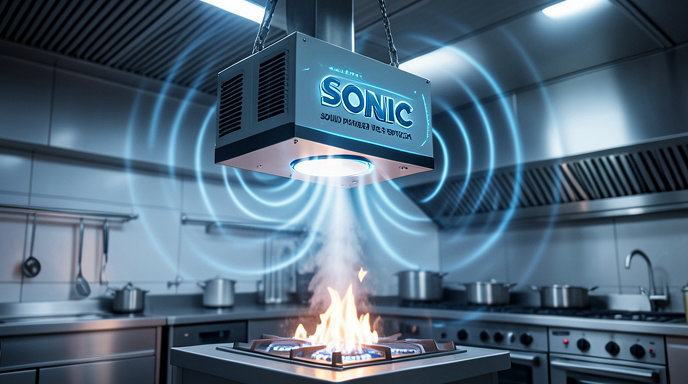
The system is built around acoustic transducers and waveguides that can be mounted on walls or ceilings, similar to speakers, and are connected to a control unit with thermal and optical sensors for rapid detection. Because it uses only electricity and sound, the system leaves no mess, requires no refill, and can be reset and reused instantly after activation.
From Lab to Kitchen: First Commercial Targets
Sonic Fire Tech plans to use the $15M to accelerate manufacturing and pursue regulatory certification for its first two target markets: commercial kitchens and apartment buildings.
These environments represent a major gap in current fire safety. In commercial kitchens, grease fires are a leading cause of property damage, and traditional chemical suppression systems require expensive cleanup and downtime after even a small incident. An acoustic system could suppress a stovetop fire in seconds without contaminating food surfaces or equipment.
In apartment buildings, the appeal is different. Conventional sprinkler systems, while effective, are a major source of water damage and are costly to retrofit in older structures. A sound-based system, which requires no water lines and causes no collateral damage when triggered, could offer landlords and developers a lower-impact alternative for early suppression, particularly in kitchens, utility closets, and hallways where fires commonly start.
The company has indicated the funding will go toward pilot installations with property management and restaurant groups, as well as expanding its engineering and safety testing teams.
A Bigger Vision: Early Wildfire and Building Prevention
While the near-term focus is indoor use, the long-term vision for Sonic Fire Tech is far more ambitious. The company has discussed adapting its acoustic technology for early wildfire intervention.
The concept involves networks of solar-powered acoustic arrays placed in high-risk wildland-urban interface zones. Equipped with smoke and heat sensors, these arrays could automatically target and suppress small spot fires in their incipient stage before they can spread, acting as an automated first line of defense. While outdoor deployment faces significant challenges related to scale, wind, and power requirements, it represents a potentially transformative application if proven viable.
The same principle could be extended to large-scale building protection, including warehouses, data centers, and heritage buildings where water damage is as concerning as fire damage itself.
What the $15M Investment Means for the Future of Fire Tech
The $15M raise marks a significant vote of confidence in alternative fire suppression at a time when climate change, urban density, and aging infrastructure are increasing fire risk. Investors are increasingly looking for clean-tech solutions that are sustainable, low-maintenance, and suitable for retrofitting.
For Sonic Fire Tech, the capital will be critical for navigating the lengthy certification process required by fire safety standards organizations and local fire codes, which is often the biggest hurdle for new suppression technologies. Success will depend not just on proving the science works in controlled tests, but on demonstrating reliability, safety for human hearing, and fail-safe operation in real-world conditions.
If the company can clear those hurdles, sound-powered suppression could move from a fascinating physics demonstration to a standard fixture in modern fire protection, offering a cleaner, smarter way to stop fires before they grow.

Get All The Latest Updates Delivered Straight To Your Inbox For Free!