
TerraPower's Secret Weapon: How Its Natrium Reactor Will Power the AI Data Center Boom
TL;DR
- TerraPower's Natrium reactor pairs a 345-megawatt sodium-cooled fast reactor with a gigawatt-hour-scale molten salt energy storage system, allowing it to surge to 500 megawatts on demand to meet volatile AI workloads.
- With construction underway in Kemmerer, Wyoming and a new $650 million funding round secured in 2025, TerraPower is targeting commercial operation by 2030-2031, positioning it to sign direct power deals with hyperscalers.
- Unlike conventional reactors and many SMR competitors, Natrium's ability to store heat and dispatch power flexibly solves the core mismatch between always-on nuclear and the spiky, 24/7 demands of AI data centers.
The AI Power Crunch Is Here
The artificial intelligence boom has created an energy problem that the grid was never designed to solve. A single large-scale AI data center campus can now consume 500 megawatts to a full gigawatt of power - equivalent to a mid-sized city - and it needs that power 24 hours a day, 365 days a year, without interruption. Big Tech's commitments to carbon-free operations have collided with this reality, sparking a frantic race to secure reliable, clean baseload power.
Tech giants are no longer waiting. Microsoft has moved to restart Three Mile Island, Amazon has backed X-energy's high-temperature reactors, and Google has signed a landmark deal with Kairos Power. But the company many analysts now see with a structural advantage is TerraPower, the Bill Gates-founded nuclear innovator building its first-of-a-kind Natrium plant in Wyoming.
More Than Just Another Small Modular Reactor
At first glance, Natrium looks like another advanced small modular reactor. It is a 345-megawatt sodium-cooled fast reactor, a design that has been studied for decades. What makes it fundamentally different is that it is not just a reactor. It is a nuclear-plus-storage hybrid system.
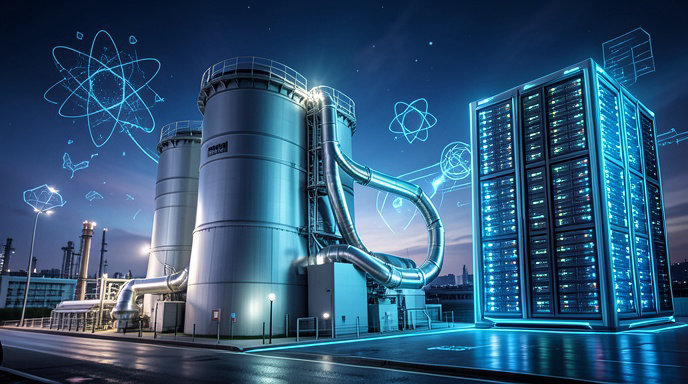
The plant is split into two islands. The nuclear island generates heat by circulating liquid sodium coolant through the reactor core. That heat is then used to heat molten salt in a separate energy island. The molten salt - the same low-cost technology used in concentrated solar plants - is stored in massive insulated tanks capable of holding more than a gigawatt-hour of thermal energy.
This decoupling is TerraPower's secret weapon. The reactor itself can run continuously at a steady, efficient 100% power, which is how nuclear performs best. The energy island, however, can dispatch electricity flexibly based on demand.
The Molten Salt Battery: Why Flexibility Wins the AI Race
Traditional nuclear plants are excellent at providing baseload power but terrible at load-following. They cannot quickly ramp up and down when a data center's power draw spikes during intensive model training or inference bursts. Renewables plus lithium-ion batteries can help, but they lack the multi-hour duration and reliability needed for mission-critical AI operations.
Natrium's molten salt storage solves this directly. When AI workloads are stable, the plant sends 345 megawatts to the grid. When demand surges, the system taps its thermal reservoir to spin its turbines harder and boost output to 500 megawatts for over five hours without burning extra nuclear fuel. It can then recharge its salt tanks when demand dips.
For a data center operator, this is the ideal profile: carbon-free, always-on power with built-in, long-duration storage that acts like a giant thermal battery. It eliminates the need for a separate gas peaker plant or massive battery farm to cover peaks, offering what TerraPower calls "flexible baseload" - a concept tailor-made for the volatile but relentless power curve of AI.
From Wyoming Coal Town to AI Power Hub
TerraPower is not building a paper reactor. Its demonstration plant in Kemmerer, Wyoming, is being built on the site of a retiring coal plant, reusing existing grid infrastructure and transmission lines. After receiving a construction permit from the Nuclear Regulatory Commission, the company began non-nuclear construction in mid-2024, pouring the foundation for the energy island and storage tanks.
The project is backed by up to $2 billion from the U.S. Department of Energy's Advanced Reactor Demonstration Program and received a major vote of confidence in June 2025 when TerraPower closed a $650 million funding round led by NVentures, Nvidia's venture arm, and Bill Gates. The company is now targeting commercial operation by late 2030 to 2031.
That timeline is critical. While competitors like NuScale have faced design and cost setbacks and Oklo is still pursuing licensing for its smaller Aurora microreactor, TerraPower has a clear path to deployment and, crucially, a product that hyperscalers actually want. In 2025, the company signed a memorandum of understanding with Sabey Data Centers to explore deploying Natrium plants directly co-located with future AI data center campuses - a model that would bypass congested grids entirely.
Why Competitors Are Playing Catch-Up
The race to power AI is crowded, but most approaches force a compromise. Light-water SMRs from companies like NuScale and GE Hitachi produce steady power but lack integrated storage, meaning they must be paired with external batteries or overbuilt to handle peaks. Microreactors from Oklo and others offer portability but at a much smaller 15-75 megawatt scale, requiring a fleet of units to power a single large campus.
Kairos Power's fluoride-salt-cooled reactor and X-energy's pebble-bed design are technologically impressive and have secured major backing from Google and Amazon respectively, but neither incorporates gigawatt-hour-scale thermal storage as a core feature. They are designed to be efficient baseload generators, not flexible peakers.
Natrium's integrated storage gives it a unique economic and operational pitch: one plant can act as both a baseload workhorse and a dispatchable peaker, commanding a premium price for reliable, clean power that can follow the load curve of a data center in real time. For Big Tech companies facing pressure to decarbonize while scaling AI compute exponentially, that flexibility is worth more than raw megawatts.
The Road to 2030
Challenges remain. Natrium is a first-of-a-kind design that must prove it can be licensed, built on time, and on budget - hurdles that have tripped up every advanced nuclear project before it. The supply chain for high-assay low-enriched uranium (HALEU) fuel is still maturing in the United States, though TerraPower is investing heavily with fuel partners to secure its needs.
Yet the strategic logic is becoming undeniable. AI data centers cannot run on intermittent power, and the grid cannot support their growth without new, firm generation. By combining proven sodium-cooled reactor physics with proven molten salt storage, TerraPower has created a system that bridges the gap between nuclear's reliability and the grid's need for flexibility.
If Kemmerer succeeds, TerraPower will not just have built a better reactor. It will have built the power plant the AI era was waiting for.

Get All The Latest Updates Delivered Straight To Your Inbox For Free!