
Uber Eats Takes Flight: Uber Partners With Zipline for Drone Delivery and Strategic Investment
TL;DR
- Uber Eats will soon offer Zipline drone delivery as a checkout option, with autonomous Platform 2 Zips handling ultra-fast deliveries of up to 8 pounds within a 10-mile radius.
- The service will launch first in Dallas-Fort Worth, Texas in late 2026, with expansion to additional U.S. metro areas planned for 2027 pending regulatory approval.
- Beyond the logistics partnership, Uber is making a direct strategic investment in Zipline to deepen its bet on autonomous last-mile delivery and reduce long-term delivery costs and times.
Beyond the App: Why Uber Is Betting on Drones
Uber is taking Uber Eats to new heights — literally. The company has announced a major new partnership with Zipline, the autonomous logistics leader best known for its medical drone deliveries in Rwanda and the U.S., to bring drone delivery directly into the Uber Eats network. The deal goes beyond a simple integration, as Uber is also making a strategic equity investment in Zipline to accelerate the rollout and co-develop the future of automated food delivery.
The move positions Uber Eats to compete more aggressively in the race for faster, cheaper, and more sustainable last-mile delivery, putting it head-to-head with rivals like DoorDash and Amazon who are also experimenting with drone logistics.
How the Zipline Delivery System Will Work
The integration will be seamless for customers. Eligible users in launch zones will see a new "Drone Delivery" option at checkout in the Uber Eats app for participating restaurants and merchants. If selected, the order process changes behind the scenes.
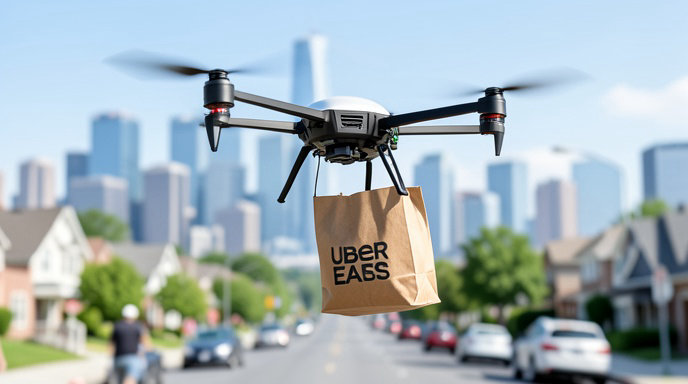
Instead of a courier picking up the order, restaurant staff will load the meal into a Zipline Platform 2 Zip — Zipline's next-generation autonomous drone designed for quiet, precise residential delivery. The Zip, which can carry up to 8 pounds, will launch from a Zipline docking station co-located near restaurant hubs or shopping centers.
Once at the customer's location, the drone doesn't need to land. It hovers nearly 300 feet overhead and lowers a delivery droid on a tether, gently placing the order on a precise spot like a doorstep, patio table, or front yard. The entire flight is autonomous and monitored remotely, with Uber Eats providing real-time tracking in the app, just like a standard courier order. The company says the system is designed to complete deliveries in as little as 10-15 minutes while being nearly silent and zero-emission.
Where It Will Launch First
Uber and Zipline will not be going nationwide overnight. The companies confirmed the initial rollout will begin in the Dallas-Fort Worth area of Texas later this year.
The choice is strategic. Dallas-Fort Worth is already a hub for Zipline's U.S. operations and has a favorable regulatory environment for commercial drone flights, with the FAA having granted Zipline key approvals for beyond-visual-line-of-sight operations. It is also one of Uber Eats' largest and most competitive markets.
Following the Texas debut, the partners plan to expand to additional metro areas in 2027, with Phoenix, Arizona and the broader Salt Lake City region expected to be next. Wider national availability will depend on aircraft certification, airspace approvals, and merchant adoption.
More Than a Partnership: Uber's Strategic Investment
This is not just a delivery deal. As part of the agreement, Uber is making a direct strategic investment in Zipline, signaling a long-term commitment to autonomy.
While the companies have not disclosed the exact size of the investment, the funding is intended to help Zipline scale its U.S. manufacturing and infrastructure while giving Uber a deeper stake in the technology powering its future delivery network. For Uber, the logic is clear: drone delivery promises to dramatically lower the cost per trip, reduce delivery times during peak hours and traffic, and solve labor shortages in suburban areas where driver economics are challenging.
For Zipline, which has already completed over a million commercial deliveries globally, the Uber Eats integration provides instant access to millions of customers and thousands of restaurant partners, fast-tracking its expansion from healthcare and retail into mainstream food delivery.
What It Means for the Future of Food Delivery
The Uber-Zipline partnership marks one of the most significant steps yet toward making drone delivery a mainstream reality in the U.S. While challenges remain — including weather limitations, air traffic management, and customer acceptance — the combination of Uber's massive marketplace and Zipline's proven autonomy platform could finally crack the code on scalable drone logistics.
If the Dallas launch succeeds, ordering a burrito by drone could soon be as normal as tracking a driver on a map.

Get All The Latest Updates Delivered Straight To Your Inbox For Free!