
A16z Launches Elite Academy to Replace Silicon Valley Dropout Culture With Startup-Ready Grads
TL;DR
- Andreessen Horowitz is launching a full-time academy for elite high school graduates as a direct alternative to college, offering hands-on training in AI, engineering, and startup building instead of a degree.
- The 12-month program blends trade-school-style practical skills with Y Combinator-style acceleration and Thiel Fellowship-style ambition, culminating in funded startup teams.
- The move signals a major shift in venture capital strategy, with a16z aiming to own the talent pipeline from age 18 rather than competing for Stanford dropouts and Ivy League grads later.
Why a16z Thinks College Is Broken For Founders
Silicon Valley has always romanticized the dropout. From Bill Gates to Mark Zuckerberg to Peter Thiel's famous pay-kids-to-quit-college fellowship, the message has been clear: if you're talented enough, leave school and build. Now Andreessen Horowitz wants to kill that pipeline entirely — not by sending kids back to lecture halls, but by replacing both college and the chaotic dropout path with something of its own design.
The firm confirmed this month that it is launching an academy aimed at promising 18- to 19-year-olds fresh out of high school. The idea is simple and radical at once: instead of spending four years and $300,000 on a computer science degree that will be outdated by graduation, or dropping out with no safety net and no skills, top teens can join a16z directly for a year of intensive, startup-focused training.
Insiders describe it as a16z's answer to a talent crisis. With AI moving faster than any university curriculum, partners at the firm say they keep meeting brilliant young builders who can ship AI agents and viral apps but have no idea how to hire, sell, raise, or scale. The academy is meant to close that gap.
Not A University, Not An Accelerator — A Trade School For Startups
The program deliberately avoids the word school in the Ivy League sense. People familiar with the plans compare it more to an elite trade school for the AI age.
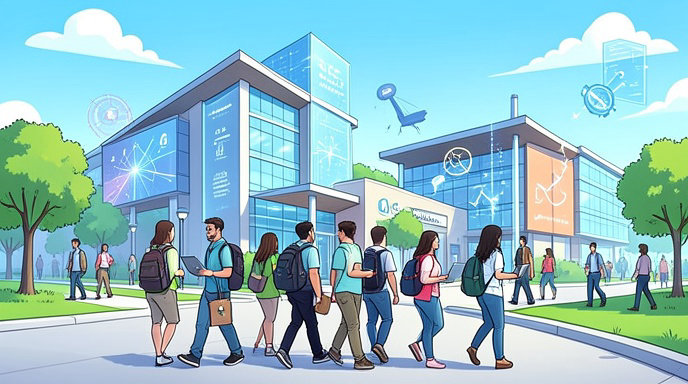
Cadets — as some inside the firm are already calling them — will spend the first months in deep technical bootcamps: coding with AI copilots, building with large language models, robotics, cybersecurity, and product design. The second phase shifts to what one partner called founder craft: storytelling, distribution, go-to-market strategy, hiring, fundraising, and even personal finance and leadership psychology.
Unlike a traditional accelerator, there is no requirement to arrive with a company. Unlike college, there are no grades, majors, or diplomas. The credential is what you ship. Students will live and work together in Silicon Valley, embedded inside the a16z network with direct access to portfolio founders, operators, and investors as mentors.
Thiel Fellowship Meets Y Combinator
The DNA of the project is easy to trace. It takes the ambition of the Thiel Fellowship — Peter Thiel's 2011 program that paid young people $100,000 to skip college — and pairs it with the structure of Y Combinator.
Like Thiel's program, it is ideological: college is too slow, too expensive, and too risk-averse for the next Elon Musk or Palmer Luckey. Like YC, it is intensely practical and cohort-based, ending in a Demo Day-style showcase where the best teams will receive pre-seed funding from a16z itself.
The key difference is ownership. Thiel Fellows were set free. YC founders arrive already formed. A16z wants to mold talent from day one, creating loyal, firm-trained founders who may spend their entire careers inside its ecosystem — from first check to IPO.
What Participants Actually Get
While final terms are still being finalized, sources say the inaugural cohort will be small and hyper-selective — likely under 50 students chosen from thousands of applicants worldwide. The program is expected to run 12 months, in-person, with housing and living stipends covered.
There is no tuition in the traditional sense. Instead, a16z is expected to take a small equity stake in any companies formed during the program, similar to an accelerator model, while providing cloud credits, compute access, and legal and back-office support. Top graduates who don't start companies immediately are expected to be placed directly into high-growth roles at a16z portfolio companies.
The faculty list reads like a tech Who's Who: successful founders, former CTOs, growth hackers, and AI researchers, rather than tenured professors. Marc Andreessen himself has reportedly been evangelizing the concept internally as a return to apprenticeship — learning by building alongside masters, not by sitting in a 400-person lecture.
What It Means For Venture Capital And Tech Talent
If it works, the implications are enormous. For decades, venture firms have fought over the same narrow pipeline: Stanford, MIT, Harvard, ex-Google, ex-OpenAI. By going after 18-year-olds, a16z is trying to expand and control the top of the funnel before Sequoia, Founders Fund, or Y Combinator even see them.
Critics are already raising concerns. Educators warn about creating a pressure-cooker for teenagers, cutting them off from broader education and social development. Others see elitism — replacing one exclusive club with an even more exclusive one, backed by billions in venture capital. And some founders question whether you can really teach ambition and contrarian thinking in a classroom, even one run by billionaires.
But supporters say this is inevitable. In an AI economy where a 19-year-old with the right tools can build what used to take a 50-person team, the four-year degree looks increasingly like a legacy system. Trade schools won in plumbing and welding because they taught real skills fast. A16z is betting the same logic now applies to startups.
The first cohort is expected to be announced in early 2027. Whether it produces the next Coinbase, Anduril, or OpenAI remains to be seen. What is clear is that Silicon Valley's oldest debate — college vs. dropout — just got a powerful third option, and it has $45 billion behind it.

Get All The Latest Updates Delivered Straight To Your Inbox For Free!