
FTC Accuses Amazon of Secret Ad Surcharge Scheme in Landmark 22-State Lawsuit
TL;DR
- The FTC and 22 state attorneys general have filed a sweeping antitrust lawsuit against Amazon, accusing the company of operating a hidden surcharge scheme that artificially inflated advertising costs for businesses selling on its marketplace.
- The complaint alleges Amazon used a secret algorithm, codenamed "Project Nessie," to raise prices on unrelated products when competitors undercut Amazon's own prices, while simultaneously forcing merchants to pay ever-higher ad fees to appear in search results—without clearly disclosing the true cost structure.
- The lawsuit seeks financial penalties, structural remedies (potentially including breaking up parts of Amazon's ad business), and new oversight rules, marking the most aggressive regulatory action yet against the company's $47 billion advertising empire.
The Hidden Surcharge: What the FTC Is Actually Claiming
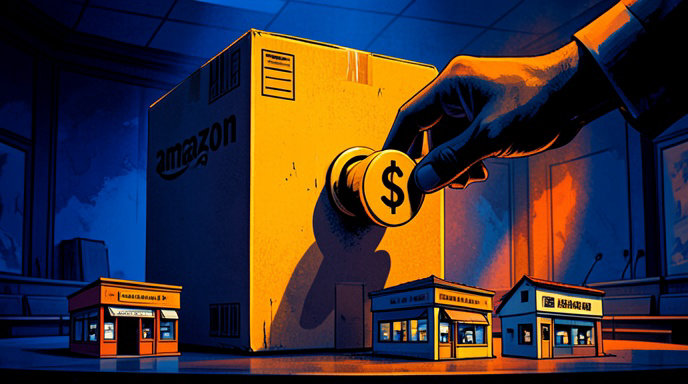
The Federal Trade Commission's long-anticipated lawsuit, filed in the U.S. District Court for the Western District of Washington, paints a picture of Amazon as a two-sided tollbooth. On one side, the company allegedly punishes third-party sellers who try to offer lower prices elsewhere. On the other, it quietly inflates the cost of ads that sellers must buy to remain visible to shoppers.
At the heart of the accusation is a practice the FTC calls a "hidden surcharge." Amazon's ad system, which lets brands bid for sponsored slots in search results, is supposedly riddled with undisclosed fees and algorithmic tweaks that push merchants to spend far more than they planned. The FTC claims Amazon does not transparently disclose how its ad auction actually works—specifically, that it can raise the "bid" price behind the scenes based on a seller's likelihood to convert a sale, rather than purely on the competitive market value of the ad slot.
The complaint cites internal documents showing Amazon executives knew sellers were paying inflated rates but feared that revealing the true mechanism would trigger backlash. One internal memo reportedly referred to the ad pricing model as a "tax" on sellers. The FTC argues this is not just a pricing quirk—it is a deliberate scheme to extract excess profits from the 2 million independent businesses that rely on Amazon to reach customers.
Project Nessie: The Algorithm That Punished Price-Cutters
Perhaps the most explosive detail in the lawsuit is the existence of "Project Nessie," a secret algorithm Amazon allegedly deployed to detect when a competitor (like Walmart or Target) offered a lower price on the same product. When Nessie found such a match, it would raise Amazon's own price on that item—and, critically, also raise prices on hundreds of unrelated products sold by the same merchant.
Why? Because the algorithm was designed to prevent sellers from undercutting Amazon's own retail prices. If a seller offered a cheaper price on Amazon than on another site, Nessie would trigger a price increase across that seller's entire catalog, including categories where no competition existed. The FTC says this functioned as a hidden surcharge on sellers who tried to pass savings to consumers—and it inflated the cost of goods for shoppers who had no idea their purchase price was being manipulated by a secret code.
Amazon has disputed this characterization, saying Nessie was a limited test that was discontinued years ago. But the FTC's complaint includes screenshots and internal emails showing the algorithm was still running as recently as 2023, and that it generated billions of dollars in extra revenue during its active periods.
The 22-State Coalition: Why This Isn't Just D.C. Politics
The lawsuit is not a solo act by the FTC. It is joined by attorneys general from 22 states and the District of Columbia, including California, New York, Massachusetts, and Pennsylvania. That bipartisan coalition matters for two reasons.
First, it broadens the potential remedies. While the FTC can seek injunctions and civil penalties at the federal level, state AGs can pursue additional damages under their own consumer protection and antitrust laws. That means Amazon could face multiple layers of financial exposure—potentially billions of dollars in restitution to affected sellers and state-level fines.
Second, the coalition signals that the "Amazon ad tax" is not seen as a niche regulatory concern. State AGs are elected officials who respond to local small-business owners. The complaint is packed with anecdotes from mom-and-pop sellers who say they were forced to spend 30% to 50% of their revenue on ads just to stay visible, and that Amazon's opaque surcharge system made it impossible to budget. This grassroots pressure could push the case toward a settlement that includes structural changes, not just a fine.
The Financial Fallout: What's at Stake for Amazon's Ad Empire
Amazon's advertising business is the company's fastest-growing profit engine. In 2025, it generated over $47 billion in ad revenue, with operating margins above 60%—far more profitable than its retail or cloud divisions. Investors have valued this segment as a core growth story, driving the stock to record highs.
The lawsuit threatens that narrative in three ways:
Direct penalties: The FTC is seeking disgorgement of "ill-gotten gains," which could theoretically reach into the tens of billions if the court agrees that the surcharge scheme was systematic.
Behavioral remedies: The FTC wants a court-appointed monitor to oversee Amazon's ad pricing algorithms for at least a decade, forcing the company to disclose its auction mechanics in plain language to sellers.
Structural breakup: While not explicitly seeking a split, the complaint repeatedly refers to "divestiture" as a possible remedy if Amazon refuses to comply. Analysts say the most likely target would be the ad division, which could be spun off as a separate publicly traded company.
Amazon has called the lawsuit "wrong on the facts and wrong on the law," arguing that its ad system is transparent, that sellers voluntarily participate, and that the company's marketplace has lowered prices for consumers overall. Legal experts, however, note that the FTC's case is built on internal documents that directly contradict those public claims—and that the sheer volume of state involvement makes an outright dismissal unlikely.
The Broader Crackdown: Amazon in the Regulatory Crosshairs
This lawsuit is the third major federal action against Amazon in two years. In 2023, the FTC sued Amazon for its Prime subscription cancellation practices, which the agency called a "dark pattern" design. In 2024, the FTC and 17 states filed a separate antitrust case over Amazon's alleged self-preferencing of its own products in search results.
The new ad surcharge case is distinct because it targets the company's most lucrative business model. It also arrives amid a global wave of scrutiny: the European Union is investigating Amazon's ad transparency under the Digital Markets Act, and the UK's Competition and Markets Authority has opened a similar probe. The U.S. lawsuit could set a precedent for how regulators treat algorithmic pricing systems that are not fully disclosed to business users.
If the FTC wins, the ruling could force Amazon to open its ad auction to independent audits, publish fee schedules, and allow sellers to opt out of "performance-based" surcharges. That would likely reduce Amazon's ad margins significantly—but it might also restore trust among the small businesses that are the backbone of its marketplace. The case is expected to take years to resolve, but the early signals are clear: the era of silent surcharges on Amazon is likely over, one way or another.

Get All The Latest Updates Delivered Straight To Your Inbox For Free!